
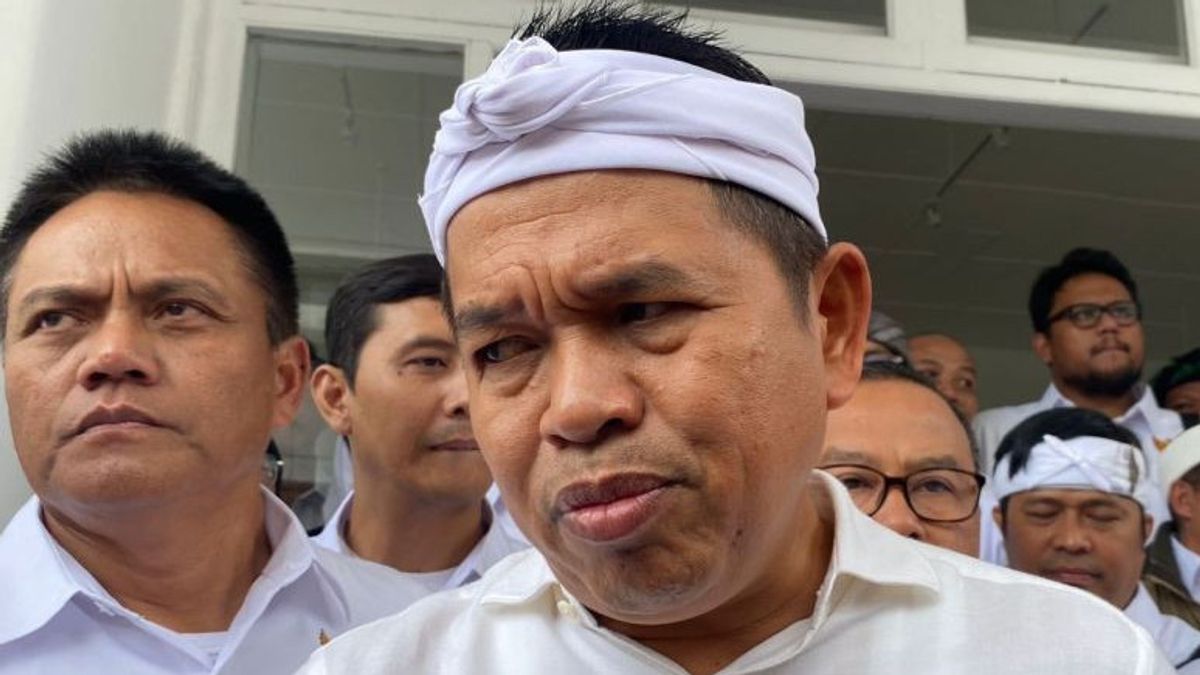


BANDUNG - In order to save ecology by issuing a total ban on new oil palm planting, West Java Governor Dedi Mulyadi took drastic steps.
He also instructed the replacement of plants or the transfer of commodities gradually for land that has already been planted with oil palm in all provinces.
The policy is contained in Circular Letter Number 187/PM.05.02.01/PEREK regarding the Prohibition of Planting Palm Oil in the West Java Province, which was signed on December 29, 2025 and addressed to all regents and mayors.
Dedi Mulyadi in a statement in Bandung, Wednesday, emphasized that the narrow geographical characteristics of West Java are incompatible with the massive and water-intensive palm oil industry, thus triggering the threat of a water crisis and environmental disaster.
"West Java is small, the area is narrow. Palm oil needs a lot of land, it's not suitable. We are suitable for tea, rubber, kina, coffee," said Dedi.
Dedi emphasized that if land use is no longer in accordance with its habitat and allocation, then the solution is to replace the commodity.
"If it is outside the provisions and not its habitat, then it will be replaced with other plants," he said.
Before this policy was officially issued, Dedi revealed a fact that was not known to the public that he had made a silent intervention about six months ago to thwart the palm oil plantation project in the conservation area.
"Six months ago, someone wanted to plant oil palm on the yellow slope of Ciremai. I just didn't tell anyone. I stopped it through the regent," he said.
Regarding the recent palm oil plantation controversy in Cirebon, Dedi admitted that there was a delay in handling due to the breaking of the information chain from the village level to the province. He regretted that there was no incoming report before the environmental impact was felt by the community.
"If this one in Cirebon, I have not reported. The village head can solve it if he reports. The governor cannot possibly know everything at all times," said Dedi.
Through this circular, the West Java Provincial Government emphasized that the prohibition applies to both public and business land, in order to restore the function of West Java's land as a water conservation area with more environmentally friendly hard plants.
The English, Chinese, Japanese, Arabic, and French versions are automatically generated by the AI. So there may still be inaccuracies in translating, please always see Indonesian as our main language. (system supported by DigitalSiber.id)
Most Popular Tags
#Prabowo Subianto #donald trump #2026 World Cup #Febrie Adriansyah #8791Popular


