

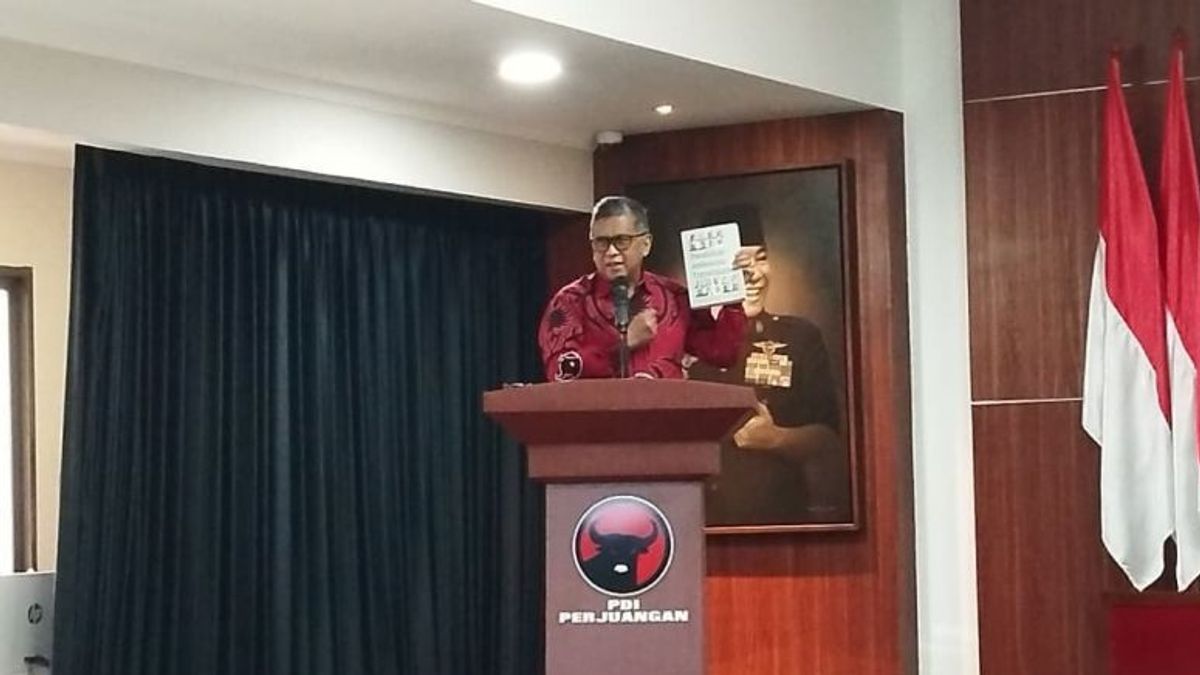


PDIP Secretary General Hasto Kristiyanto highlighted Megawati Soekarnoputri's leadership while serving as president who consistently avoided corrupt practices, and kept his distance from intervening in state institutions for personal or party interests.
"When Megawati became President, Mrs. did not intervene in other powers. There was never any intervention in the KPU to win the first direct presidential election," said Hasto at the "World Anti-Corruption Day Reflection" seminar in Jakarta, Tuesday, December 9.
Hasto emphasized that Megawati's attitude was seen when the KPK was formed by Megawati because she saw the acute problems of nepotism, collusion, and corruption as well as weak law enforcement conditions, especially law enforcement, which were controlled by many authorities.
"KPK was formed in a consideration when law enforcement officers were still controlled by the authorities, so the Corruption Eradication Commission was formed with great authority," said Hasto.
The 2004 election, said Hasto, was equivalent to the 1955 General Election as the most democratic election due to the absence of power intervention.
This, according to Hasto, was because Megawati showed an independent attitude when she became head of state by supporting the prosecution of corruption cases by the KPK.
"Mrs. Mega has never intervened with the KPK which was born from the demands of reform, never because this is part of moral ethics held by a leader," said Hasto.
The increasingly massive phenomenon of corruption, according to Hasto, is related to the nation's ethical crisis. He cited Steven Levitsky's thinkers as describing how authoritarian regimes are often born from crises, which lead to power camps in executives.
"Currently, the eradication of corruption feels anticlimactic because corruption is getting bigger, meaning that moral ethical values are also starting to decline," said Hasto.
He also emphasized the absolute prohibition in democracy, namely the intervening authorities against state institutions that display an absolute picture of power. The principle of checking and balances will not work if it is violated.
"The Steven Levitsky book on the demonstration process reminds us that democracy requires ethics and morals, as well as a ban on the intervention of executive power to other institutions such as judiciary and legislative. This is the norm of implementing state governance. I received the book from Doctor Sukidi," said Hasto.
The faded nation's ethics, added Hasto, can be seen in historical flashbacks that remind the nation to have been kept away from ethical and national moral values during the 32 years of the New Order.
Hasto emphasized that the birth of PDIP was part of a total correction movement to the authoritarian and economic system that fertilizes nepotism, collusion and corruption.
The English, Chinese, Japanese, Arabic, and French versions are automatically generated by the AI. So there may still be inaccuracies in translating, please always see Indonesian as our main language. (system supported by DigitalSiber.id)
Most Popular Tags
#Prabowo Subianto #donald trump #Febrie Adriansyah #8791 #giias 2026Popular


