

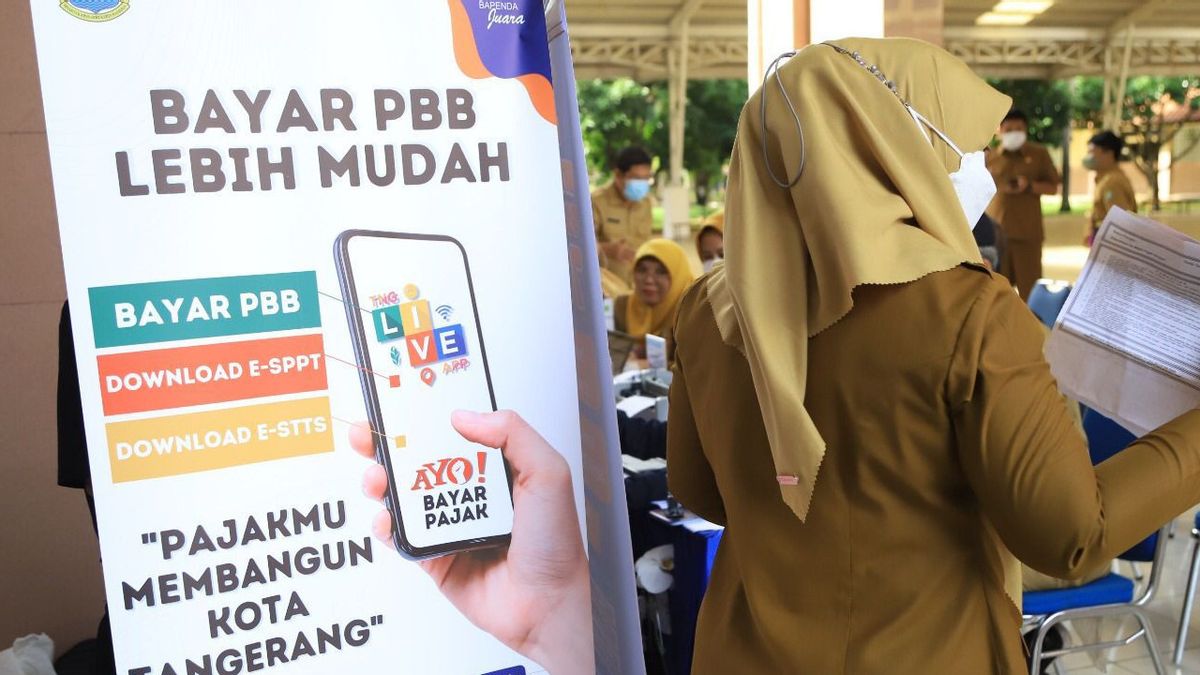


JAKARTA - Member of Commission II of the Indonesian House of Representatives Muhammad Khozin responded to the issuance of a new fatwa of the Indonesian Ulema Council (MUI) regarding the elimination of taxes in a number of sectors. According to him, if this fatwa is implemented by the Regional Government (Pemda), it has the potential to affect the economy in its territory.
This fatwa is the result of the XI MUI National Conference which discusses the concept of fair tax, including the view that the earth and residential buildings and motorized vehicles do not deserve to be taxed repeatedly. Khozin assessed that the MUI fatwa was a legal opinion that departed from the istinbat methodology in Islamic tradition.
"The MUI fatwa is based on the legal instability mechanism through Islamic legal sources. As a legal opinion, of course this will add to the region's public policy," said Khozin, Thursday, November 27.
Even so, Khozin emphasized that the elimination of Rural and Urban Land and Building Taxes (PBB-P2) has the potential to affect regional fiscal stability. He also reminded that the tax instrument is one of the main sources of income for districts/cities as stated in Law Number 1 of 2022 concerning Central and Regional Financial Relations (HKPD).
"If removed, it will have a serious impact on regional fiscals," he said.
Khozin also highlighted the MUI fatwa regarding motor vehicle taxes (PKB). According to him, if it is fully implemented, it will have a similar impact on regional finances.
Moreover, said Khozin, Law Number 1 of 2022 concerning Financial Relations between the Central Government and the Regional Government (UU HKPD) introduced a new nomenclature related to regional income from motor vehicle taxes.
"There is a new nomenclature in the HKPD Law, namely the PKB opsen tax including the transfer fee for the name of motorized vehicles (BBNKB) which is intended for district/city local governments," he said.
Regarding the aspect of justice that is the basis for fatwas, the member of the commission in charge of regional government affairs explained that in fact the HKPD Law has provided space for partiality to vulnerable groups. In particular, in Article 96 paragraph (1) which states that Regional Heads can provide relief, exemption, and delays in payments on the subject and tax sanctions.
"This means that there is an affirmative policy space by regional heads for vulnerable groups," explained the PKB legislator from the East Java IV electoral district.
Khozin also mentioned the regional fiscal objective condition based on data from the Ministry of Home Affairs (Kemendagri) 2025 which shows that the majority of local governments still have weak fiscal capacity, including 15 provinces, 407 districts, and 70 cities. "There are 493 local governments whose fiscal capacity is categorized as weak from a total of 546 local governments throughout Indonesia," said Khozin.
SEE ALSO:
-
 | BERITA
Prabowo Instruksikan Penegakan Aturan Tegas di Bandara IMIP Morowali
27 November 2025, 07:06 -
 | LIFESTYLE
Makanan khas Sulawesi Utara Paling Populer yang Wajib Dicoba Wisatawan, Apa Saja?
27 November 2025, 05:25 -
 | OLAHRAGA
Konsistensi Arsenal Akan Diuji Bayern Munchen, Duel Tim Papan Atas Liga Champions
27 November 2025, 00:15
Khozin assessed that the spirit of justice in the MUI fatwa can be understood. However, according to him, the preparation of legal views and policies should consider various aspects comprehensively.
"We agree with the spirit of the MUI fatwa on the aspect of justice. Although it must also be remembered the objective conditions of our current regions. A balance is needed in the formulation of policies in the tax sector, especially in the regions," he concluded.
The English, Chinese, Japanese, Arabic, and French versions are automatically generated by the AI. So there may still be inaccuracies in translating, please always see Indonesian as our main language. (system supported by DigitalSiber.id)
Most Popular Tags
#Prabowo Subianto #donald trump #2026 World Cup #Febrie Adriansyah #8791Popular


