
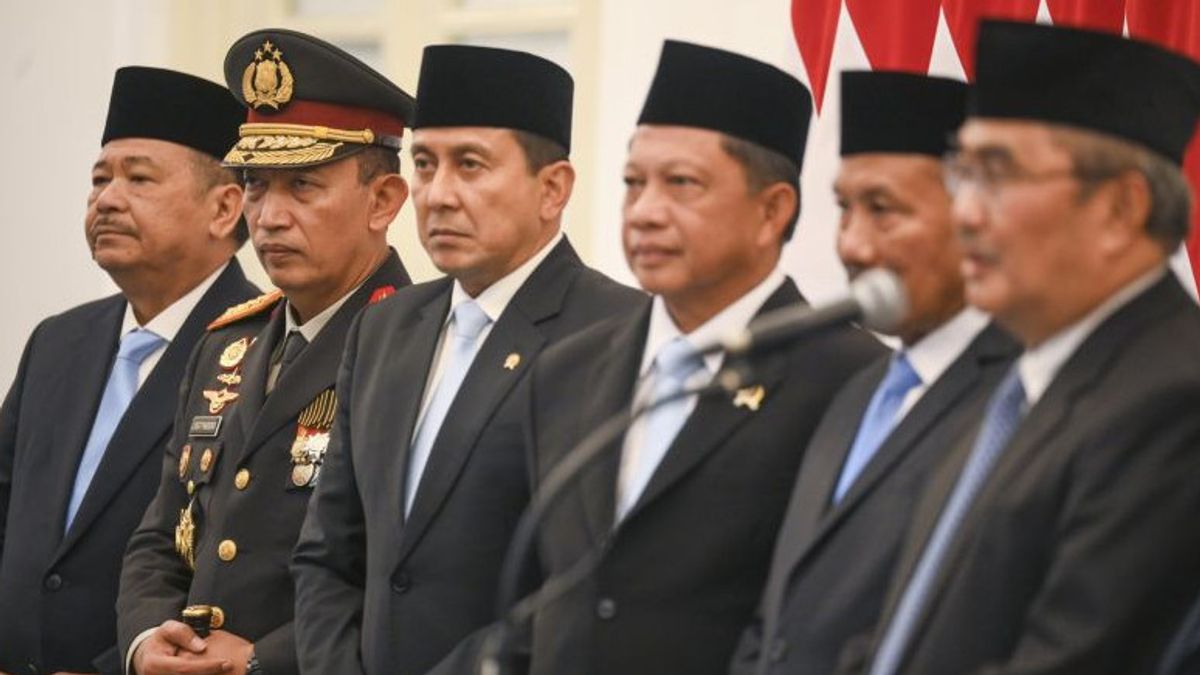


JAKARTA - Minister of Home Affairs and Chairman of the Board of Trustees of Sriwijaya University Muhammad Tito Karnavian said that global power is no longer determined by the military alone, but by economic, cultural and knowledge forces.
I am in a constructive paradigm position. This means that many things are now resolved not with military power, but through the economy, trade, social, and culture. The most decisive battle right now is economic combat," Tito said, quoted by ANTARA, Saturday, November 8.
The strategic view of the direction of the new world order was conveyed by a scientific oration entitled The Role of Higher Education in Supporting Indonesia Gold 2045 at the 65th Anniversary of Sriwijaya University (Unsri) in Palembang, South Sumatra.
According to Tito, in the new world order, economic battles will determine who is the dominant force. Countries capable of massively producing goods and services, flooding the world market, and controlling global supply chains will take control of the world economy.
Quoting Prof. Sait Yilmaz in the book State, Power, and Hegemony, Tito explained that the massive production capacity of a country is determined by four main factors.
The first is a large workforce, as the main production engine. Second, abundant natural resources, to support production raw materials. Third, a wide stretch, as storage space and distribution of production products. As well as a strategic geographic location, which acts as a choke point in international trade.
"I added the fourth factor, namely the strategic geographical location. Indonesia is on the vital path of the world. If we can make good use of it, this position can affect the economy of other countries," he said.
With these four large capitals, Tito assessed that only a handful of countries that meet the requirements to become the world's dominant strength, namely China, India, the United States, Russia, and Indonesia.
Tito himself is optimistic that Indonesia will have a great opportunity to become the fourth world economic power in 2045, after China, India, and the United States. However, he reminded that the superiority of natural resources (SDA) alone is not enough. The main key to jumping into a developed country is the quality of human resources (HR).
"The country is progressing not because of natural resources, but because of human resources. Indonesia's demographic bonus of 68.95% of the total population must be directed through education so that it becomes a productive force," he said.
He gave an example of Singapore under the leadership of Lee Kuan Yew who managed to become a developed country without abundant natural resources, only by relying on superior education and scholarships for the best generation.
According to Tito, the policy direction of President Prabowo Subianto's government is currently in line with Indonesia Gold's 2045 vision through public education and health programs, such as Public Schools, Garuda Schools, and medical scholarships.
For this reason, Tito invites universities not only to become ivory towers, but to appear as drivers of innovation and national transformation. Universities must dare to invest in research, technology, and human resource development in order to be able to support Indonesia in facing a new world order based on knowledge and the digital economy.
"Universities must transform. The world is changing rapidly, and we should not just be spectators. We must be the main players in the new global order," said Tito.
SEE ALSO:
-
 | BERITA
Pendiri BNI, RM Margono Djojohadikusumo Dinilai Pantas Menyandang Gelar Pahlawan Nasional
08 November 2025, 21:30
Atma Jaya University International Law Lecturer Yogyakarta Triyana Yohanes assessed that Tito's view was relevant to the current global conditions. He said Tito succeeded in presenting a strategic narrative based on the constructive paradigm that was in line with modern international political challenges.
Tito's view deserves to be used as a basis for Indonesia's foreign policy. The world is still in the paradigm of constructiveism, although it is often hampered by the military power of superpowers," said Triyana.
Triyana assessed that Tito had presented a modern constructive framework based on data, research, and empirical experience.
He also assessed that the oration could be a conceptual basis for Indonesia to strengthen its position in the international arena through improving the quality of human resources, mastery of technology, as well as a clean and pro-people government.
"I see Tito encouraging Indonesia to build hegemony based on knowledge and economic productivity. This is much more sustainable than just military power," he added.
Furthermore, Triyana also linked Tito's idea to Ray Dalio's economist views in the book How Countries Go Broke, a country that wants to survive in the midst of a global debt cycle must strengthen clean human resources, technology, and governance.
According to him, Tito's oration contains a moral message that a visionary and corruption-free government is a prerequisite for Indonesia to become the dominant power in 2045.
"Legal development and clean governance must be the foundation. Without it, Tito's great potential will be difficult to realize," he said.
The English, Chinese, Japanese, Arabic, and French versions are automatically generated by the AI. So there may still be inaccuracies in translating, please always see Indonesian as our main language. (system supported by DigitalSiber.id)
Most Popular Tags
#Prabowo Subianto #donald trump #2026 World Cup #venezuela #Bhayangkara hut #konflik timur tengahPopular


