
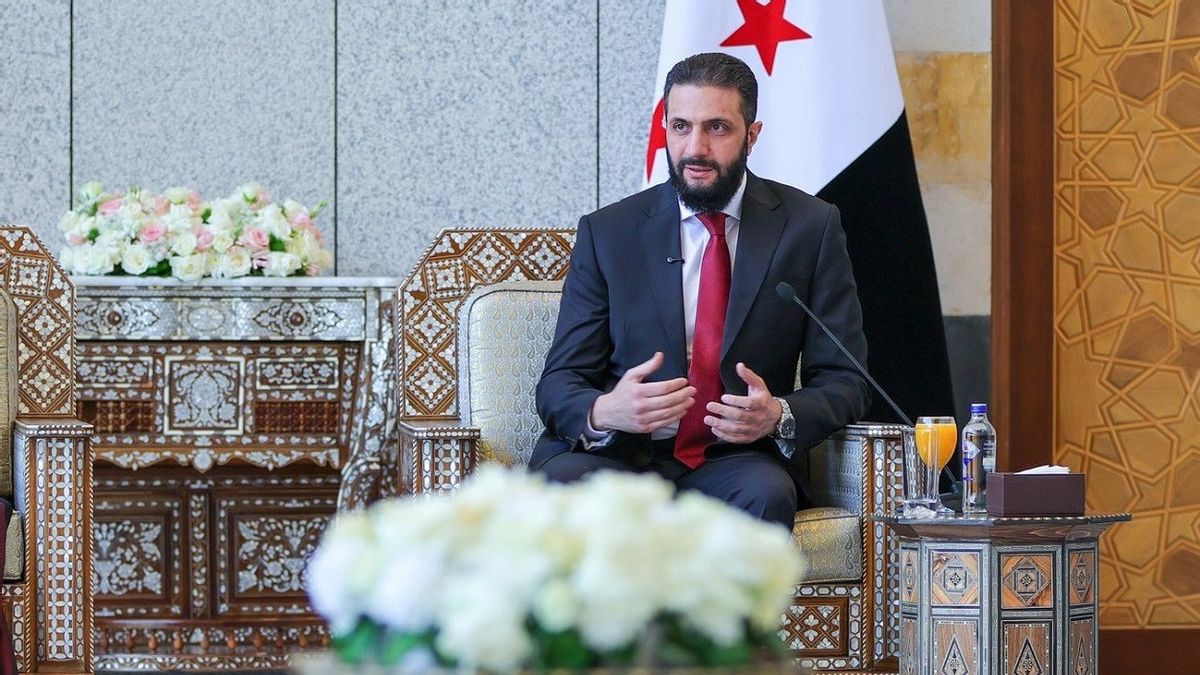


JAKARTA - The United Nations Security Council lifted sanctions against Syrian President Ahmed al-Sharaa and Syrian Interior Minister Anas Khattab.
The decision was taken in a vote on the resolution of the United States draft by 15 members of the council, in which 14 votes supported China's provisional abstention.
Washington is known to have urged the Security Council for months to ease sanctions against Syria.
President Trump announced a major US policy change in May when he said he would lift US sanctions against Syria.
"I think he did a very good job," President Trump said Thursday of President al-Sharaa.
"It's a tough environment, and he's a tough guy, but I'm on good terms with him. And a lot of progress has been made with Syria."
"We did lift sanctions against Syria to give them a chance," he told reporters in Washington.
After years of divided Security Council, Syrian Ambassador to the United Nations Ibrahim Olabi praised the decision on Thursday as "a message of support for Syrian women and men in their efforts to rebuild the homeland and restore their lives."
"The new tradition will be a success story. Syria will be a brilliant model that proves that the optimal path in international relations is positive engagement and constructive cooperation. If there are concerns, Syria is fully ready to address it with sincere intentions based on mutual respect," he told the Council.
Meanwhile, China chose abstain because the resolution did not answer its concerns about counterterrorism and the security situation in Syria appropriately, said Chinese Ambassador to the United Nations Fu Cong.
The Bamboo Curtain country has long been vocal in voicing its concerns about the fate of the East Turkistan Islamic Movement (ETIM) in Syria.
Uighur fighters from China and Central Asia are members of the group. Human rights groups accuse Beijing of widespread abuses against the ethnic minority, most of whom are Muslims.
Fu said the resolution adopted on Thursday "enforced" Syria must "take firm action to combat terrorist acts and respond to the threat of FTF (foreign terrorist fighters), including ETIM in Syria."
Meanwhile, Russia's Ambassador to the United Nations, Vassily Nebenzia, said Moscow supports the short and congested resolution because "most importantly reflects the interests and aspirations of the Syrian people themselves."
Russia itself diplomatically protected its ally, Assad, during the war, by providing more than a dozen vetos on the Security Council, which China has on many occasions supported.
It is known that President al-Sharaa himself is scheduled to meet with President Trump at the White House on Monday.
After 13 years of civil war, Syrian President Bashar al-Assad was ousted in December in a flash attack by rebel forces led by Hayat Tahrir al-Sham (HTS).
SEE ALSO:
-
 | BERITA
Trump Yakin AS, Rusia dan Tiongkok Bisa Menyepakati Pengurangan Senjata Nuklir
07 November 2025, 09:30 -
 | BERITA
Presiden Meksiko Sheinbaum Bawa Kasus Pelecehan Terhadapnya ke Ranah Hukum
07 November 2025, 05:00 -
 | BERITA
Israel Lakukan Kampanye Teror Terorganisir Terhadap Keluarga Tahanan Palestina
07 November 2025, 04:00
Previously known as the Nusra Front, HTS was the official al-Qaeda wing in Syria until it cut ties in 2016. Since May 2014, this group has been on the list of sanctions for al-Qaeda and ISIS of the UN Security Council.
A number of HTS members were also subject to UN sanctions - travel bans, asset freezes, and arms embargoes. Sanctions against Sharaa and Khattab have now been lifted.
UN sanctions monitors did not see any "active relations" this year between al-Qaeda and HTS, according to a UN report seen by Reuters in July.
The English, Chinese, Japanese, Arabic, and French versions are automatically generated by the AI. So there may still be inaccuracies in translating, please always see Indonesian as our main language. (system supported by DigitalSiber.id)
Most Popular Tags
#Prabowo Subianto #donald trump #2026 World Cup #Febrie Adriansyah #8791Popular


