


YOGYAKARTA - Indonesia's foreign policy under President Prabowo Subianto has been in the world's spotlight since its inauguration in October 2024.
Indonesia's different diplomatic approach from the previous era sparked heated debate among international observers.
Some consider Prabowo's move as a revolutionary breakthrough that places Indonesia as a medium power that is more taken into account on the global stage. However, not a few have questioned the direction of this policy.
But the question is whether Prabowo's pragmatic approach will strengthen Indonesia's position as a regional key player, or does it carry the risk of being dragged into the rivalry of great powers?
After six months of running, the direction of Indonesian diplomacy has become a big puzzle, even among international relations audiences.
The head of the BRIN Political Research Center, Athiqah Nur Alami, expressed this confusion in a webinar entitled "The Teka-Teki Policy Luar Negeri Indonesia Era Presiden Prabowo Subianto".
This happened not only because of the global constellation that is dynamic, but also because of Prabowo's different leadership style from the previous era. So what is the difference between Prabowo's style and Jokowi?
Also Read the articles that discuss Disclosure! Moh Yamin's Basic State Proposal Which Becomes The Forerunner Of Pancasila
Based on research conducted by BRIN, the striking difference between Prabowo and Jokowi lies in the diplomatic approach.
Even though they are both pragmatic and focus on economic diplomacy, Prabowo is much more directly involved (hands-on) in foreign affairs. He became the main actor who played an active role in Indonesian foreign politics.
However, Prabowo's personalistic approach that prioritizes direct bilateral relations with the head of state also carries its own risks.
Athiqah warned of potential unilateral decisions based on personal considerations, too compromised diplomatic relations, and inconsistent policies.
As a result, Prabowo's leadership style, according to Athiqah, can create uncertainty in the direction of Indonesia's foreign policy.
In the geopolitical field, Indonesia is facing an increasingly complicated Indo-Pacific landscape. This area is an arena for competition between the United States and China in the fields of economy, military and technology.
But you need to know, not only the United States and China are players, there are still India, Japan, and Australia also play an important role.
This area holds a conflict time bomb, especially in the South China Sea and Taiwan Strait. On the other hand, ASEAN seeks to maintain neutrality and stability, while minilateral groupings such as AUKUS and Quad add complexity.
Indonesia has built strategic partnerships with the United States, Beijing, and Australia. However, in the midst of great power rivalry, Indonesia must balance national interests with non-block and active free principles that serve as Indonesian diplomatic guidelines.
Meanwhile, Prof. Dr. Nur Azizah, a lecturer at the International Relations Study Program, raised important issues regarding the perspective of women in Indonesian foreign politics.
Reporting from the website of the University of Muhammadiyah Yogyakarta, Prof. Azizah explained that although 42% of Indonesian diplomats in the Jokowi era were women, gender equality in decision making had not been fully realized.
Prof. Azizah emphasized the importance of women's access and participation in the decision-making process, not just equal access but justice benefits.
Without the involvement of women in foreign and diplomatic politics, there is a risk of normalizing the dominance of masculinity that does not reflect true justice in the representation of national interests.
Indonesia's foreign policy under President Prabowo Subianto focuses on active diplomacy and pragmatics to strengthen the economy amid complex global dynamics.
Indonesia should further emphasize the importance of increasing domestic capacity starting from the economy, politics, military and defense as a geopolitical navigation strategy.
SEE ALSO:
-
 | BERITA
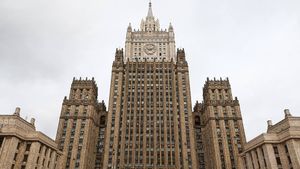
Rusia Gelar Latihan Militer Senjata Nuklir, Ukraina Cari Jet Tempur Swedia
23 Oktober 2025, 00:01 -
 | TEKNOLOGI
Irak Larang Platform Gim Roblox karena Kekhawatiran Keamanan Anak
23 Oktober 2025, 04:05 -
 | LIFESTYLE
Prilly Latuconsina Dapat Pesan Mesum dari Oknum yang Mengaku Sebagai Omara Esteghlal
23 Oktober 2025, 00:10
However, this is just the beginning of the Prabowo era's journey, and future policy developments will continue to be interesting to observe.
In addition to discussing Indonesia's foreign policy under President Prabowo Subianto, follow other interesting articles on VOI, to get updated news, don't forget to follow and monitor all of our social media accounts!
The English, Chinese, Japanese, Arabic, and French versions are automatically generated by the AI. So there may still be inaccuracies in translating, please always see Indonesian as our main language. (system supported by DigitalSiber.id)


