

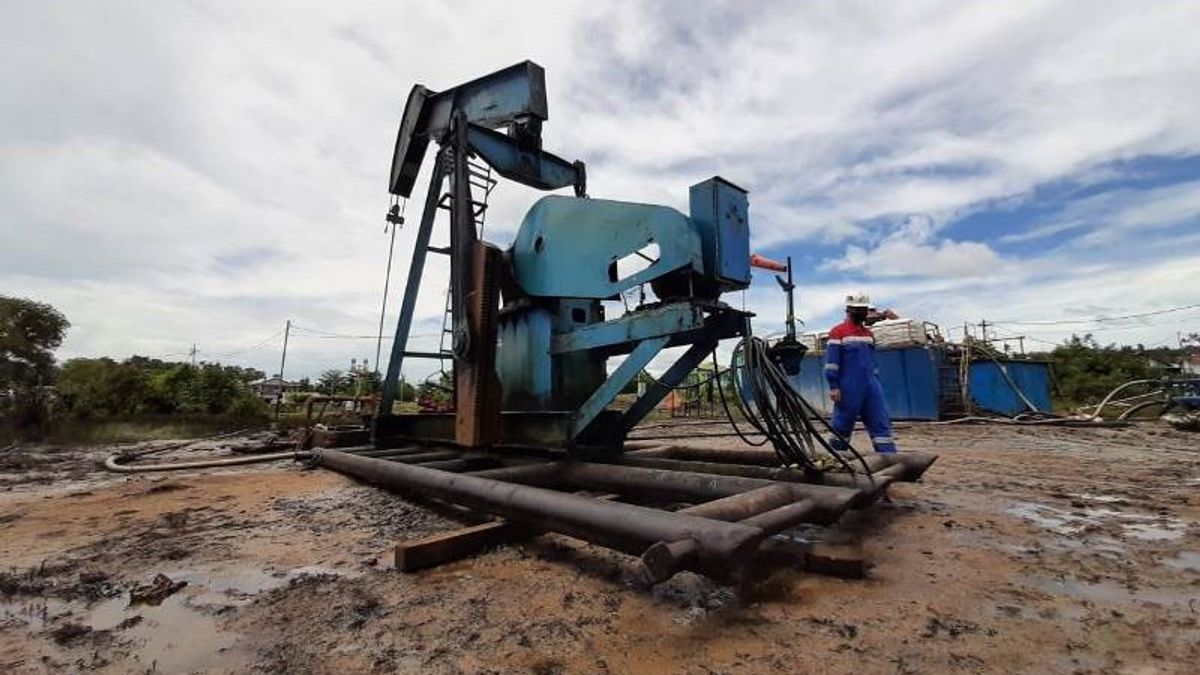


JAKARTA - Surabaya State University (Unesa) economist, Hendry Cahyono, assessed that the government has succeeded in rearranging the people's oil wells which have been inviting polemics.
According to him, the steps taken by the Minister of Energy and Mineral Resources (ESDM) Bahlil Lahadalia to legalize 45,000 people's oil wells through the Regulation of the Minister of Energy and Mineral Resources Number 14 of 2025 will also raise national lifting.
This means that people's oil wells have an effect, right? Influence too. Big or small must have an effect on our national total lifting," said Hendry in a public discussion entitled Suppressing the One Year National Energy Independence Era of Prabowo' Gibran from East Java in Surabaya, Wednesday 15 October.
Hendry explained that the government under the leadership of President Prabowo Subianto and Vice President Gibran Rakabuming Raka has shown the direction of energy policies that favor national independence and community welfare. He assessed that this policy is not only focused on big projects, but also opens up space for local community participation.
Something that has been targeted and it has exceeded the target is certainly good. And I think it's already on the right track on the right track," he said.
He added that the government's policy of rearranging and legalizing people's wells also helps meet needs. Domestic oil. Thus, this policy can reduce Indonesia's oil and gas import quota.
As of August 2025, Indonesia's oil production reaches around 608,000 barrels per day. This is certainly a positive achievement and should be appreciated. However, our national needs are still much greater, which is around 1.6 million barrels per day. This means that Indonesia still has to import around 1 million barrels per day," he said.
Meanwhile, Airlangga University (Unair) Public Policy Expert, Falih Suaedi, assessed that the government's move to place energy issues as a national priority as stated in Asta Cita is the right decision. According to him, taking sides with people's energy shows a new direction for governance that is more just.
The current government is not only talking about energy supply, but also independence in managing it. That means, the state is leading to real energy resilience," said Falih.
On the same occasion, the Coordinator of the Renewable Energy Integration Demonstrator Indonesia (REIDI) Project at the Sepuluh November Institute of Technology (ITS), Ary Bachtiar Krishna Putra, assessed that legalizing people's oil wells is part of building Indonesia's energy independence in the regions. In addition to people's oil wells, Ary assessed that there are many other things that can be developed in the regions so that energy independence can be achieved.
"First, we have to pay attention to regional characteristics, because each region has different energy potentials," said Ary.
SEE ALSO:
-
 | BERITA
Bom Mobil Tewaskan Caleg Irak Jelang Pemilu 2025, Tim Investigasi Dibentuk
15 Oktober 2025, 16:44 -
 | BERITA
Korsel Wanti-wanti 3 Wilayah Kamboja Ini Rawan TPPO, Berkaca Warganya Tewas Diculik
15 Oktober 2025, 17:06 -
 | BERITA
Topan Halong Hantam Alaska, Rumah-rumah Terseret Arus Laut, 1.500 Warga Mengungsi
15 Oktober 2025, 15:51 -
 | BERITA
2 Polisi India Bunuh Diri Dalam Sepekan, Diduga Pemicunya Rasisme Berbasis Kasta
15 Oktober 2025, 14:52 -
 | BERITA
Penjara Wanita Iran Memanas, Tahanan Inggris Kasus Spionase Dipindahkan
14 Oktober 2025, 18:13
While developing people's wells, according to Ary, the government also needs to encourage local innovation and expand new and renewable energy research in universities. We have great potential to develop an integrated energy system that can support national needs without relying too much on imports," he said.
Previously, Minister of Energy and Mineral Resources Bahlil Lahadalia said that the legalization of this people's oil well was in accordance with Article 33 of the 1945 Constitution (UUD) which emphasized that the earth, water, and natural wealth contained in it were controlled by the state and used for the greatest prosperity of the people.
"And on another point in managing natural resources is that economic and economic democracy is prepared based on kinship. What does that mean? There is equity," said Bahlil at the Office of the Ministry of Energy and Mineral Resources, Tuesday, October 14.
In addition, Bahlil said that people's wells had existed since before Indonesia's independence. However, so far the oil wells have been managed by the community illegally because they do not have a legal umbrella.
"This is a community well, which has happened in the past, a well that since before Indonesia's independence, these wells already existed, they have been working on it, only so far it is illegal," said Bahlil.
The English, Chinese, Japanese, Arabic, and French versions are automatically generated by the AI. So there may still be inaccuracies in translating, please always see Indonesian as our main language. (system supported by DigitalSiber.id)
Most Popular Tags
#Prabowo Subianto #donald trump #firearm #8791 #giias 2026Popular


