

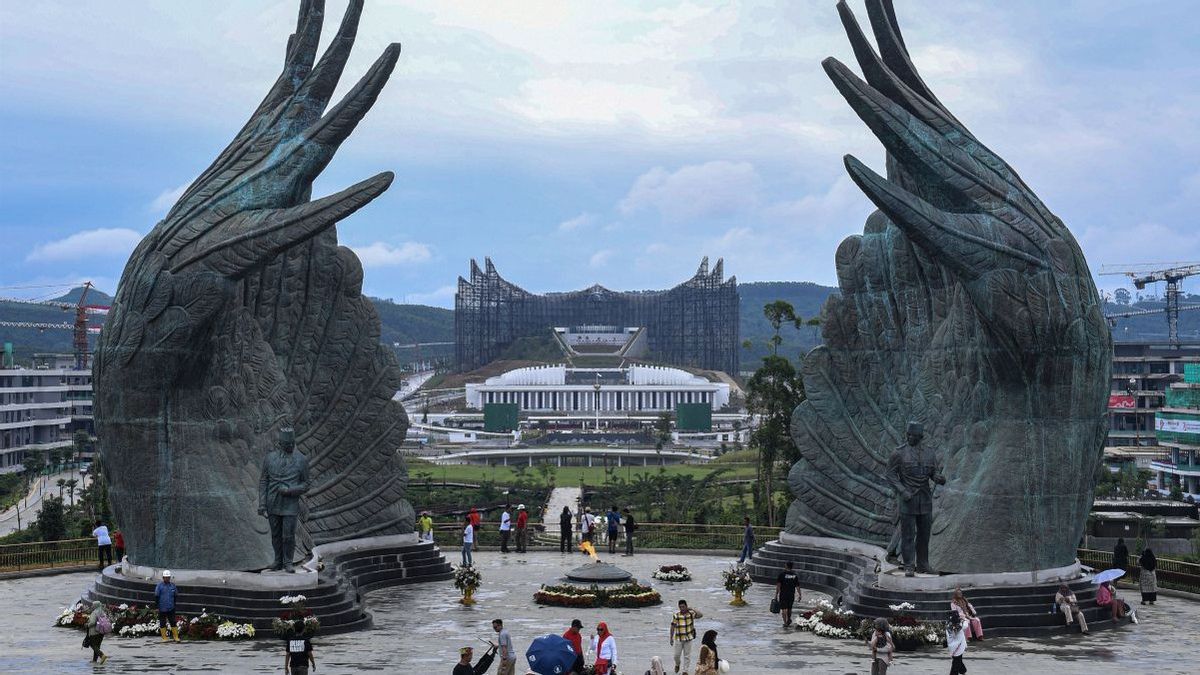


JAKARTA The availability of clean water in the Capital City of the Archipelago (IKN) is still a serious challenge that has been revealed through the research results of the National Research and Innovation Agency (BRIN). BRIN's Principal Research Center for Climate and Atmospheric Research (PRIMA), Dr Laras Toersilowati, said that the condition of water resources in the country's potential capital city area is far from ideal and requires massive handling.
In a study conducted in 2024 with satellite data in 2022 using Artificial Neural Network (ANN) technology, BRIN found that the availability of natural surface water in IKN and buffer areas (Balikpapan and Samarinda) is very limited.
"The results of the study of the percentage of water availability in the IKN and surrounding areas show that the availability of high water (HW) is only 0.51 percent, water vegetation (VW) is 20.41 percent, and non water (NW) is 79.08 percent," said Dr Laras, Thursday, October 2.
The high water (HW) in question is pure water found in water bodies such as rivers and lakes. On the other hand, more than 79 percent of the area is dominated by non-water in the form of buildings or buildings built. This condition is considered to be one of the basic challenges in IKN development.
Laras said, from a climate and environment perspective, IKN's natural conditions were still not supportive. He even admitted that when he visited directly, the area felt arid, hot, and uncomfortable.
"If I was a researcher, I shouldn't lie. Indeed, the current natural conditions from a climate research perspective are still not suitable," he said.
Even so, Laras emphasized that there are still opportunities to improve water conditions in IKN, although large investments are needed. Some of the recommended solutions include the construction of artificial lakes and reservoirs to collect water, planting urban forests to store rainwater, to implementing the concept of sponge City or sponge cities that can absorb rainwater naturally.
"It should be by limiting the existing forest, it must be converted again. It must be planted with more gardens and green spaces. If I propose urban forests," said Laras.
To ensure the accuracy of the study results, BRIN uses the Imitation Facilities Network (JST) or ANN method which is able to process satellite image data up to 25,000 repetitions with an accuracy level of 97.7 percent. This technology works by detecting groundwater and vegetation levels using spectral indexes such as NDVI, NDWI, and LSWI from multi-band satellite imagery.
SEE ALSO:
-
 | TEKNOLOGI
Gawat! Google Sebut Peretas Mengirim Email Pemerasan ke Para Eksekutif
03 Oktober 2025, 05:06 -
 | LIFESTYLE
Kim Kardashian dan Ibu Gugat Mantan Kekasih karena Pencemaran Nama Baik
03 Oktober 2025, 05:10
The results of this research are an alarm for the government in preparing the ecological foundation of IKN. The availability of clean water is not only a matter of technical development, but also concerns the sustainability of the environment and comfort of people who will live in the new capital city.
Do you want me to add a view from the government / IKN authority as a news balancer?
The English, Chinese, Japanese, Arabic, and French versions are automatically generated by the AI. So there may still be inaccuracies in translating, please always see Indonesian as our main language. (system supported by DigitalSiber.id)
Most Popular Tags
#Prabowo Subianto #donald trump #Febrie Adriansyah #8791 #giias 2026Popular


