
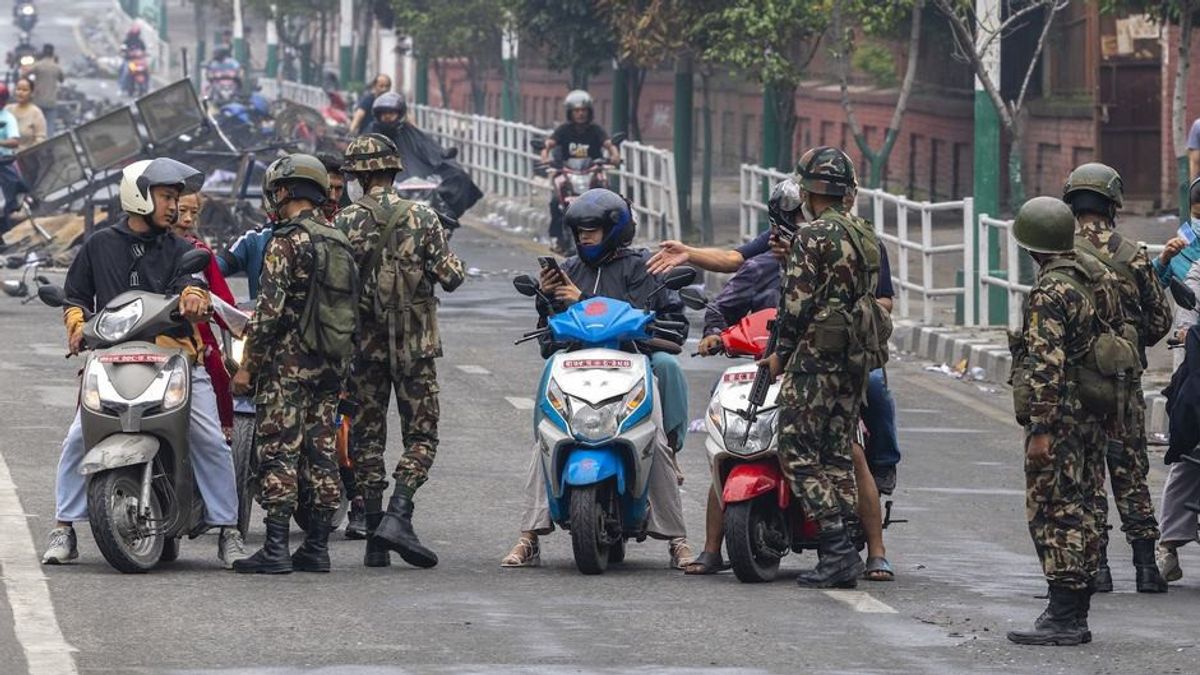


JAKARTA Nepal's military will continue negotiations on Thursday with "Gen Z" demonstrators to elect a temporary leader for the Himalayan nation.
Negotiations came after bloody demonstrations that killed 30 people and forced Nepal's prime minister to resign.
Soldiers patrolled the deserted streets of Kathmandu following the worst protests in the capital in decades, sparked by social media bans lifted by authorities after 19 people were killed while police fired tear gas and rubber bullets to control the crowd.
Former Chief Justice of the Supreme Court Sushila Karki, Nepal's first woman to be appointed to the post in 2016, is the leading candidate to become interim leader. His name was suggested by many demonstration leaders.
"We see Sushila Karki as it is honest, without fear, and steadfast," said Sujit Kumar Jha.
"He's the right choice. When the truth speaks, it sounds like Karki," he continued.
Karki, 73, has given his approval, but efforts are underway to find a constitutional path to appoint him, a source familiar with the matter told Reuters, who spoke on condition of anonymity.
However, there are some disagreements regarding his candidacy among protesters, who are trying to reach unanimous decisions, other sources said.
Earlier, spokesman Raja Ram Basnet told Reuters initial negotiations were underway and will resume today, referring to discussions on interim leaders.
"We are trying to slowly normalize the situation," he said.
Shops, schools, and colleges remain closed in Kathmandu and surrounding areas, but some of the essential services have returned to operation.
The ban order will remain in effect in Kathmandu and its surroundings for most of the day, the military said in a statement, while an airport spokesman said international flights were still operating.
The death toll from protests rose to 30 people as of Thursday, Nepal's Ministry of Health said, with 1,033 people injured.
SEE ALSO:
-
 | BERITA
Presiden Israel Berdebat dengan PM Inggris soal Invasi Gaza hingga Pengakuan Negara Palestina
11 September 2025, 16:22 -
 | BERITA
Buntut Drone Rusia, Polandia Batasi Lalu Lintas Udara Perbatasan Belarus-Ukraina
11 September 2025, 16:03


This demonstration is popularly referred to as the "Gen Z" protest because most participants are young people who voice frustration at the government's failure to eradicate corruption and increase economic opportunities.
Government buildings, ranging from the Supreme Court to the homes of ministers, including the private residence of the Oli, were also burned down in the protest, which only subsided after the prime minister resigned.
Several places of business burned include several hotels in the tourist city of Pokhara and Hilton in Kathmandu.
The English, Chinese, Japanese, Arabic, and French versions are automatically generated by the AI. So there may still be inaccuracies in translating, please always see Indonesian as our main language. (system supported by DigitalSiber.id)


