
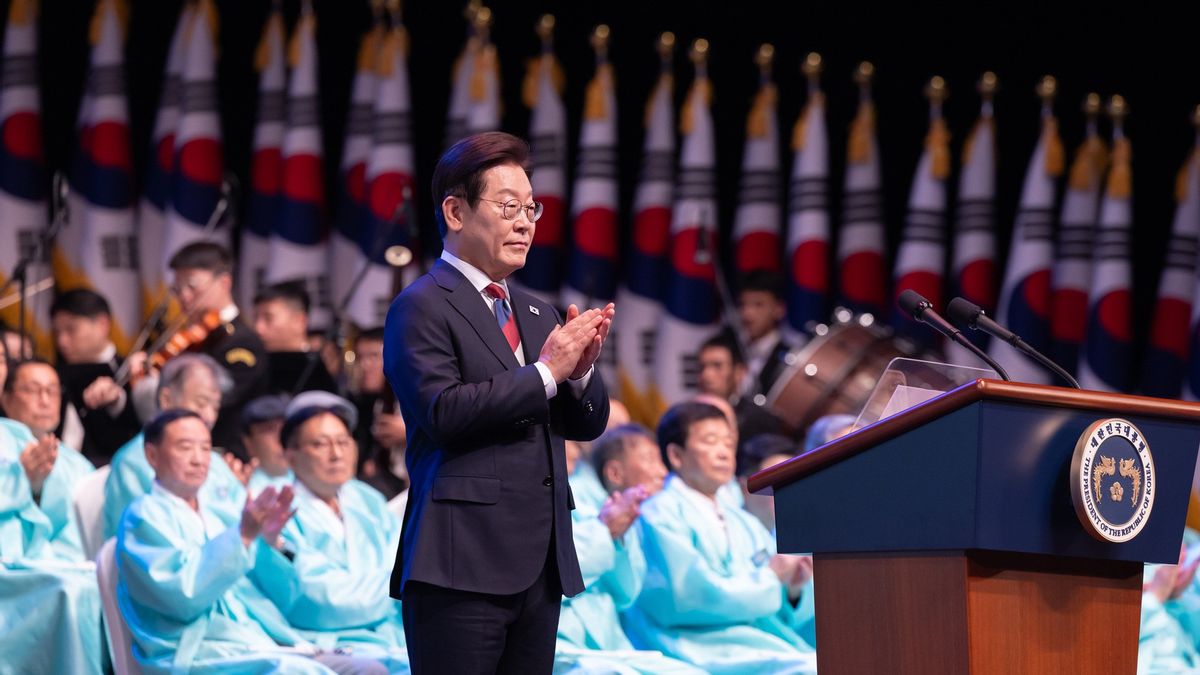


JAKARTA - South Korea will end several military activities along its border with North Korea.
This decision is the latest attempt by his government to improve relations between the two neighboring countries which are technically still at war.
In a speech to commemorate 80 years of Korea's release from Japanese colonialism, South Korean President Lee Jae Myung said he would restore the so-called Comprehensive Military Agreement September 19, a de-escalation measure that halted several military activities on the border between North Korea and South Korea.
The pact was signed at the 2018 inter-Korean summit, but failed due to rising cross-border tensions.
How Pyongyang will respond to Seoul's latest offer remains unclear. North Korean top officials in recent weeks have ignored other steps taken by Lee, a liberal who won an impromptu general election in June, to ease tensions between the two countries.
The Korean war ended in 1953 with a ceasefire, instead of a formal peace treaty, and confirmed the separation of the peninsula.
"Everyone knows that this protracted hostility does not benefit the people of both Korea," Lee said in a speech in Seoul.
Lee cited his government's efforts to ease tensions, including stopping the launch of balloons flown by activists with anti-North Korean leaflets and dismantling loudspeaker propaganda broadcasts on the military- heavily fortified border.
"Especially, to prevent unexpected clashes between South Korea and North Korea and build military trust, we will take proactive and gradual steps to restore the September 19 Military Agreement," Lee said, without providing a timeframe.
In June 2024, former South Korean President Yoon Suk Yeol declared a full suspension of the military pact, which Pyongyang had abandoned in November 2023, after North Korea sent hundreds of balloons filled with garbage across the border.
The pact includes measures such as both sides ending military exercises near the border, banning direct shooting exercises in certain areas, imposing a no-fly zone, removing several guard posts along the Demilitarization Zone, and maintaining hotlines.
"I hope North Korea will repay our efforts to restore trust and revive dialogue," Lee said.
SEE ALSO:
-
 | BERITA
Trump Ingin Selamatkan Taipan Hong Kong Jimmy Lai, China Menentang Intervensi Asing
15 Agustus 2025, 18:37 -
 | BERITA
Spanyol Berjibaku Atasi 14 Kebakaran Hutan yang Hanguskan Area Seluas London
15 Agustus 2025, 18:06
Earlier this month, South Korea and the US postponed part of their annual joint military exercises that had been a source of tension with North Korea.
Cheong Seong-chang, North Korean expert at the Sejong Institute in Seoul, estimates Pyongyang will "ignor or condemn" Lee's latest move, given Pyongyang has seen Seoul previously violate the military pact.
To invite North Korean leader Kim Jong Un to a dialogue, Lee needed a bolder offer, such as persuading US President Donald Trump to relax sanctions, said Yeom Don-jay, a former official at South Korea's National Intelligence Agency.
Yeom said North Korea would monitor the upcoming summit between Lee and Trump this month.
Turning to South Korea's relations with Japan, Lee said the relationship should be "forward insight", based on pragmatic diplomacy focused on Seoul's national interests.
The English, Chinese, Japanese, Arabic, and French versions are automatically generated by the AI. So there may still be inaccuracies in translating, please always see Indonesian as our main language. (system supported by DigitalSiber.id)
Most Popular Tags
#Prabowo Subianto #donald trump #2026 World Cup #venezuela #konflik timur tengahPopular


