


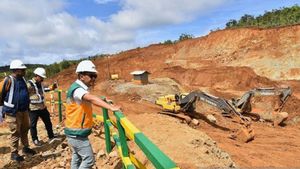
JAKARTA - The Mining Business License (IUP) of four mining companies on small islands in Raja Ampat, Southwest Papua, was officially revoked by the Government after it was widely reported that it had damaged the environment.
Member of Commission VI DPR RI Mufti Anam asked the Government to evaluate the IUP issuance system so that mining activities do not violate the rules like what happened in Raja Ampat. He also asked for the closure of this mine to only be a temporary maneuver.
"The incident in Raja Ampat can be a lesson for the Government not to recklessly issue mining permits. Do not let the Government become a mining broker," said Mufti Anam, Tuesday, June 10.
Mufti reminded Raja Ampat that it has mega diversity which is a habitat for hundreds of unique, endangered, and endangered species of flora and fauna, so mining activities are very detrimental to the environmental ecosystem and the prosperity of the local community.
What is excavated is not only mining, but our pride as a nation! Raja Ampat is not to be mined but to be guarded. The government that allows mines to enter there is tantamount to destroying the future of our children and grandchildren," he said.
As is known, the public is busy campaigning for #SaveRaja Ampat following the exploitation of a number of small islands in Raja Ampat because they are known to damage the area known as the world's heaven. After much discussion, the government at the direction of President Prabowo Subianto revoked the IUP 4 company in Raja Ampat Regency.
The names of the four companies whose permits were revoked were PT Anugerah Surya Pratama (ASP), PT Nurham, PT Mulia Raymond Perkasa and PT Kawei Sejahtera Mining.
PT ASP is a foreign investment company from China whose mine location is located on Manura Island, PT Mulia Raymond Perkasa with a mine site on Batang Pele Island and Manyaifun Island, as well as PT Nurham which is located on the island of Yesner Waigeo Timur. The four companies have their permits revoked for environmental violations, including because some of their mining areas have entered the geopark area.
Meanwhile, the permit for PT GAG Nickel, whose mining on Gag Island has recently been highlighted by the public, has not been revoked by the government. PT GAG Nickel, which is affiliated with PT Aneka Tambang Tbk. or Antam, was not revoked with the status of a Production Operations Work Contract permit.
According to Minister of Energy and Mineral Resources (ESDM) Bahlil Lahadalia, PT GAG is still allowed to operate because based on the results of the Government's evaluation, the company complies with environmental regulations and good waste management according to the analysis regarding environmental impacts (Amdal). Even so, the Government will continue to monitor mining in the mining area of PT GAG.
Mufti also reminded that mining on small islands in Raja Ampat not only damages the environment but also contradicts Law Number 1 of 2014 concerning Management of Coastal Areas and Small Islands in conjunction with Law No. 27 of 2007 which prohibits mining activities on islands of less than 2,000 km2.
Therefore, Mufti highlighted how the mining permit was issued in Raja Ampat, which is mostly a conservation area. Moreover, some mines are adjacent to Piaynemo Island, which is known as the main tourist destination in Raja Ampat.
"In fact, maybe the Regional Regulation of Raja Ampat Regency Number 3 of 2011 concerning the Regional Spatial Planning (RTRW) actually sets several small islands as mining areas that are very contrary to the law," said Mufti.
"Not to mention the response of a number of officials who seemed to defend mining activities and then narratives emerged that contradicted the voices of indigenous Papuans," he added.
Mufti said Raja Ampat is a world-class conservation and tourism area, not an extractive industrial zone. So, according to him, it does not make sense if mining permits appear in the Raja Ampat area.
"There are enough forests to run out, the sea is damaged, indigenous peoples are evicted. We must not pawn nature which will become the capital of future life," said Mufti.
Based on Greenpeace's analysis, it was stated that more than 500 hectares of forest had been damaged by nickel and sedimentation mining in Raja Ampat. The activity also threatens coral reefs and underwater life. In fact, in the video released by Greenpeace, it can be seen that there is land clearing in the middle of an island suspected of being an active mining site.
For this reason, Mufti said that firmness from the Government by closing the mining permit was problematic because this was related to the commitment to protect the environment, and integrity in carrying out the law.
"If this country is still sane, problematic mining activities in Raja Ampat should be stopped. Because Raja Ampat must be protected, not damaged! Listen to the voice of the people, not just the voice of the capital owner," said the legislator from the East Java II electoral district.
"Don't sell heaven in the world in Indonesia to profit makers that cause damage to the environment and the people suffer," continued Mufti.
Mufti also criticized the Government's response which was considered too reactive but slow in responding to the nickel mining polemic in the small island area of Raja Ampat, Southwest Papua because the temporary suspension of mining was only carried out after the hashtag #SaveRaja Ampat became public attention on social media.
"This is not a new problem. The rules regarding mining bans on small islands are clear, but still mining permits are issued. The government should not wait for the virus to move first," he said.
In addition to the viral case, Mufti assessed that what needed to be a question was how mining permits in the Raja Ampat area could arise.
"Whereas it is clear that the criteria on small islands are legally prohibited from being mined? It is also necessary to cross-check the background of companies that have mining concessions. Not only nickel mines, but also gold and coal," explained Mufti.
Mufti also urged the Ministry of Energy and Mineral Resources and the Ministry of Environment (LH) to disclose complete data regarding all mining permits in the Raja Ampat area, including legal status and detailed locations.
"The public has the right to know the extent to which the state protects conservation areas. There should be no impression that the law can be negotiated for investment," he said.
Mufti also underlined the issue of mining permits on small islands. "It needs to be noted that mining bans on small islands are not only in Raja Ampat. So it must also be investigated whether similar activities also occur in small islands in other regions," said Mufti.
SEE ALSO:
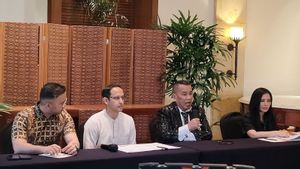

The member of the Commission in the DPR in charge of SOE affairs and business competition said that the Government must really take into account people's anxiety. Mufti asked for the consistency of the Government's firmness regarding the mining issue.
"This problem is crowded not without reason. The government must also listen to people who have been harmed by mining activities in Raja Ampat so far," he said.
Mufti also ensured that Commission VI of the DPR RI would continue to oversee this issue, and asked that there be no compromise on mining permits that violate the rules and damage nature and interfere with the welfare of the people.
"We will monitor it. Do not let the public spotlight subside, mining activities continue again as if there were no problems. The closure of the mine in Raja Ampat should not only be a temporary maneuver," concluded Mufti.
The English, Chinese, Japanese, Arabic, and French versions are automatically generated by the AI. So there may still be inaccuracies in translating, please always see Indonesian as our main language. (system supported by DigitalSiber.id)
Most Popular Tags
#Prabowo Subianto #donald trump #Febrie Adriansyah #8791 #giias 2026Popular


