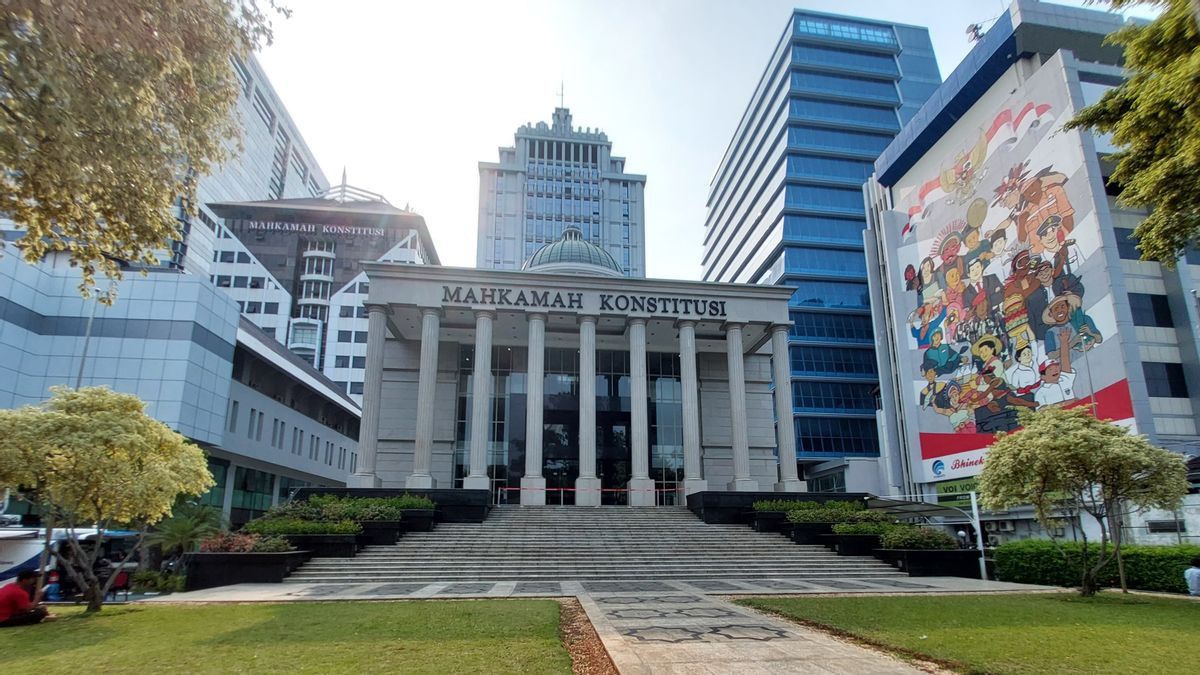


The Constitutional Court stated that the central and regional governments must free primary education in elementary, junior high, and madrasas or equivalent, both in public and private schools, gradually.
Constitutional Justice Enny Nurbaningsih when reading out the legal considerations of Decision Number 3/PUU-XXII/2024 at the Constitutional Court of the Republic of Indonesia, said that basic education without charge is part of fulfilling economic, social and cultural rights (ekosab).
In contrast to the immediate fulfillment of civil and political rights (sipol), the fulfillment of the right to education as part of the right of economy can be carried out in stages in accordance with the conditions of the country's capabilities.
Because, continued Enny, the fulfillment of the right of the embassy is always related to the availability of state facilities, infrastructure, resources, and budgets.
"Therefore, the realization of basic education that does not charge fees related to the fulfillment of ekosob rights can be carried out in stages, selectively and affirmatively without giving rise to discriminatory treatment," said Enny as quoted by ANTARA, Tuesday, May 27.
Through this decision, the Constitutional Court stated that the phrase "mandatory to study at least at the basic level of education without charge" in Article 34 paragraph (2) of Law Number 20 of 2003 concerning the National Education System (Sisdiknas) has caused multiple interpretations and discriminatory treatment so that it is contrary to the constitution.
The Constitutional Court in its decision changed the norm of the phrase to, Pemerintah dan pemerintah daerah menjamin terelenggaranya wajib belajar minimal pada tingkat pendidikan dasar tanpa membuat biaya, baik untuk satuan pendidikan dasar yang diselenggarakan oleh pemerintah maupun unit pendidikan dasar yang diselenggarakan oleh masyarakat.
According to the Court, the constitution has clearly mandated state obligations in the implementation of national education, by prioritizing the level of basic education. In this regard, the financing and implementation of basic education by the government is a necessity.
The problem is, the Constitutional Court found that the government actually applied the norms of Article 34 paragraph (2) of the National Education System Law by establishing and administering basic education through state-owned elementary education institutions (SD, SMP, madrasa) or public schools.
In fact, basic education is not only organized by the government through public schools, but also by the community through educational units known as private schools or madrasas.
According to the Court, if the phrase "obliged to study at least at the level of primary education without charge" is only interpreted as applicable to public schools, the state actually ignores the fact that the limited capacity of public schools has forced many children to attend private schools with a greater cost burden.
Such conditions are assessed by the Court as contrary to the state's obligation to guarantee basic education without collecting fees for all citizens. Therefore, the state must realize the basic education financing policy, both in public and private schools, through educational assistance mechanisms or subsidies.
SEE ALSO:




The Constitutional Court asked the state to prioritize the allocation of education budgets for the implementation of basic education, including in private schools, by considering the need factors of these private schools. This is because there are private schools that apply additional curricula in addition to the national curriculum as a selling value.
In addition, the Constitutional Court also highlighted the existence of private schools that were never or were not willing to receive budget assistance from the government, as well as organizing fully educational activities from the payment results of students.
The private school, according to the Court, would be inappropriate if forced to no longer charge students; while the government's fiscal capacity to provide assistance in the cost of providing basic education for private schools from the APBN and APBD is still limited.
Therefore, even though private schools are not prohibited from financing themselves, the Constitutional Court asks the private school to continue to provide opportunities for students in their environment by providing certain financing facilities schemes.
"Especially for regions where there are no schools/madrasah that receive financing from the government and/or local governments," said Enny.
The English, Chinese, Japanese, Arabic, and French versions are automatically generated by the AI. So there may still be inaccuracies in translating, please always see Indonesian as our main language. (system supported by DigitalSiber.id)
Most Popular Tags
#Prabowo Subianto #donald trump #2026 World Cup #Febrie Adriansyah #8791Popular