

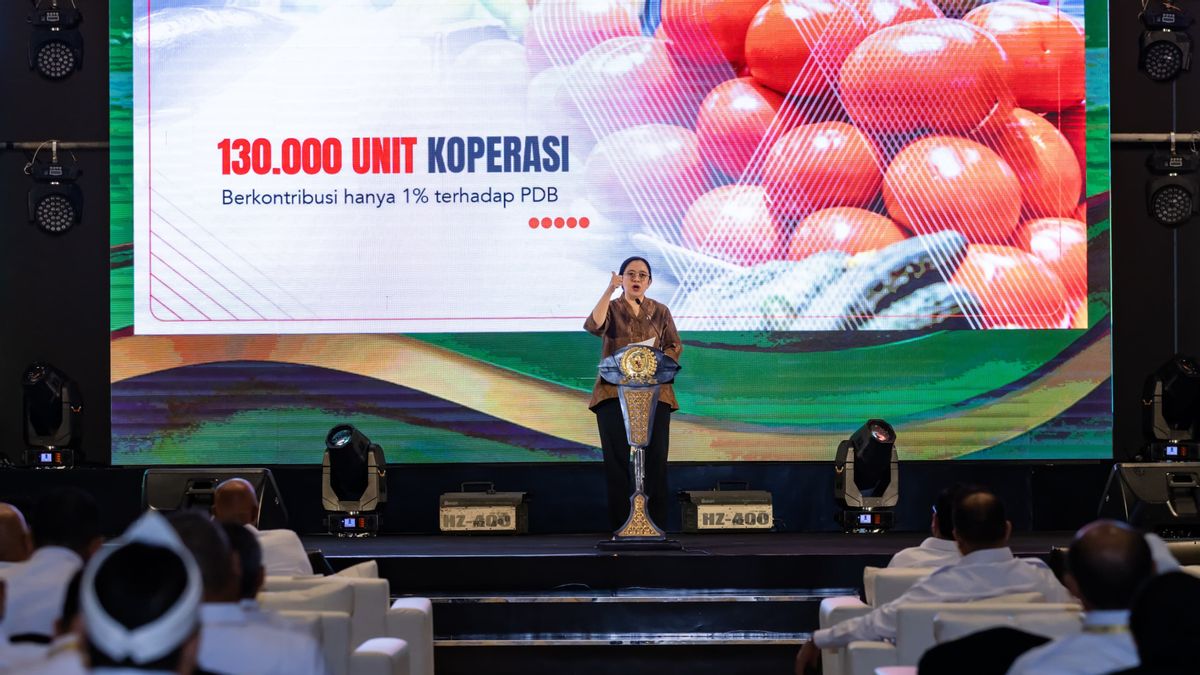


JAKARTA - Chairman of the Indonesian House of Representatives, Puan Maharani, attended the National Leadership Meeting (Rapimnas) of the Indonesian Cooperatives Council (Dokopin) which was held at the Sultan Hotel, Jakarta, Monday, May 26. On this occasion, Puan expressed her hope that the revision of the Cooperative Law which is being prepared by the DPR will strengthen the world of national operations.
Puan said that Dekopin is a national cooperative movement that is a forum for struggle and togetherness in realizing justice and social prosperity through cooperatives. He also mentioned Article 33 of the 1945 Constitution which mandates that the Economics is prepared as a joint effort based on the principle of kinship' such as the spirit of cooperatives.
"Cooperation grows from the idea that in improving the fate of economic livelihoods, we must do it with a joint effort, in a place to work together. All take part and responsibility," said Puan, Monday, May 26.
"Even our constitution (Article 33), is very much in line with the principles of Cooperatives. Cooperative members are cooperative owners," he continued.
Puan said, many cooperative practices were successful in various countries. For in his own country, he believes that Dekopin is certainly more aware of the current condition of the national cooperative.
In terms of numbers, said Puan, Cooperatives in Indonesia have reached more than 130,000 units based on the latest BPS data in 2022. But unfortunately, the contribution of Cooperatives to Gross Domestic Product (GDP) is only 1 percent.
"This figure shows us that the Cooperative has not become a support for the national economy teacher," he said.
According to the former Coordinating Minister for Human Development and Culture, Dekopin has a very strategic role in advancing Indonesia's operations. Dekopin, said Puan, can also take a role in forming professional leadership in cooperatives.
"Dekopin can strengthen cooperative literacy for members, establish cooperation and business partnerships so that it has a sustainable economic scale. How cooperatives can become a part of the industrial process business or instead become the main support for the industry, both the food industry, the clothing industry, the tourism industry, and so on," he explained.
In addition, Puan assessed that Dekopin could also build a cooperative ecosystem that has strong competitiveness. He also reminded cooperatives to keep up with the times.
"A modern, digital, and close operation is with young people. There is no business field that cannot be carried out by the Cooperatives," said Puan.
As a representative of the cooperative movement, Dekopin was encouraged to actively participate in conveying the aspirations of cooperative interests to the government, DPR RI, and other institutions. So, said Puan, Dekopin can contribute to the birth of policies that help strengthen cooperatives, both in terms of regulation, coaching, and strengthening financial access.
Puan then mentioned about the DPR which is currently discussing the Revision of the Law on Cooperatives (RUU Cooperatives). This DPR initiative bill will replace the old Cooperative Law, namely Law Number 25 of 1992 concerning Cooperatives which was present 33 years ago.
Bung Karno's grandson hopes that the Cooperative Bill will absorb and accommodate all the aspirations of the cooperative world. Moreover, said Puan, the discussion of the Cooperative Bill has opened public participation, including from Dekopin.
"The new law is expected to provide arrangements that further encourage the growth and development of cooperatives. Discussions on the bill will soon be carried out with the Government," he explained.
On the other hand, the Government is also launching the Red and White Village Cooperative Program which is targeted to form 80,000 Cooperatives. President Prabowo Subianto's Government efforts to build the people's economy through cooperatives are said to need appreciation from all parties.
At the same time, Puan assessed, it is also necessary to be able to carry out red and white village cooperatives properly. Such as human resources (HR) that can manage good cooperative governance, including the supervisory function of cooperative members by cooperative members.
"Preparing the form of business that will be carried out and sustainable, preparing members of the cooperative, providing cooperative capital, and risk mitigation," explained Puan.
"Dekopin can also take a role to help the Government in carrying out the Red and White Village Cooperative, especially in providing training," he added.
Puan also ensured that the DPR RI through its legislative, budget and supervisory functions would also strengthen state policies in operation. So that cooperatives can become the support of national economic teachers as mandated by the Constitution.
"Mohammad Hatta, known as the Father of the Indonesian Cooperatives, said, 'We cannot build a strong national economy without building the people's economy, and the people's economy can only be strong with cooperatives'," said Puan.
"Soekarno said, 'People should not become jongos in the economy. So cooperatives must be used as a means of emancipating the people's economy'," he continued.
SEE ALSO:
-
 | BERITA
Kremlin Sebut Pengerjaan Rancangan Nota Perdamaian Rusia Masih Berlanjut
27 Mei 2025, 05:00


Puan hopes that Rapimnas Dekopin will be a momentum to reaffirm that cooperatives are a tool of mutual cooperation economic struggle, which prioritizes working with cooperative members. As well as cooperatives that provide a way for its members to live independent and prosperous lives.
"Hopefully Dekopin can build Indonesia's cooperative as a national economic teacher figure," concluded Puan.
The English, Chinese, Japanese, Arabic, and French versions are automatically generated by the AI. So there may still be inaccuracies in translating, please always see Indonesian as our main language. (system supported by DigitalSiber.id)
Most Popular Tags
#Prabowo Subianto #donald trump #2026 World Cup #Febrie Adriansyah #8791Popular


