
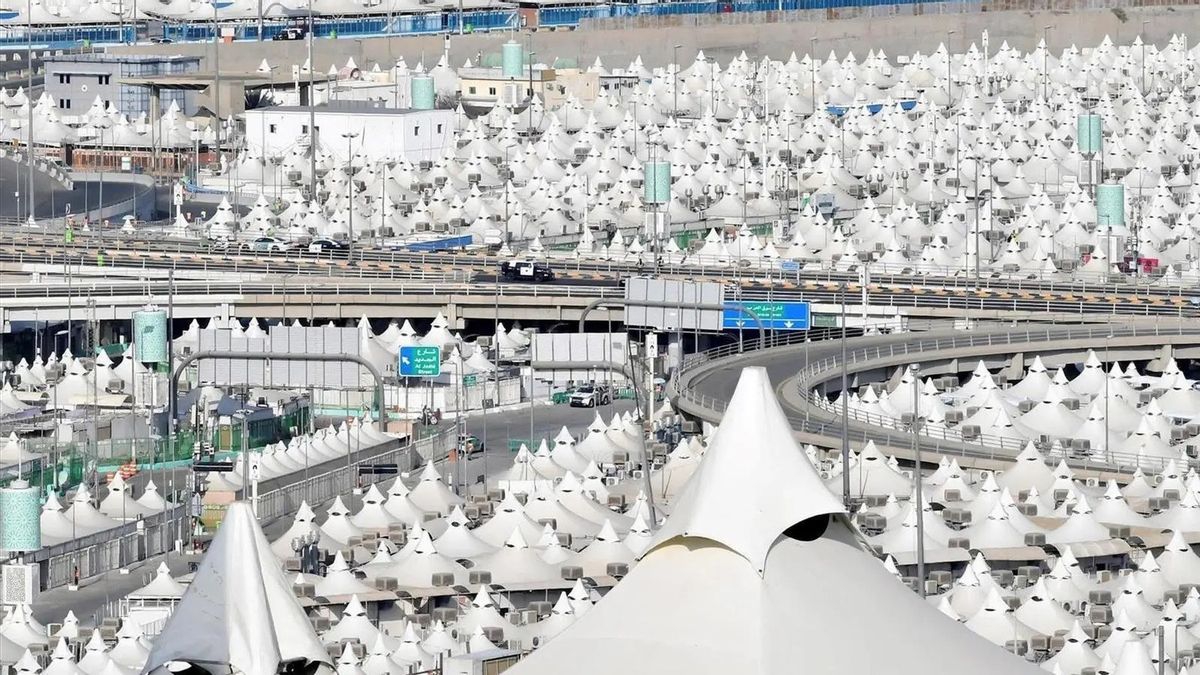


JAKARTA - This year's Hajj pilgrims can enjoy a safer and better quality pedestrian path in Makkah, along with the expansion of the use of new construction techniques for roads.
The Saudi Arabian government has announced a 33 percent expansion of the flexible rubber asphalt road this year, with road construction stretching from the Namibia Mosque to the Al-Mashaer train station in Arafat, bringing the total road area to 16,000 square meters.
"Instead of collecting used tires, which are the main sources of air pollution when burned, this technology recycles them and converts them into flexible asphalt layers that absorb impacts and provide comfortable pedestrian paths," the Saudi Press Agency reported.
The report quoted the General Authority of the Kingdom of Saudi Arabia (RGA) as saying testing on asphalt surfaces and regular sidewalks showed the road "corresponding to a strong reaction to the ankles and feet of worshipers, especially parents, which is 53 percent of the congregation."
About 38 percent of leg and ankle injuries handled by health facilities during Hajj are caused by walking on regular sidewalks.
As explained, smart surfaces that use flexible rubber asphalt help absorb shocks and reduce pressure on the joints of the body, especially ankles and feet.
The RGA experiment is in line with Saudi Arabia's 2030 Vision commitment to sustainable development, smart cities, and increased safety to the comfort of all residents and visitors.
Saudi Arabian officials estimate this year's number of pilgrims will exceed last year's figures, which the General Statistics Authority said amounted to 1.83 million. Of these, about 1.61 million came from outside the Kingdom, while 221,854 were internal pilgrims, including citizens and expatriates.
The 2025 Hajj season is expected to start on June 4, but the certainty is awaiting confirmation from the official Saudi Arabian authorities for new lunar observations.
Meanwhile, the Directorate General of Saudi Arabian Passports on Friday announced that around 890,883 pilgrims had arrived in the country until May 23.
SEE ALSO:



According to the directorate, most of the pilgrims, 846,415 people, entered Saudi Arabia by air, 41,646 pilgrims by land and 2,822 pilgrims arrived by sea.
The Directorate reaffirms its commitment to simplify entry procedures for pilgrims by equipping their platforms at international airports, land and sea with advanced technical equipment and placing personnel with high qualification multi-language capabilities.
Indonesian pilgrims are expected to return to be the largest delegation for the 2025 hajj. Last year, 221,000 Indonesian pilgrims arrived at the Kingdom for Hajj, followed by Pakistan with 180,000. India is in third place with 175,025, Bangladesh is in fourth place with 127,198 and Nigeria completes the top five positions with 95,000 Hajj pilgrims.
The English, Chinese, Japanese, Arabic, and French versions are automatically generated by the AI. So there may still be inaccuracies in translating, please always see Indonesian as our main language. (system supported by DigitalSiber.id)


