

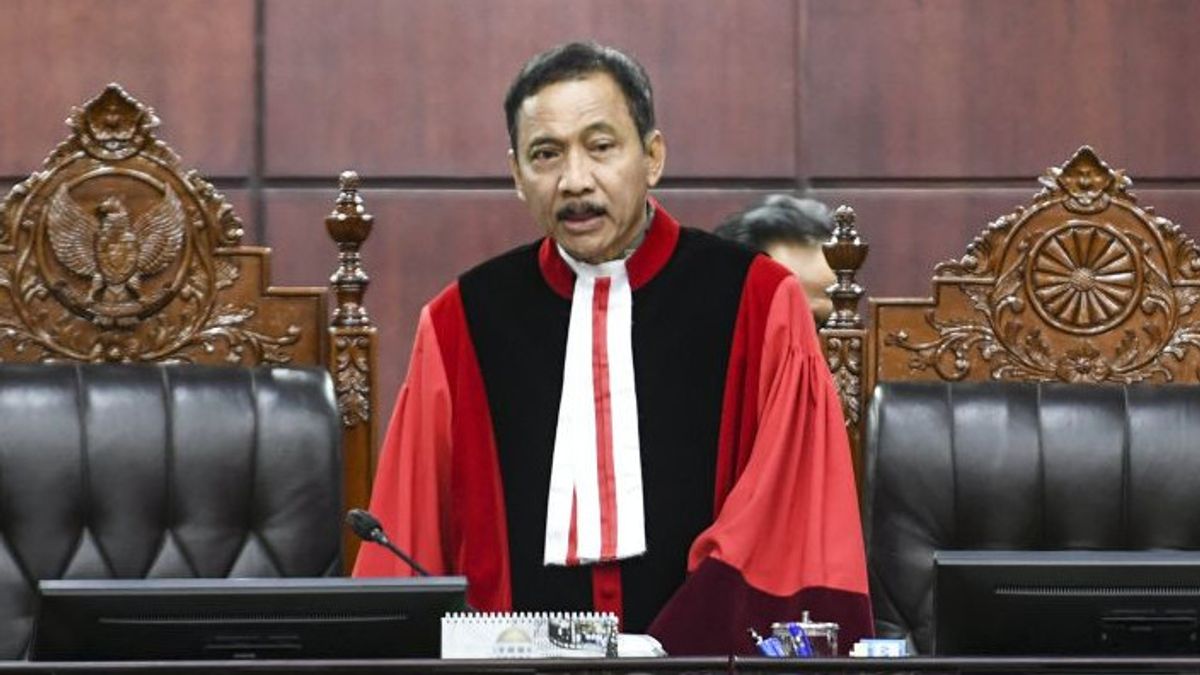


JAKARTA - The Constitutional Court (MK) has decided that acts of disseminating information or electronic documents containing false notifications or hoaxes can be punished if they cause riots in the physical space, not in the digital space.
This is an explanation from the Constitutional Court for the meaning of the word "concursion" in Article 28 paragraph (3) and Article 45A paragraph (3) of Law Number 1 of 2024 concerning Electronic Information and Transactions (UU ITE).
"Granted the petitioner's petition in part," said Chief Justice of the Constitutional Court Suhartoyo reading the verdict No. 115/PUU-XXII/2024 in the Plenary Court Session Room, Jakarta, Tuesday, April 29, as reported by Antara.
The Court stated that the word "construction" in Article 28 paragraph (3) and Article 45A paragraph (3) of the ITE Law contradicts the 1945 Constitution of the Republic of Indonesia and does not have conditionally binding legal force as long as it is not interpreted as "corruption is a condition that disturbs public order in the physical space, not a condition in the digital/cyber space".
Article 28 paragraph (3) of the ITE Law regulates actions prohibited from electronic transaction activities. The article originally reads: "Everyone deliberately disseminates electronic information and/or electronic documents which they know contain false notifications that cause riots in the community."
SEE ALSO:



Meanwhile, Article 45A paragraph (3) of the ITE Law contains criminal provisions on Article 28 paragraph (3). Based on this article, anyone who violates Article 28 paragraph (3) of the ITE Law can be sentenced to a maximum imprisonment of 6 years and/or a maximum fine of IDR 1 billion.
In legal considerations, the Court stated that the norm of Article 28 paragraph (3) of the ITE Law creates legal uncertainty when it comes to its explanation section. In the explanation of Article 28 paragraph (3) of the ITE Law, it stipulates that the word "construction" means conditions that disturb public order in the physical space, not in the digital or cyber space.
This means that the explanation of Article 28 paragraph (3) of the ITE Law has provided clear restrictions that the spread of false notifications that cause physical unrest in the community, while the commotion or riots in cyberspace are not included in the provisions of this article.
With these restrictions, law enforcement officers can only carry out legal processes against the spread of fake news that causes commotion or physical unrest that occurs in the community.
"This is intended so that the application of Article 28 paragraph (3) of Law 1/2024 which is a material offense that emphasizes the consequences of acts or riots committed by the perpetrators of these crimes meets the principles of lex scripta, lex cirta, and lex stricta," said Constitutional Justice Arsul Sani reading out the Court's considerations.
This request for judicial review was requested by a prosecutor as well as law enforcement activist and bureaucrat Jovi Andrea Bachtiar.
He submitted an application for fear of potentially being reported to the police because he actively criticized government policies and the practice of administering government.
The English, Chinese, Japanese, Arabic, and French versions are automatically generated by the AI. So there may still be inaccuracies in translating, please always see Indonesian as our main language. (system supported by DigitalSiber.id)
Most Popular Tags
#Prabowo Subianto #donald trump #firearm #8791 #giias 2026Popular


