
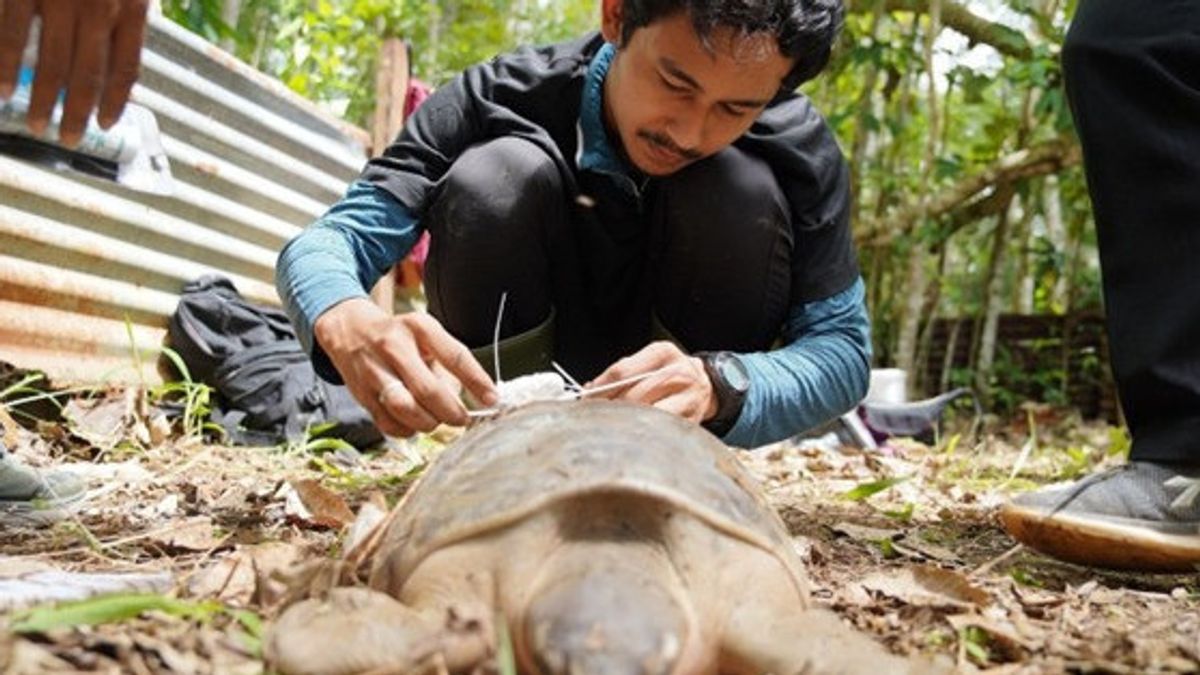


JAKARTA - Earth of Papua is blessed with many biodiversity, including from various animals or endemic fauna. One of them is a pignosed tortoise which is also a protected animal in Indonesia.
Various efforts have also been made to prevent the pig-nosed tortoise from becoming extinct and can be seen by generations. As a concrete action to support this effort, the TSE Group together with IPB carried out an endemic Papuan animal conservation project.
Tunas Sawa Erma (TSE) Group is a palm oil plantation company headquartered in Boven Digoel, Papua. The company is committed to continuing to practice sustainable business governance and the palm oil industry.
Through various innovation projects, TSE supports the government's efforts to protect and maintain natural resources on Earth of Cenderawasih. TSE took part with the endemic Papuan species conservation project in collaboration with IPB University.
TSE and IPB University are currently working in the southern region of Papua to conduct a series of observations and research on the movement of pignosed turtles. What are the roles of TSE in this endemic Papuan species conservation project?
1. Provide Conservation Equipment
One of the roles of the TSE Group in conservation projects is to provide the equipment needed by the research team in observing animals. Such as GPS tools used to monitor animal movements and the reach of pig-nosed turtles in the Kao and Muyu rivers.
2. Providing Costs and Accommodation
TSE also provides accommodation for a research team from IPB University who are involved in this animal conservation project. Ensure the team gets safe and comfortable accommodation facilities for project smooth running.
3. Provide Transportation
The transportation needs for the teams involved are also provided by the TSE. Transportation to youth teams to research places and others during this big mission.
The pig-nosed tortoise (Carrettochelys Insculpta) is an endemic animal that is only found in South Papua, such as Asmat, Merauke, Mappi, and Boven Digoel. In its natural habitat, these animals are often hunted to be traded and even smuggled illegally abroad.
Not a few cases of smuggling pig-nosed turtles, especially those still in the hatchling stage. The largest destination countries of this illegal animal trade include Hong Kong and Taiwan. High demand is usually related to the efficacy of turtle meat which is believed to be a strong drug to use for cosmetics.
Meanwhile, the surrounding community also often takes their eggs for consumption. Some of these factors have the potential to threaten the sustainability of pignosed turtles in the wild, especially in the freshwater ecosystem.
Pig-nosed turtles have an important role in maintaining biodiversity in their natural habitat. Therefore, Papuan conservation such as the TSE and IPB projects is an important step that needs to be taken.
If hunting continues without strict control, it is not impossible that these animals could become extinct in the next dozen or several years. Pig-nosed turtles have been classified as endangered animals based on IUCN (International Union for Conservation Nature and Natural Resource) data.
TSE Group and IPB agreed to cooperate in a five-year conservation project starting from 2022 to 2026. The IPB team that went directly to the field and TSE helped provide equipment, accommodation, and transportation.
TSE Group support is certainly very helpful for the IPB research team in every research and conservation process. This project is expected to improve the quality and quantity of pignosed turtles in the wild.
The English, Chinese, Japanese, Arabic, and French versions are automatically generated by the AI. So there may still be inaccuracies in translating, please always see Indonesian as our main language. (system supported by DigitalSiber.id)
Most Popular Tags
#Prabowo Subianto #donald trump #2026 World Cup #Febrie Adriansyah #8791Popular


