

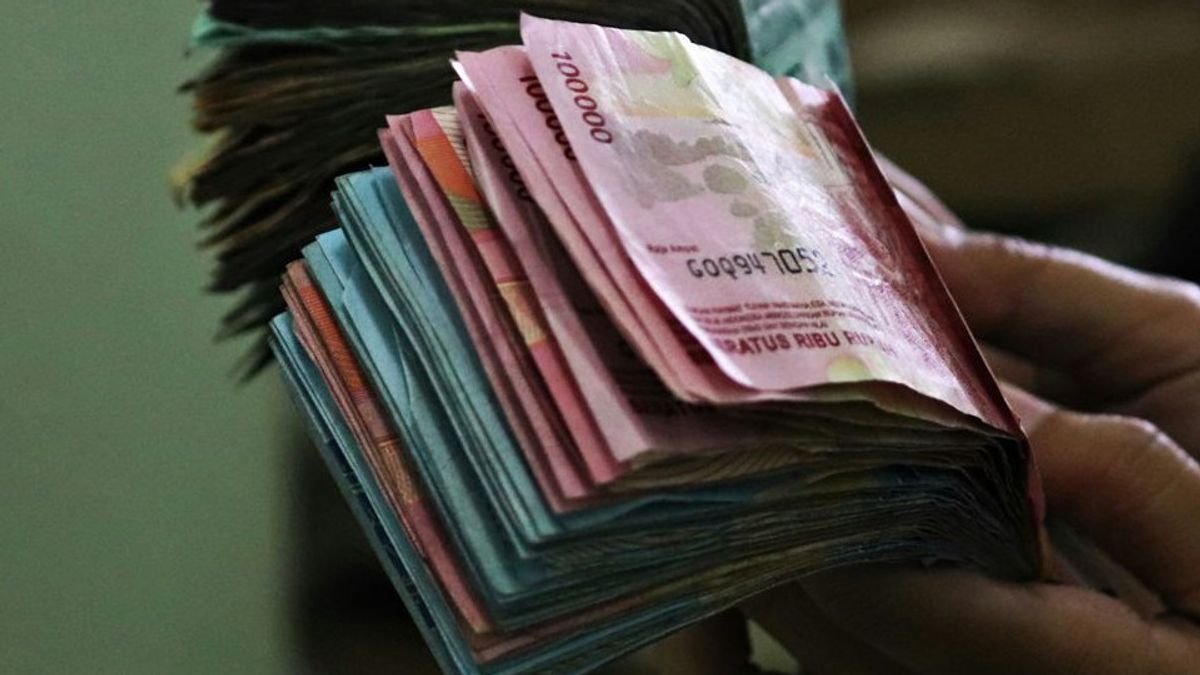


YOGYAKARTA - Money exchange services on the side of the road are commonly found in times near Eid. They usually operate in strategic places such as near markets, public roads, and so on. But because it is not done in official places, many ask about the rule of law on exchanging roadside money.
These impromptu money exchangers offer convenience and speed in exchanging new money for Eid. Their existence is a practical solution when they need cash quickly without having to queue in the bank or official money changers.
But behind this convenience, this raises concerns regarding security, validity, and compliance with applicable laws. So what exactly is the rule of law on exchanging roadside money according to Islamic law and teachings?
In Indonesia, money exchange activities are strictly regulated by law. Based on Law Number 7 of 2011 concerning Currency, every foreign currency exchange activity or rupiah must be carried out by an institution that has obtained an official permit from Bank Indonesia (BI).
These institutions are usually banks, official money changers, or other financial institutions that have met the requirements set by BI.
The practice of exchanging money on the side of the road by individuals or groups without official permission is clearly against the law. According to Article 33 of Law no. 7/2011, currency exchange activities that do not have a permit can be subject to criminal sanctions in the form of fines or imprisonment.
In addition, this activity also has the potential to violate Law Number 8 of 2010 concerning the Prevention and Eradication of Money Laundering (TPPU Law), because transactions carried out are not recorded and vulnerable to misuse for illegal activities.
Bank Indonesia as the monetary authority has also issued regulations prohibiting the practice of exchanging illegal money. BI emphasized that currency exchanges must be made through official institutions to ensure the safety, validity, and stability of the financial system.
The practice of exchanging money on the side of the road is considered a high risk because there is no guarantee of security for both parties, both exchangers and those who exchange money. In addition, the exchange rates offered are often not transparent and tend to harm one party.
From an Islamic perspective, money exchange activities are known asharf. Islam strictly regulates the practice of half to avoid the practice of usury (interest) and gharar (uncertainty) which is prohibited in the Shari'a.
According to Islamic law, currency exchanges may be made as long as they meet several requirements, including:
The practice of exchanging money on the side of the road often does not meet these requirements. For example, unclear exchange rates or potential fraud can be categorized as gharar which is prohibited in Islam. In addition, transactions carried out without clarity of legal status and security also contradict the principles of ihtiyath.
Islam also emphasizes the importance of legitimate and transparent transactions. The practice of exchanging illegal money by the side of the road often involves high uncertainty and risks, not in line with these principles.
Therefore, Muslims are advised to exchange money through official institutions that have met the legal and sharia requirements.
SEE ALSO:

Such is the review of the rule of law on the exchange of roadside money based on Islamic laws and teachings. Money exchange services on the side of the road do provide convenience for some people. However, this practice has a number of legal, security and moral risks. Also read the Ministry of Transportation preparing 520 buses for free Eid 2025 homecoming.
Stay up to date with the latest domestic and other overseas news on VOI. We present the latest and updated information nationally and internationally.
The English, Chinese, Japanese, Arabic, and French versions are automatically generated by the AI. So there may still be inaccuracies in translating, please always see Indonesian as our main language. (system supported by DigitalSiber.id)
Popular


