

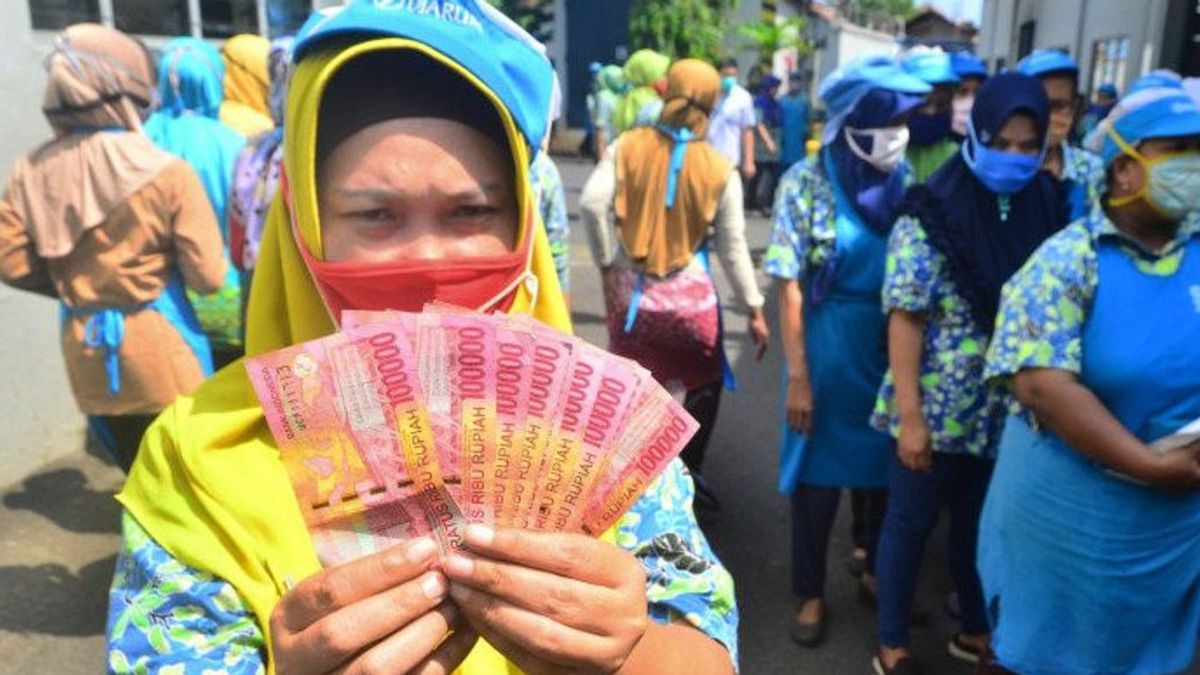


YOGYAKARTA The calculation of the Holiday Allowance (THR) now refers to the Job Creation Law (UU Ciptaker), namely Number 11 of 2020. The calculation of the THR version of the Job Creation Law is adjusted to the working period of employees, both permanent and non-permanent. To get a more complete explanation, see the following article.
As explained earlier, the THR according to the Ciptaker Law is adjusted to the employee's tenure, whether permanent or non-permanent. That way the THR giver must first know how long the working period of the THR recipient is.
Employees who work under one year will receive a proportional THR that is adjusted to their working period. Meanwhile, employees who work above or more than one year will get a THR of 1x salary. To make it easier, here are the formulas that can be used.
Workers with this criterion will get THR which is calculated by THR = 1 \times Monthly Salary,
Workers with this criteria will get THR proportionally. THR is given even though it has only worked for one month or more but is under 12 months. The calculation used is THR = Work Period / 12 \times one month of wages.
Arif is a worker who pays the UMK of Yogyakarta City with a basic salary of IDR 2,400,000. He has worked for 4 consecutive years. So, according to the Job Creation Law, Arief's UMR is 1 x 2,400,000.
Meanwhile, Reta has the same salary as Arief but he has only worked for six months. So, he will get THR with a calculation of 6/12 \times Rp5,000,000 = Rp1,200,000 (out of salary).
THR must be given by employers to employees according to applicable criteria. Some of these criteria are as follows.
In addition, employers are required to give THR to their employees no later than seven days before religious holidays. The company still has to fulfill this obligation even though the company has problems distributing THR.
Employees have the right to file a complaint with the local Manpower Office if the THR that should be received experiences delays, nominal reductions, or other obstacles. Later the Manpower Office will follow up on the problem.
Companies or those who provide jobs will be subject to sanctions if they violate the THR rules. Sanctions can be in the form of written warnings, restrictions on business activities, temporary suspension of business activities, and even revocation of business licenses.
SEE ALSO:
-
 | BERITA
Kepala Staf IDF Letjen Eyal Zamir Sebut Misi Melawan Hamas Belum Selesai
06 Maret 2025, 06:00 -
 | TEKNOLOGI
Trump Desak Penghapusan Subsidi Rp860 Triliun untuk Industri Semikonduktor
06 Maret 2025, 05:05

The company is also obliged to pay a late fine or non-compliance with regard to the issue of THR distribution to employees. Sanctions are given to provide a deterrent effect to employers.
That's the calculation of THR according to the Job Creation Law. Visit VOI.id to get other interesting information.
The English, Chinese, Japanese, Arabic, and French versions are automatically generated by the AI. So there may still be inaccuracies in translating, please always see Indonesian as our main language. (system supported by DigitalSiber.id)
Most Popular Tags
#Prabowo Subianto #donald trump #2026 World Cup #Febrie Adriansyah #8791Popular


