
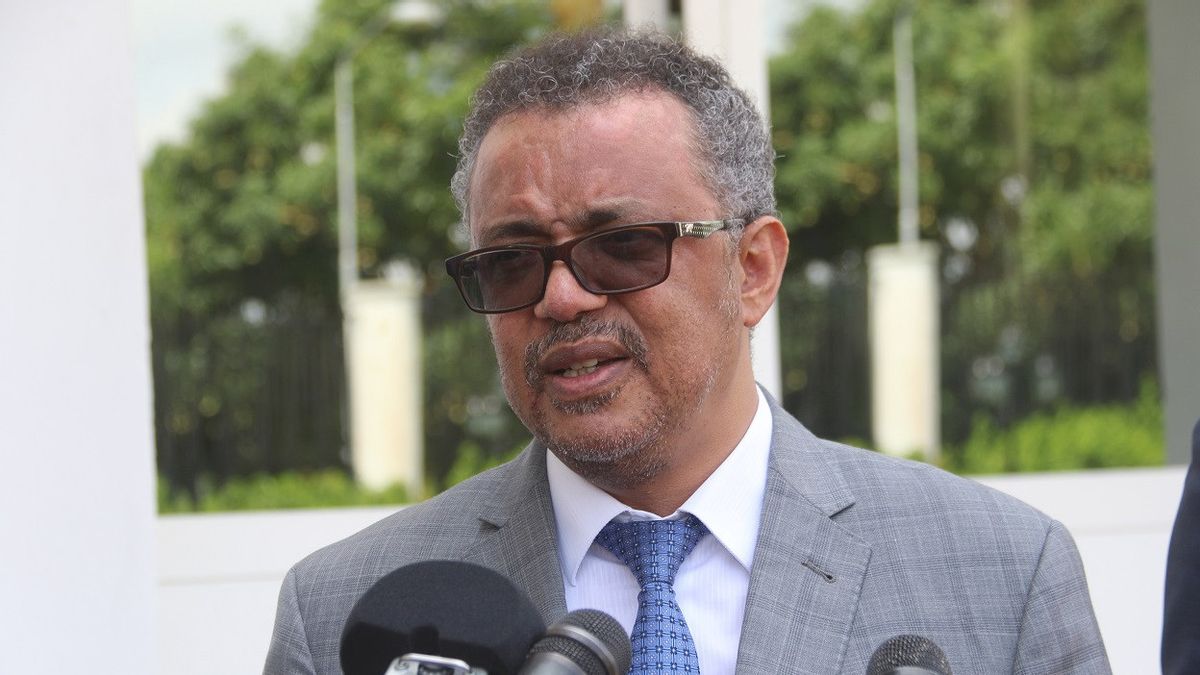


JAKARTA - Director-General of the World Health Organization (WHO) Tedros Adhanom Ghebreyesus said the United States' move to temporarily suspend foreign aid donations had a serious impact on global health, hitting programs fighting polio, HIV and other threats.
Tedros urged the United States to consider continuing funding aid until a solution can be found.
"There have been actions taken by the US government that we are concerned about having a serious impact on global health," Tedros said in a virtual press conference from Geneva.
Efforts to contain HIV, polio,mpox, and bird flu were all affected by the temporary suspension of US foreign aid implemented by President Trump last month, shortly after he took office while the programs were reviewed.
In particular, Tedros said, the suspension of funding for the Presidential Emergency Plan for AIDS Management (PEPFAR) has led to the immediate suspension of HIV treatment, testing and prevention services in 50 countries it supports.
"Although subsequent relief allows some services to resume, prevention efforts for risk groups are not included," he said.
"Clinicals are closed and health workers are temporarily suspended," he added, saying WHO is trying to help countries fill the gap in anti-retroviral drug supplies.
The termination of funding and termination of US institutions also affected efforts to eradicate polio and respond to the campx, he said, while nearly 60,000 people do not have access to life-saving services in Myanmar.
"We ask the US to consider continuing its funding at least until a solution can be found," Tedros said.
In addition to the suspension of aid, President Trump also moved to withdraw the United States from WHO on the first day of his second term, which also had an impact on collaboration, particularly in fighting outbreaks and influenza, Tedros said.
Tedros also refers to the funding gap for WHO itself. The agency has reformed its funding model in recent years, but other ideas are also on the table, he said.
This includes raising an endowment fund of 50 billion US dollars, although he did not provide details on how it would be done.
SEE ALSO:
-
 | BERITA
Tepis Ancaman AS dan Israel Soal Gencatan Senjata, Hamas: Posisi Kami Jelas
13 Februari 2025, 08:00 -
 | BERITA
Telepon Zelensky Usai Bicara dengan Putin, Trump: Ia Juga Ingin Perdamaian
13 Februari 2025, 07:00 -
 | BERITA
Kepala Pentagon Sebut Keanggotaan NATO untuk Ukraina Tidak Realistis
13 Februari 2025, 06:00
He also said his agency had considered recovering cash, or billing fees for some of its services, for institutions or people who could afford to pay.
Separately, Maria Van Kerkhove, interim director of the pandemic and epidemic, said WHO had not received an influenza report from the US Centers for Disease Control and Prevention since around January 24.
"We continue to contact our colleagues and US Government agencies. We have not received a response from them, but we will continue to contact, and we hope the exchange can resume," he said.
The English, Chinese, Japanese, Arabic, and French versions are automatically generated by the AI. So there may still be inaccuracies in translating, please always see Indonesian as our main language. (system supported by DigitalSiber.id)
Most Popular Tags
#Prabowo Subianto #donald trump #Febrie Adriansyah #8791 #giias 2026Popular


