
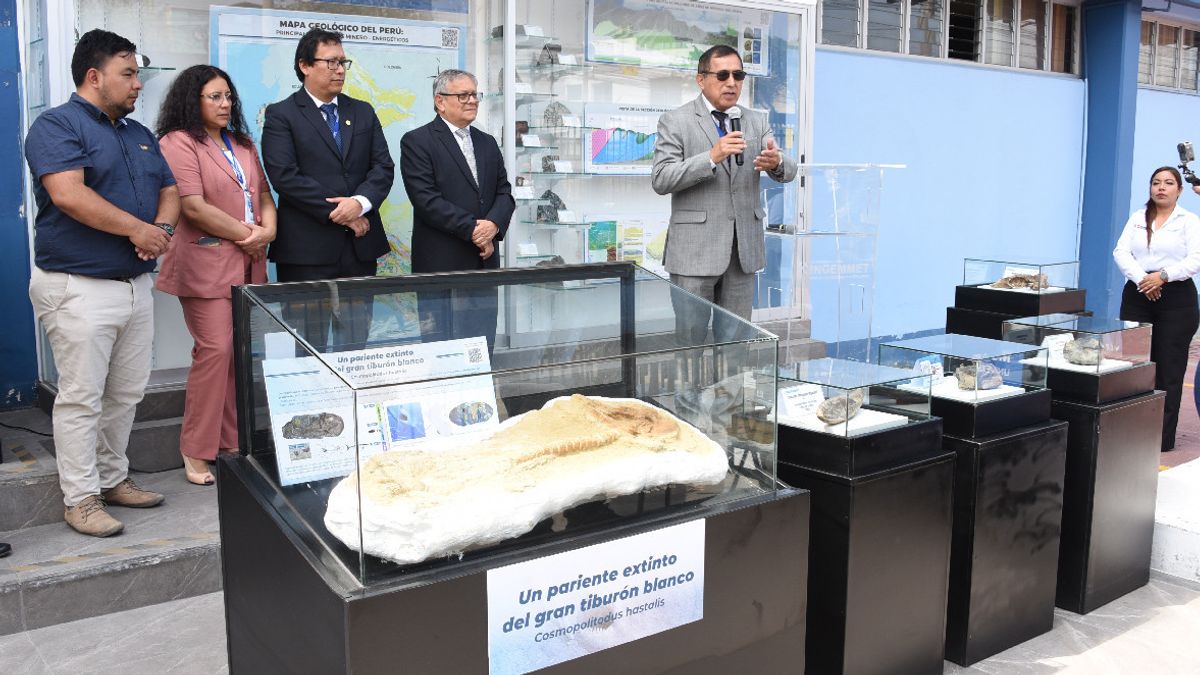


JAKARTA - Peru's paleontologist on Monday revealed fossils of relatives of a 9 million-year-old large white shark that once lived in the waters of the southern Pacific Ocean, where the shark likes to eat sardines.
Nearly complete Fossil Cosmopolytodus Hastalis was found about 235 km (146 miles) south of Lima in the Pisco Peru basin, a hot desert area famous for its frequent discovery of ancient marine species.
The shark is believed to be the progenitor of a great white shark. The shark is now extinct, but its teeth have reached 8.9 cm (3.5 inches) long, while the adult shark can grow up to nearly seven meters in length - the size of a small boat.
Cesar Augusto Chacaltana, an engineer at the Peruvian geological and mining agency (INGEMMET) said in a presentation the shark's remains showed "extraordinary fossilization," quoted by Reuters on January 20.
The researchers showed off the remains of the ancient shark in several glass jars, including an jar containing a giant jaw with sharp teeth.
"There are not many complete shark (fossils) in the world," explains paleontologist Mario Urbina at the event, adding the remains of a number of sardines were found in his stomach.
Urbina noted, because anchovies did not exist when sharks explored the high seas and oceans, sardines became staple food for marine predators.
SEE ALSO:
-
 | BERITA
Rusia Tegaskan Pelarangan Israel Terhadap UNRWA Tidak Boleh Dibiarkan
25 Januari 2025, 05:00 -
 | BERITA
Presiden Trump Tetap Ingin Anggota NATO Naikkan Anggaran Pertahanannya Menjadi 5 Persen
24 Januari 2025, 18:00 -
 | BERITA
146 WNI Asal Sejumlah Provinsi Berhasil Dipulangkan dari Arab Saudi ke Tanah Air
24 Januari 2025, 17:00 -
 | BERITA
Militer Korsel Perkirakan Korut Tengah Menyiapkan Pengiriman Pasukan Tambahan ke Rusia
24 Januari 2025, 16:00

Previously, Peruvian paleontologists in November showcased young crocodile fossils that lived more than 10 million years ago off the coast of central Peru, where Pismo and agricultural area Ica are located.
Meanwhile, in April last year, researchers showcased the largest river dolphin skull fossil known to date, which has inhabited Amazon about 16 million years ago.
The English, Chinese, Japanese, Arabic, and French versions are automatically generated by the AI. So there may still be inaccuracies in translating, please always see Indonesian as our main language. (system supported by DigitalSiber.id)
Most Popular Tags
#Prabowo Subianto #donald trump #Febrie Adriansyah #8791 #giias 2026Popular


