

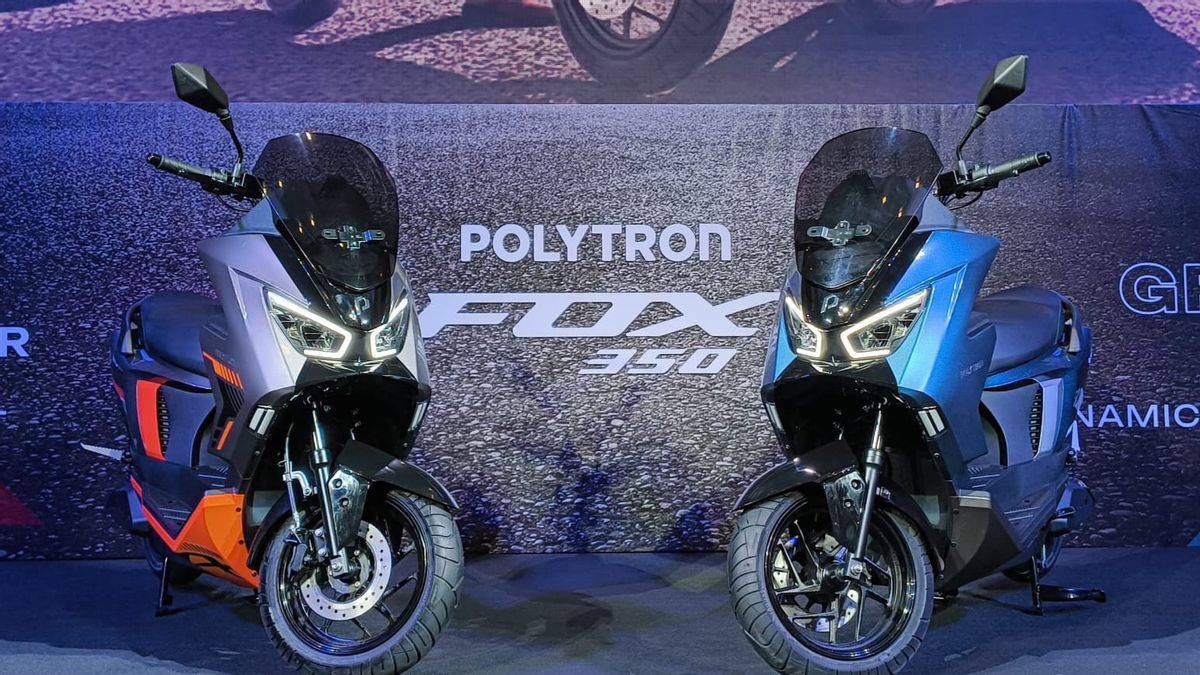


JAKARTA Polytron has again shown its commitment to delivering safe electric vehicles by releasing comprehensive education on the importance of battery cell selection. This initiative comes after the launch of FOX 350.
Where, Polytron offers two ownership schemes, namely Battery as a Service (BaaS) and direct battery purchases. Behind the development of its electric vehicle ecosystem, Polytron places security aspects as a top priority.
Polytron CEO Hariono, said that batteries are the most crucial and most complex components in an electric motor. He emphasized that each battery cell used has gone through rigorous testing.
The POlytron applies international level testing standards to ensure each battery cell is used safely before being installed on an Electric FOX electric motor. This standard refers to UN 38.3, QC/T 743, SNI 8872:2019, UN R136, to ISO 26262 which includes thermal testing, vibrations, shocks, punctures, collisions, to simulations of accident risk, "said Hariono, in a written statement, Friday, December 12.
Polytron explains that not all lithium batteries have the same level of security. Some types such as NMC, NCA, and LCO have a higher risk of fire. That's because it produces internal oxygen when it catches fire, making the fire get bigger and difficult to control.
To avoid this risk, Polytron chose cell LFP (Lithium Iron Phosphate) which has better thermal stability and does not produce oxygen during a fire, so the potential for large explosions or fires can be minimized.
In the education, it is explained that LFP cells have a thermal runaway starting point at a temperature of 250300$C, much higher than NMC cells which are in the range 170220$C. Polytron's LFP cell has also gone through tests such as nail penetration and mechanical impact, ensuring the battery remains safe despite punctures, high pressure, or physical damage that simulates accident conditions.
SEE ALSO:
-
 | MOBIL
Hyundai Ioniq 3 Meluncur Tahun Depan, Berbagi Teknologi dengan Kia EV3?
12 Desember 2025, 15:17 -
 | MOBIL
Toyota bZ4X Resmi Meluncur di Filipina, Harga Lebih Murah dari Indonesia
12 Desember 2025, 14:28
Polytron adds that battery safety is also determined by battery pack design. FOX Electric uses an aluminum heatsink structure that serves as a cooler as well as a shield from collisions, vibrations, and exposure to extreme heat.
The case has IP67 certification, makes batteries waterproof and flooded. In addition, the Battery Management System (BMS) system complements protection through temperature sensors, automatic current breaks when there is an overload or over-discharge, and cell balancing mechanism to maintain battery health in the long term.
The company also highlighted that there are still many electric motors in the market that use assembled batteries with low safety standards, are not water resistant, without adequate cooling, and without safety certification. This condition is considered very dangerous and increases the risk of a fire if the motor experiences a collision, a handful of foreign objects, or is submerged in water.
Polytron also describes the comparison between LFP batteries and Graphene Lead Acid which is still used by a number of electric vehicle manufacturers. Although often marketed as new technology, Graphene Lead Acid has longer charging times, low efficiency, high self-discharge levels, and heavier weights than LFP.
Meanwhile, LFP excels in energy efficiency, fast charging capabilities, resilience, and long-term stability. Head of Design, Quality and Assurance EV Polytron Josaphat Bagus Purnama, emphasized that security was never a compromise area for Polytron.
In Polytron, the safety of electric motorcycle users has never been a compromise area. We select certified LFP cells that pass the most stringent testing, including the nail penetration test, to ensure their resilience even in extreme accident scenarios. We believe that the electric vehicle industry can only develop if users feel safe and believe in its technology," he explained.
The English, Chinese, Japanese, Arabic, and French versions are automatically generated by the AI. So there may still be inaccuracies in translating, please always see Indonesian as our main language. (system supported by DigitalSiber.id)
Most Popular Tags
#Prabowo Subianto #donald trump #2026 World Cup #Febrie Adriansyah #8791Popular


