

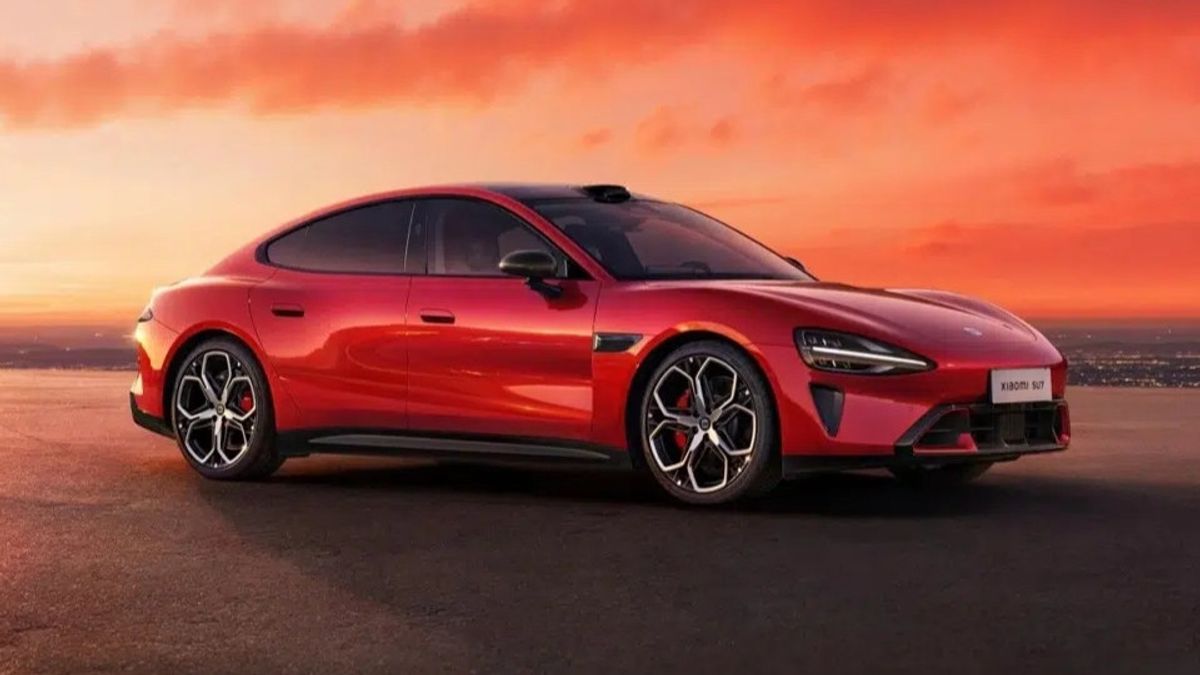


JAKARTA - Xiaomi officially introduced the latest version of the SU7 electric sedan for the 2026 model year with a series of significant improvements. This update includes safety, performance, smart technology, and cabin materials.
Launching Carnewschina, Monday, March 23, the new model is priced at 219,900 yuan or Rp. 541 million. This means an increase of 4,000 yuan compared to the previous version.
In this latest generation, Xiaomi presents hardware that was previously only available in the top variant as standard across the line. All variants are now equipped with LiDAR, 4D millimeter wave radar, and the Nvidia Thor-U computing platform with 700 TOPS capabilities that support the Xiaomi HAD driver assistance system.
For the power plant, all models use a V6S Plus motor, with 235 kW of power in the Standard and Pro variants, while the Max version reaches 508 kW. The battery options consist of LFP 73 kWh and 96.3 kWh, as well as a 101.7 kWh ternary lithium battery.
The distance covered based on the CLTC standard reaches 720 km, 902 km, and 835 km respectively. Xiaomi also carries a high voltage system between 752V to 897V, which is claimed to be in the 800V class platform.
In terms of design, the SU7 still maintains the fastback silhouette with a length of 4,997 mm and a wheelbase of 3,000 mm. Exterior updates are more focused on function, such as the integration of a radar in the front and the use of wider rear tires.
Entering the cabin, Xiaomi made updates to the material and user interface. The interior now relies on a 16.1-inch center screen, a 7.1-inch rotatable instrument panel, and a head-up display.
The entire system is integrated in Xiaomi's smart cockpit which supports wider voice control and multi-screen connectivity inside the cabin. In terms of safety, improvements are made through the use of high-strength materials, including 2200 MPa steel at a number of critical points, as well as the presence of nine airbags.
Xiaomi also embeds a three-layer door opening mechanism with a power backup line so that it can still function in extreme conditions. Meanwhile, the battery pack gets additional protection at the bottom as well as an improved protective layer.
The sedan is also equipped with a "Dragon Chassis" which combines a double-wishbone suspension in the front and a five-link in the back. In the higher variant, there is a dual-chamber air suspension with adaptive damping, complete with predictive control features based on road conditions.
With these various updates, the latest SU7 still targets the mid-size electric sedan segment and becomes a rival for models such as the Tesla Model 3. Xiaomi now positions the SU7 2026 as a product with more complete standard features, including driver assistance technology and high voltage architecture in all variants.
The launch of this model also coincides with the adjustment of production that had previously occurred. Xiaomi SU7 shipments were recorded as falling to 218 units in February, along with the process of improving factory facilities to welcome the latest model.
This condition reflects the transition of manufacturing, not a decline in market demand. On the other hand, Xiaomi's electric vehicle business continues to show progress.
The company previously recorded cumulative shipments of more than 600,000 units in 22 months, and targets the distribution of 550,000 vehicles throughout 2026. This confirms the role of SU7 as the backbone of Xiaomi's automotive expansion strategy going forward.
The English, Chinese, Japanese, Arabic, and French versions are automatically generated by the AI. So there may still be inaccuracies in translating, please always see Indonesian as our main language. (system supported by DigitalSiber.id)
Most Popular Tags
#Prabowo Subianto #donald trump #2026 World Cup #venezuela #konflik timur tengahPopular


