

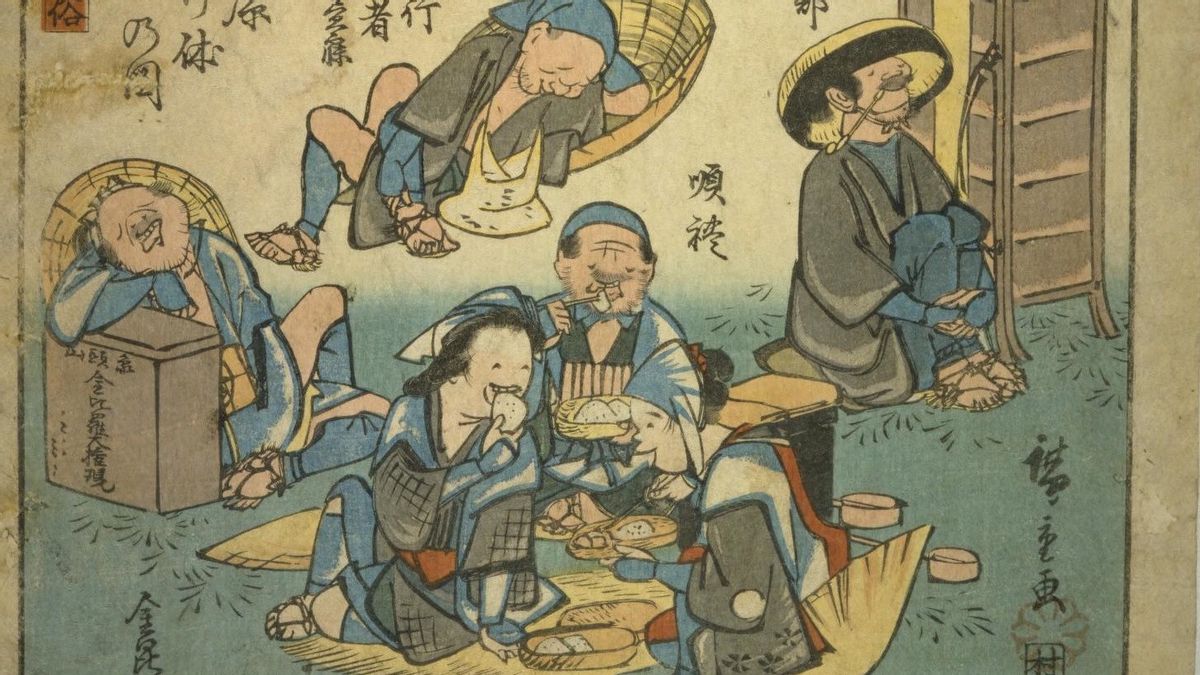


JAKARTA - For the Japanese, onigiri is a special form of food. From time immemorial, onigiri “rice balls” have been a daily snack for the people of the Land of the Rising Sun. Onigiri can be eaten in any setting --morning, afternoon, or evening. Onigiri also became food for all classes, from nobles to commoners. This privilege increases when Onigiri becomes an important provision for samurai who go to war. In fact, onigiri was also recorded as the contents of the Japanese military bento in World War II.
Since its inception, onigiri has become a popular dish in Japan. The passion for onigiri, which is able to adapt to the tastes of the times, is the estuary. Most interestingly, at first the basic ingredients of making onigiri were glutinous rice (mochi), not Japanese rice (Uruchi-mai) as we know it in the modern era. Even the shape is still diverse - from round, city, to triangle.
The food is not only known as onigiri. There are many other Japanese names for Onigiri. Some call it omusubi (rice balls) and nigirimeshi (rice food).
Launching the Samurice page (http://samurice.sg/blog/what-is-onigiri-japanese-traditional-meal/ ), archaeological evidence shows Onigiri has existed since the Yayoi era (300 BC-250). During archaeological excavations in Ishikawa Prefecture, archaeologists found lumps of carbonated rice grains.
The findings of lumps of rice were immediately investigated. The results are surprising. They found traces of pressure from human fingers in lumps of rice. Therefore, the discovery is proof that the ancestors of the Japanese were used to making rice balls for daily consumption, especially for pleasure.
Furthermore, Onigiri appeared in the early Nara period (710 to 794). The special evidence of the Nara era onigiri is evidenced by the presence of the description of “nigiri” (handmade rice) in a topography ordered by Empress Gemmei (660-721). The Wiliyah described as nigiri is Hitachi no Kuni. Which, the area is known to be very rich in natural products.
Similarly, the following eras: the Heian era (794-1185), the Kamakura era (1185 to 1333), the Sengoku era (1493-1573), to the Edo era (1603-1868). Each of the past eras shows evidence of the importance of onigiri in Japanese society.
FolkloreOther evidence of the roots of onigiri in Japanese society also appears in the form of folklore. One of them is the story of Omusubi Koronin (rolling rice balls). The story was passed down from generation to generation by the Japanese people. In addition to loading onigiri as a cultural heritage. The story teaches an important value in life that life should not be greedy.
The story opens with the story of an old farmer and his wife who live happily even though they are simple. One day, the old farmer worked as a lumberjack in the mountains. At lunch time, the wife of the old farmer immediately prepared lunch for her husband. The old farmer then began to make his wife's onigiri wrapped in leaves.
The old farmer then ate voraciously. He didn't realize that a rice ball had fallen into a small hole. Realizing that, the old Farmer immediately rushed towards the direction where the onigiri fell. The farmer saw and heard the rats being happy to get food. The mice also sang a song: Omusubi kororin sutton ton!

The old farmer was shocked. He then accidentally dropped the rice ball many times. The singing was getting louder and louder. The rats then saw the old farmer. Instead of being afraid, the rats were grateful.
The old farmer was offered two choices. big box and small box. Old farmers do not want to be grandiose. He just chose a small box. Just before going home, he then said goodbye and thanked the tikut-tikut for the gift. As a result, when the box was opened the old farmer found a lot of money.
“Unexpectedly a young man heard the story of an old farmer. He then went to the mountain with a lot of onigiri. He dropped the onigiri one by one into the small hole where the tikut lived. When he heard the singing of the rats, the young man jumped in and asked for a reward."
“The mouse asked him to choose a big box or a small box. The greedy youth then took the two boxes belonging to the mouse and tried to leave. But the rat bit him and the young man returned home with only bites all over his body, without the box," wrote Sanae Inada in the book Simply Onigiri (2011).
Important supplies during warTraces of onigiri became an important provision for samurai (Japanese knights) during the war, which was clearly recorded when the Sengoku era began (1493-1573). This era is the most brutal era. The absence of descendants from the Shogun, Yoshimasa Ashikaga became the main reason for the rulers and generals of each region of Japan to fight for territory. Inevitably many of the samurai family joined.
The samurai did not want to miss the opportunity to "gamble" to fight for the shogun's throne. Which, at that time the shogunate had full power over Japan. Because, the Emperor of Japan is only used as a symbol of a mere leader.
When the war began, many of the generals brought their samurai troops to fight for enemy territory. However, Japan's mountainous terrain made it difficult for the samurai to transport traffic. Not to mention, transportation at that time was limited to horse and human power only.
As a result, the transport of supplies and war equipment mostly used horsepower and the samurai themselves. Meanwhile, the samurai who headed to the battlefield always carried onigiri as part of the most important rations. As a supplier of energy in times of war, he said.

“Rations were brought to the battlefield in long and narrow pouches by all the samurai. Cooked rice for one meal in the form of onigiri (rice balls). Or a day's supply of rice is put in a bag, then tied up. The next portion is added, and the bag is tied again. A full ration bag can contain 10-15 'bubbles' of rice,” said Anthony J. Bryant in Samurai 1550-1600 (2008).
Not only that. Onigiri even remains an important ration for the Japanese army, sea, and air forces in the modern era. In World War II, for example. Onigiri is like a war talisman. Onigiri is always brought by Japanese troops to conquer their enemies. Including being an important provision to conquer the Dutch royal army, Koninklijk Nederlandsch-Indische Leger (KNIL) in the Dutch East Indies. The persistence of the Japanese army made them the new rulers of Indonesia.
The onigiri trail as a provision for wartime was also perpetuated by thousands of pilots who were preparing to carry out the "noble" Kamikaze mission. The mission was a suicide mission that required the pilots to crash the plane they were flying into the enemy. Kamikaze is a Japanese term derived from the name of a typhoon that saved Japan from the Mongol invasion in 1281.
“On April 6, 1942, various suicide planes started arriving from the Kyushu (Japan) military base to Taiwan. They were the young Kamikaze pilots who brought us onigiri (rice balls) a dish that was highly valued in those days.”
“They talk to mothers and children. They must be lonely, and we have to somehow ease their pain. One of the young pilots promised me that if they survived the battle, he would marry me, but of course they would never come back,” said Masako Kimura Streling in the book I Thought the Sun Was God (2013).
*Read other information about HISTORY or read other interesting articles from Detha Arya Tifada.
Other BERNASThe English, Chinese, Japanese, Arabic, and French versions are automatically generated by the AI. So there may still be inaccuracies in translating, please always see Indonesian as our main language. (system supported by DigitalSiber.id)
Most Popular Tags
#Prabowo Subianto #donald trump #2026 World Cup #Febrie Adriansyah #8791Popular


