



JAKARTA - The rising crime rate cannot be underestimated. Fear is everywhere. The economy is sluggish. This narrative was adopted by the Soeharto and New Order governments. The government moved to maintain order – violence was permitted only when necessary.
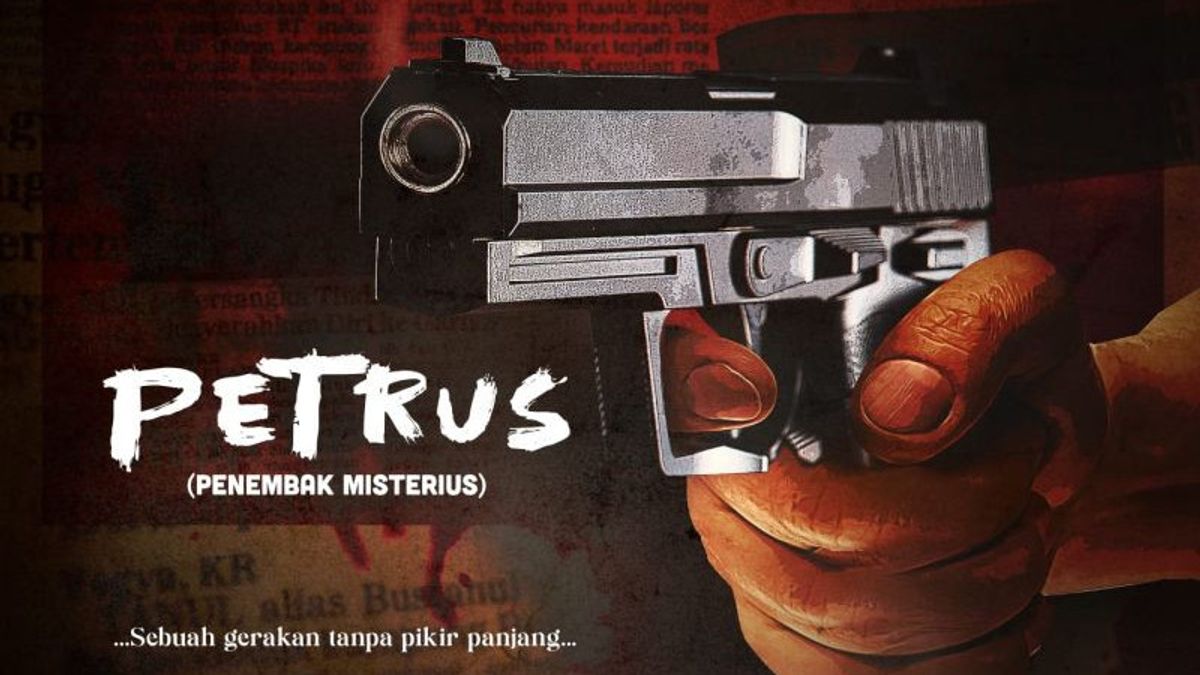
As a result, many criminals and thugs were found dead every day. They were dumped in gutters and on the streets. This action sparked controversy because it was seen as not only eliminating crime but also eliminating political opponents. The public nicknamed them "mysterious shooters" (petrus).
No one doubted that life in big cities in the 1980s was increasingly unsafe. This was because not all Indonesians received a significant portion of the benefits of development. As a result, poverty increasingly ensnared many.
This led many to become disillusioned and turn to the underworld. They robbed and mugged, sometimes even killing their victims. This action fueled fear. Take Yogyakarta in 1983, for example.
Robbery became increasingly rampant and often resulted in fatalities. The Yogyakarta Garrison Commander, Lieutenant Colonel M. Hasbi, was furious. He launched the Crime Eradication Operation (OPK) in March 1983.

The operation received support from the New Order government. Anyone who committed a crime would be pursued down to the ant hole. This narrative was not to be taken lightly. The military truly penetrated the criminals' lair.
All criminals were to be apprehended and destroyed. Those who resisted were denied a place to live. Many criminals were killed. The operation in Yogyakarta was a success. All Yogyakarta residents began to feel safe.
Later, the government adopted this action in other major cities—even beyond Java. As a result, many unidentified bodies were dumped daily in the gutters or streets. Usually, these bodies were known as Mister X.
Some also placed 10,000 Rupiah notes on top of the bodies. This was usually for burial costs. The government, through the Commander of the Indonesian Armed Forces/Commander of the Operational Command for the Restoration of Security and Order (Pangkopkamtib), L.B. Moerdani, denied that his men had committed this.
He believed the military only killed when under duress. Furthermore, the identity of the shooter was unknown. As a result, the shootings became known as "petrus."

"What's unclear is the perpetrator. At the time, rumors circulated about a 'mysterious shooter' or 'mysterious killer' sent by the security forces themselves. That's where the term "petrus" emerged. However, General L.B. Moerdani, the then Commander of the Armed Forces/Pangkopkamtib, denied this."
"Indonesia is a country of law. Shootings are only carried out in cases of necessity, namely when criminals resist or try to escape. The mysterious corpses, according to Moerdani, may have been the result of gang warfare. However, the public didn't immediately believe it," stated Priyono B. Sumbogo in his article for Tempo magazine titled "Petrus, Seven Years Ago" (1990).
Controversy of Petrus
The presence of Petrus (the "petrus") temporarily reduced crime rates in major cities. However, the Petrus operation didn't solely target criminals. Many of the victims were ordinary people, often with the same names.
Sometimes, the victims were political opponents of the New Order. The Petrus mantra was considered effective in instilling terror in political opponents. This narrative silenced previously vocal individuals, unwilling to become victims of Petrus.
As a result, Petrus received widespread criticism. The international community condemned Suharto and the New Order. Attempts to kill thugs or criminals, regardless of the reason, without a court decision were considered unjustified. Yet, the New Order often used the narrative of Indonesia as a state of law.
Petrus' presence, which occurred from 1983 to 1985, was seen as evidence that Indonesian law was not functioning properly. Death tolls from Petrus varied, with some claiming 2,000, others claiming 10,000.
Famous lawyer during the New Order era, Adnan Buyung Nasution, considered Petrus nothing more than premeditated murder. Adnan asked the New Order to first hold a speedy trial to determine whether the perpetrators were criminals or victims of mistaken arrest.
The option of a speedy trial was more reasonable than shooting first and then questioning. Later, Petrus' actions were considered by many to be nothing more than vigilantism.
Suharto was also portrayed as a human rights criminal. Many demanded that he be held accountable. However, Suharto did not deny it and emphasized that Petrus was the government's way of saving the people.
"Some evil people have acted beyond the bounds of human rights. So, we must take action, decisive action. What kind of action? Yes, we must use violence. But it is not simply execution by shooting. No! Those who resist must be shot. They are shot dead because they resist," Soeharto explained in chapter 69 of his biography, "Ucapan, Pikiran, dan Tindakan Saya".

In a 1983 issue of Tempo magazine, the Jakarta Legal Aid Institute (LBH) expressed the opinion that Petrus could be classified as premeditated murder.
"According to Buyung, LBH considers the mysterious shooting to be premeditated murder. If the court procedure is deemed lengthy, a speedy trial can still be conducted, which is still within the legal framework."
"Former Vice President Adam Malik also agreed with the speedy trial. We have a court. If necessary, arrest him in the morning, try him in the afternoon, and shoot him in the evening. This means his death is due to a court decision. And that means we are proceeding on a legal basis," he wrote in a Tempo magazine report titled "Ada Dor: Ada Ya, Ada Tidak" (1983).
The English, Chinese, Japanese, Arabic, and French versions are automatically generated by the AI. So there may still be inaccuracies in translating, please always see Indonesian as our main language. (system supported by DigitalSiber.id)


