

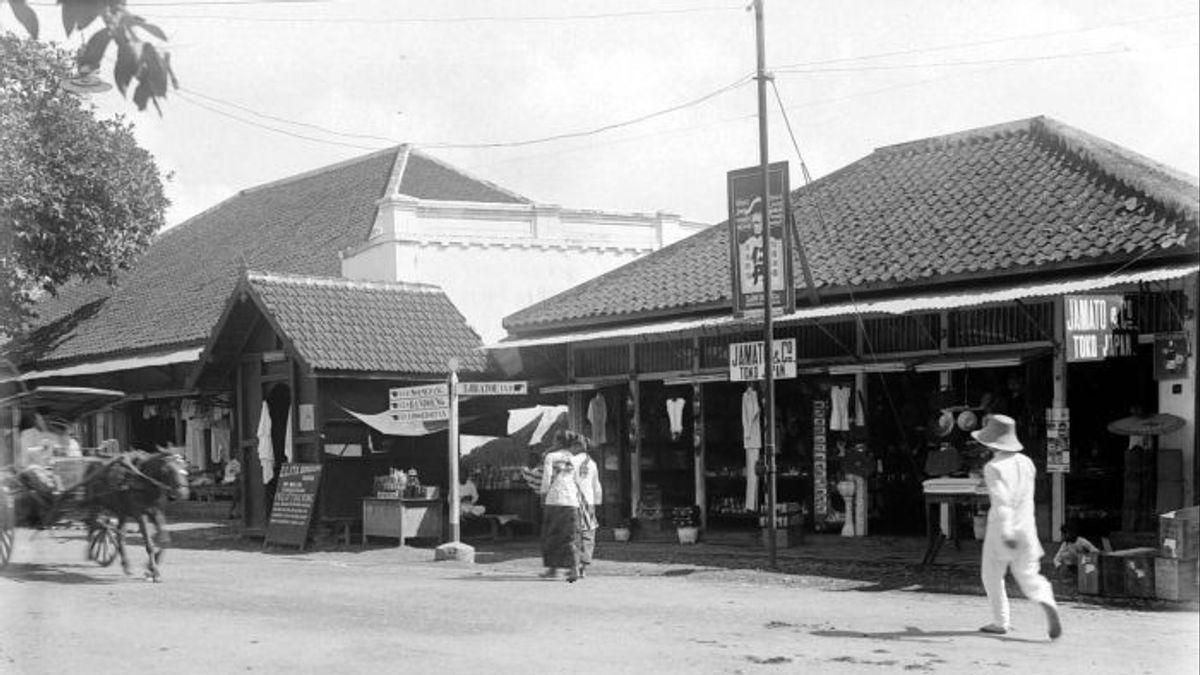


JAKARTA - The Dutch and Japanese colonizers have good relations. Japanese people even fall into the category of first class society in the archipelago the same as Europeans. This narrative made the Japanese population in the Dutch East Indies grow.
They run many businesses from plantations to trade. However, everything changed when the Japanese government had ambitions to become the ruler of Asia. Most Japanese traders in the Dutch East Indies were recruited into spies. Sometimes it also spreads political propanganda.
Andil The Dutch colonized the archipelago and could not be separated from his good relations with the Japanese. The Japanese helped the Dutch a lot in the face of war. This good relationship continued from the Dutch trading partnership era, the VOC, to the colonial government of the Dutch East Indies.
Japanese people are famous for being special. They even became first-class citizens or the equivalent of Europeans in the archipelago. The population of Japanese people in various parts of the Dutch East Indies increased when the Meiji Restoration surfaced in Japan in the 1868 era.
The Japanese government has become active in sending educated people to America and Europe. While the Asian region is part of the lower class Japanese people. The goal is to get a better life sometimes also as part of efforts to get rid of the poor in Japan.
The effort brings significant results. Many of the Japanese who are successful in the archipelago and their respective businesses. There are those who do business in the plantation sector. There are also those who do business trading.
Capital matters are not a problem. The Matahari Terbit State Government also invests. However, the most are those who are in the trade business. The trade business made many Japanese people open shops almost throughout the archipelago.
The Bumiputras call it Japanese shop names. The shop is able to compete with Chinese stores. They not only sell cheap goods, but quality. Their shop is the field of the natives spending. The seller is friendly. In fact, it is often a place to vent the concerns of the natives.
All because Japanese people never discriminate between their customers. Later this development was sniffed out by the Japanese government. The owner of the power sees the potential of traders as spies.
Japan's ambition to be the ruler of Asia is behind it. They also wanted to control the Dutch East Indies. This condition made the Japanese military recruit many traders into spies. They are also charged with the task of doing political propaganda - vilifying the image of the Dutch.
SEE ALSO:
-
 | MEMORI
Kontroversi Wakil Rakyat: Rencana Ngawur Pengadaan Televisi dengan Anggaran Rp1,5 Miliar
11 Oktober 2025, 07:15


We know Japanese people as traders who open their shops to remote areas. Some are named Toko Saerah (meaning Sae in Javanese is good andrah means cheap) and there is also the name Chiyoda Shop which reminds us of the bun (conde) mode that was once popular before the first war used in fantastic Priangan mojangs.
And Japanese traders who own this shop every Sunday close shop and wander coolly are now recreation. However, their recreation is not just recreation for entertainment, more than that they make notes that are important for their military interests," wrote Dharmasena magazine report entitled The Air Force of Japan Masters the Ocean (1988).
The presence of Japanese shops brings blessings to the Land of the Rising Sun. They easily recruit traders to be spies. Some of them are intelligence that deliberately acts as traders. They are preparing to be Japanese eyes and ears.
The role was done well. Japanese traders are known to be friendly and make a little profit. A thing that makes the natives feel comfortable. Japanese traders also began to play the role of their propaganda. They expressed sensitivity to the fate of the natives.
The occupation of the Dutch was considered outrageous. The sympaths made the way of espionage smooth. Information for information is easily obtained. Traders are also spying on the strengths of the Dutch colonialists.
The results of the observations were immediately divided among the military. As a result, the Dutch colonialists were able to be paralyzed with measurability in 1942. The Dutch ran back and forth. However, none of the natives cared. The Bumiputras actually had time to consider Japan as a savior.
The public's own reactions were excited. Many did not expect that Japanese traders where they subscribed to the Dutch were intelligence. They used ordinary clothes like traders, after Japan controlled the archipelago they were then in military clothing.
Hoegeng Imam Santoso did not expect Japanese traders to be part of an intelligence action. The figure who later became the 5th Indonesian National Police Chief was then amazed. A narrative proving that the Japanese espionage mission was successful.
I think Pekalongan people generally know Kagiyama as a Japanese trader who knows the art of dealing with buyers and potential buyers! He is a unique and special example for that. And inconceivably others from a mere trader. After all, who knows Kagiyama in his shop must have finally been shocked by himself when the Japanese military entered Indonesia."
Kagiyama which is actually not a merchant: it turns out that he is a Keigun major or Japanese Imperial Navy major assigned to Pekalongan and disguised as a grocery trader! He is as before, back to being a foreigner in the eyes of people who know him, but he remains in a position that must be respected! Kagiyama in my eyes is very mysterious. "explained Hoegeng Imam Santoso as written by Ramadhan KH and Qurar Yusra in the book Hoegeng: Police Idaman and Reality (1993).
The English, Chinese, Japanese, Arabic, and French versions are automatically generated by the AI. So there may still be inaccuracies in translating, please always see Indonesian as our main language. (system supported by DigitalSiber.id)
Most Popular Tags
#Prabowo Subianto #donald trump #2026 World Cup #Febrie Adriansyah #8791Popular


