

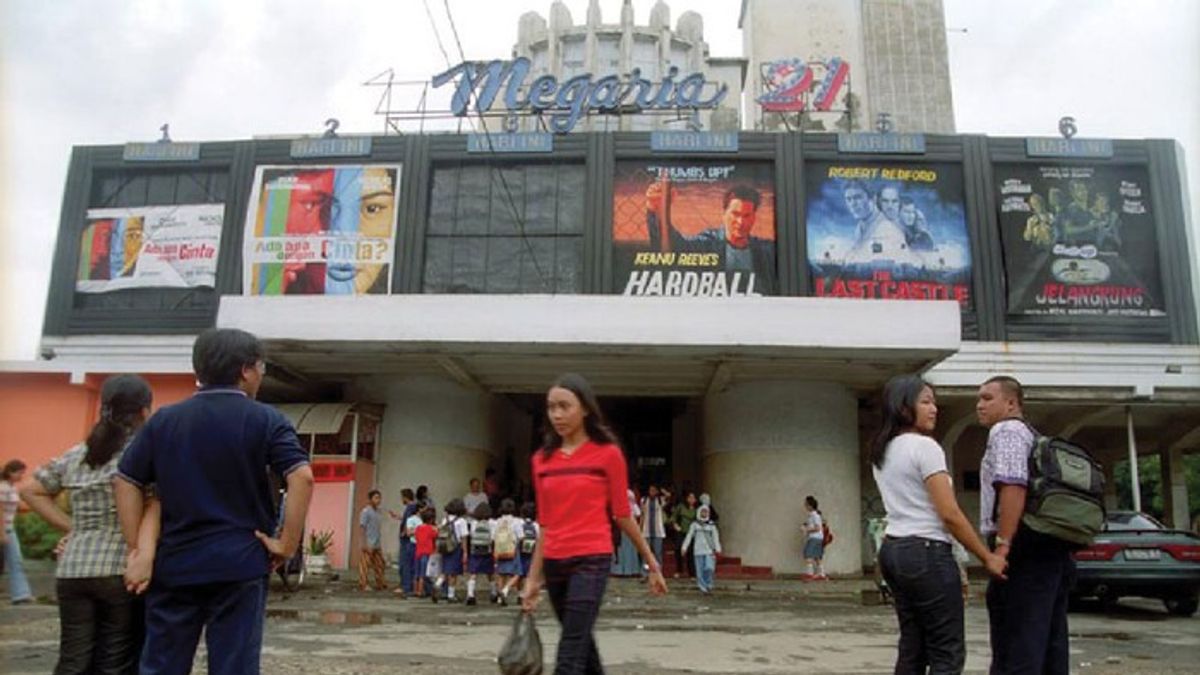


The struggle of filmmakers in national films to seize the domestic market is not easy. They have to struggle to compete with the screening of foreign films in various Indonesian cinemas. The risk of losing competitiveness is certainly large. The impact is able to make the national film industry out of business.
Fauzi Bowo (Foke) does not want that to happen. The government must step in to help. The Governor of DKI Jakarta is planning to exempt national film entertainment taxes. He wants Jakarta to have a major contribution to advancing the national film industry.
Jakarta is an important city in the development of the national film industry. Jakarta's status as the center of the economy, politics, creative industry, and entertainment is behind it. This narrative makes domestic and foreign film people busy marketing films in the capital city.
The success of screening films in the capital city is often a sign of success elsewhere. Ali Sadikin once looked at this picture. The governor of the 1966-1977 era saw Jakarta as an international city. He considers the DKI Jakarta government to need to fully support the Indonesian film industry.
Ali also provides ample space for national cinema artists and filmmakers to grow. He also often interferes when censorship agencies censor too many important scenes. Something that makes filmmakers lose money.
He considered the loss to have a domino effect. So that cinema entrepreneurs lose money. This means that the government has also lost the entertainment tax from films. The spirit of advancing the national film industry was also carried out by Foke in 2012.
The Governor of DKI Jakarta does believe that the entertainment tax is an important instrument for development in Jakarta. However, he has other views specifically on national film entertainment taxes. He tries to fully support the national flim industry which is competing with films from abroad.
He tried to waive some of the entertainment taxes for national films. At that time the government took a 10 percent entertainment tax from each entrance ticket to the cinema.
SEE ALSO:


This value was then distributed to return the government to the owner of the flim as much as 75 percent, while the government only got 25 percent. The instrument of the regulation is contained in DKI Jakarta Governor Regulation Number 115 of 2012.
Every national film performance in cinemas is given an exemption from the entertainment tax of 75 percent (seventy five percent) of each entry sign price, contains Article 2 Paragraph 1 in DKI Jakarta Governor Regulation Number 115 of 2012.
The steps that Foke took did bring losses. Government input is decreasing. However, Foke tried to look further. He did not want the national film industry to go out of business. He wants the national film industry to be able to compete from the onslaught of foreign films.
The tax cuts were made to help filmmakers continue to work. The industry is running. New job opportunities are open. Quality films then appeared. Foke initiation is also an inspiration to many of its other regions.
Several regions in the archipelago are starting to try to implement various other policies to help the national film industry. The Foke program also gets support from here and there. Foke is proof of a leader who doesn't just think about forcing tax withdrawals.
He led the Jakarta government to make sacrifices so that the national film industry was maintained. Foke policy is also the most inherent step in the memory of Indonesian film filmmakers. Take for example Rano Karno.
Rano, who in fact was a flim who later became Deputy Governor of DKI Jakarta from 2025, felt that the policy was right on target. Rano considers the previous Foke policy to be the great foundation of Jakarta's image as a city of cinema.
However, Rano couldn't stop thinking when Joko Widodo (Jokowi) became the leader of Jakarta. Jokowi actually changed the tax exemption, which started at 75 percent to only 25 percent.
"Friends, I say that the seeds here are the forerunners of the city of cinema that already exists, namely the side of the Jakarta government towards film being born in 2012. The Governor of Foke issued Governor Regulation Number 115 of 2012 which contained an exemption from the entertainment tax of 75 percent. So, the film has become a concern, do you agree? But Pak Jokowi's era was lowered to 50 percent. I don't know yet, I haven't learned why Pak Foke 75 percent, Jokowi's era fell 50 percent. . "
"This means that the revenue from the spectacle tax is returned to the producers, for what? Building a film industry in Indonesia. Then what strategic support? I said the mandate of the law and the cooperation of strategies between the DKI Provincial Government and the Ministry of Creative Economy to harmonize the national film economic development program with initiatives at the provincial level," said Rano as quoted on the detik.com page, June 15, 2025.
The English, Chinese, Japanese, Arabic, and French versions are automatically generated by the AI. So there may still be inaccuracies in translating, please always see Indonesian as our main language. (system supported by DigitalSiber.id)
Most Popular Tags
#Prabowo Subianto #donald trump #firearm #8791 #giias 2026Popular


