

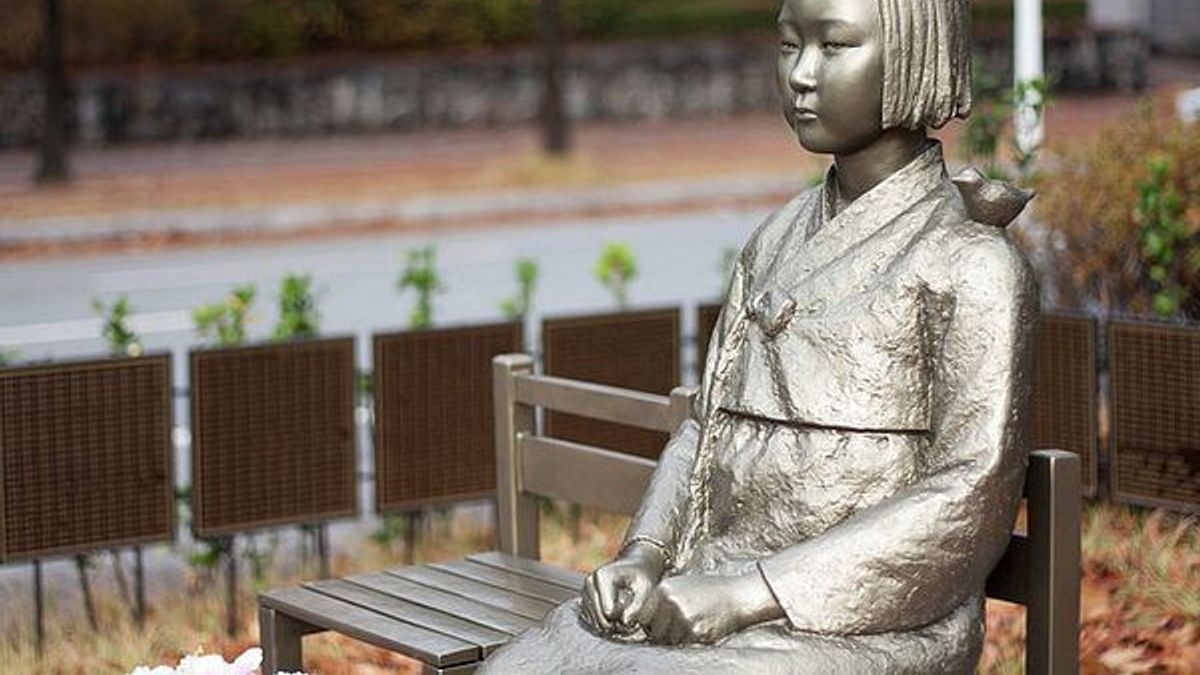


JAKARTA Memories of today, eight years ago, January 13, 2017, South Korean Foreign Minister (South Korea), Yun Byung Se regretted the placement of a statue of a comfort woman in front of a Japanese consulate office in Busan. The placement is considered to damage good relations between the two countries.
Previously, Japan had a bad history with South Korea. Japan, which acted as the invaders, forced South Korean women to become sex slaves, a woman who entertained Japanese soldiers. This condition carries a very deep wound for the people of South Korea.
Japan once emerged as a new force in Asia. This condition made Japan confident that their presence could be a savior from many Asian countries. They began to carry out missions to control many regions.
The action began by expelling foreign invaders. Then replace it with a temporary government. Locals are asked to support Japan's agenda in the Pacific War. Take South Korea for example.
South Korea was used by Japan in many ways in the 1930s. Japan placed many troops for war in South Korea. This condition made many South Korean women taken to satisfy the struggle of Japanese soldiers.
The women were taken to a military merchant. They were also forced to serve dozens of soldiers per day. The cruelty lasted a long time. However, Japan's defeat in 1945 changed everything. The women were later released.
The relationship between South Korea and Japan has become so bad. South Korea will not want to cooperate with Japan in the modern era. Even though the two of them reconciled too. The war was a long time ago. Colonialization is the same way.
The Japanese side also agreed to provide compensation to victims in 2015. However, the move still received criticism. Japan's attitude made South Korean women a sex slave. Activists also built a statue of a comfort woman in front of the Japanese consulate in Busan, South Korea in 2016.
In December 2016, activists installed a female entertainer gold statue in front of the Japanese Consulate in Busan. The local government initially moved the statue on the grounds that there was no permit. After public protests, local officials allowed the statue to be installed.
The mayor also held a press conference apologizing for the transfer. Japan protested and said the move violated the 2015 deal by withdrawing its ambassador from Seoul and its consultant from Busan, "said Abdul Manan in his article in Tempo magazine entitled Patung Emas in Busan (2018).
SEE ALSO:
-
 | MEMORI
Makan Gratis Ala Mbak Tutut: Program Sinterklas Bantu Korban PHK Era Orba
11 Januari 2025, 16:30




The presence of the statue made Japan furious. They felt South Korea did not respect the commitment to good relations in 2015. Japan then withdrew the consulate general in Busan and its ambassador in South Korea. The action was considered a step of protest for the presence of the statue.
Japan's action also received a response from South Korean Foreign Minister, Yun Byung Se. Yun also regretted the placement of a picture of a comfort woman in front of a Japanese consultant in Busan. He considered the placement inappropriate on January 13, 2017.
Yun revealed that he had no problem with the presence of monuments or statues related to female victims who were forced to become comfort women. The problem is not to put the statue in front of the Japanese consulate yard in Busan.
"The issue of the comfort woman statue in Busan is very unfortunate. The government is not against the presence of the statue, but I think we need to have the wisdom on the location issue (the place of the statue)," Yun said as quoted by the Sindonews page, January 13, 2017.
The English, Chinese, Japanese, Arabic, and French versions are automatically generated by the AI. So there may still be inaccuracies in translating, please always see Indonesian as our main language. (system supported by DigitalSiber.id)


