
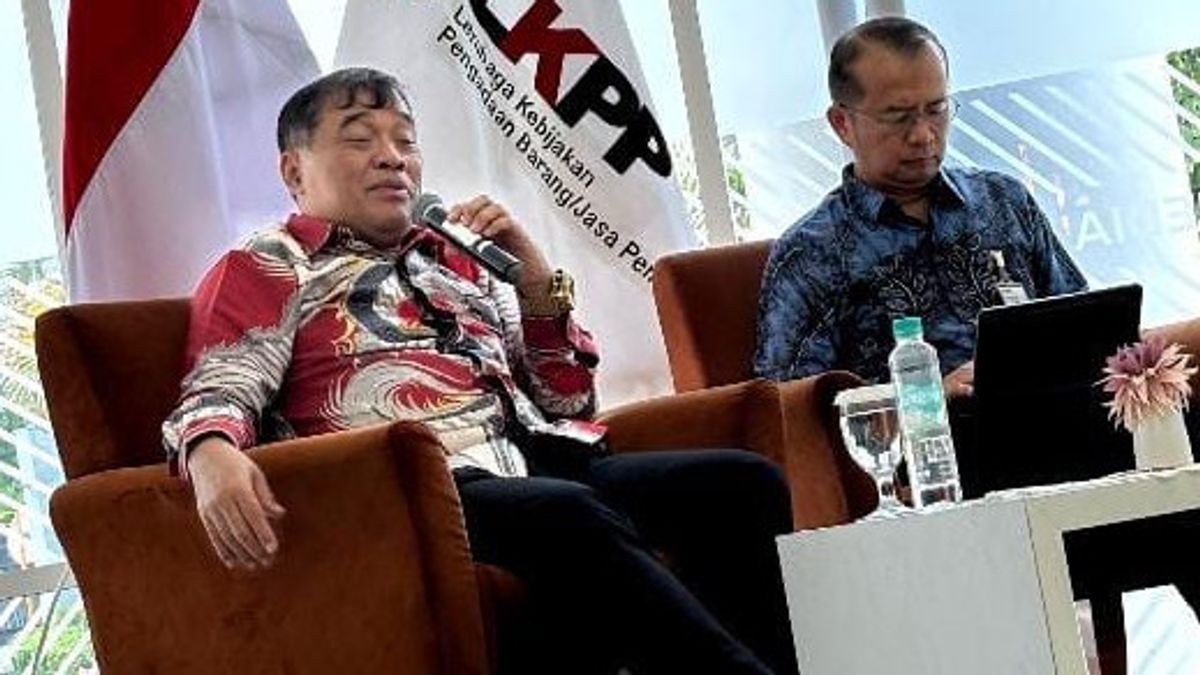


JAKARTA - The Government Procurement Policy Agency (LKPP) continues to strengthen the role of the Electronic Catalog as an instrument of strategy in encouraging transparent, accountable, and efficient procurement of government goods/services.
The Electronic Catalog is an important part of the national digital procurement transformation that allows the government's procurement process to be more open and measurable.
Based on the LKPP Regulation Number 11 of 2018, the Electronic Catalog is an information system that contains various information related to goods/services, ranging from product lists, technical specifications, Domestic Component Levels (TKDN), Domestic Products (PDN), SNI-standard products, green industrial products, country of origin, to prices and provider profiles. With this coverage, the Electronic Catalog is not merely a price list, but a dynamic digital market ecosystem.
Deputy for Legal and Settlement of the LKPP, Setya Budi Arijanta, emphasized that the prices listed in the Electronic Catalog are the maximum bid prices (ceilings). In practice, the e-purchasing process guarantees negotiations between the buyer and provider agencies to obtain the best value.
"This negotiation ensures a crucial stage for the efficiency of budget use, especially in procurement with large volumes," said Setya, in Jakarta, Tuesday (7/4/2026).
Setya emphasized the importance of understanding the Electronic Catalog in its entirety. According to him, the Electronic Catalog is often misunderstood as if it were the procurement method closest to potential deviations, although in principle the risk is not inherent in the system, but in the integrity of procurement actors.
"The risk of deviation is not inherent in the system, but in the integrity of procurement actors. The Electronic Catalog is designed to strengthen transparency and accountability," said Setya.
He added that negotiations must be carried out if a mini competition is not carried out. Even after the mini competition, the institution can still carry out further negotiations to get the best price according to needs.
LKPP also, he continued, did not set a single price rigidly in order to maintain a healthy business competition climate. The negotiation feature in the Electronic Catalog provides room for suppliers to offer prices competitively. On the other hand, procurement without negotiation has the potential to create competition and trigger unreasonable prices.
Setya also reminded that negotiating practices outside the system are one of the loopholes for irregularities that are often found in the hand-catching operation (OTT). Therefore, the entire negotiation process must be carried out transparently in the Electronic Catalog system.
In this system, he explained, the provider is responsible for the display of products which includes the initial price as well as the fulfillment of the specifications and quality of the products offered. LKPP acts as a regulator as well as a platform manager, conducting administrative verification and establishing the rules of the game.
Meanwhile, Setya explained, the Ministry/Agency/Regional Government (K/L/PD) as the user of the budget is responsible for carrying out technical clarifications and price negotiations before the transaction.
Furthermore, the determination of reference prices in e-purchasing is not carried out by the LKPP, but by the Commitment Maker Officer (PPK) in each agency based on market information.
"The PPK that compiles price references according to the government procurement mechanism, taking into account market conditions," explained Setya.
To maintain price fairness, LKPP also formed a price patrol team tasked with unifying products in the Electronic Catalog. Products with unreasonable prices can be removed from the system. In the future, this supervision will be strengthened by the use of artificial intelligence (AI) technology to increase effectiveness and minimize potential fraud.
"Well, we are now preparing to use the AI system. If the manual patrol is prone to abuse of authority," said Setya.
He also invited the general public and all parties to monitor so that there is no deviation and abuse of
Through the Electronic Catalog system, added Setya, LKPP ensures that every procurement stage can be traced digitally and accounted for.
"This system not only facilitates transactions, but also becomes an important foundation in building transparent, efficient, and ethical government procurement governance," concluded Setya.
The English, Chinese, Japanese, Arabic, and French versions are automatically generated by the AI. So there may still be inaccuracies in translating, please always see Indonesian as our main language. (system supported by DigitalSiber.id)
Most Popular Tags
#Prabowo Subianto #donald trump #2026 World Cup #venezuela #konflik timur tengahPopular


