
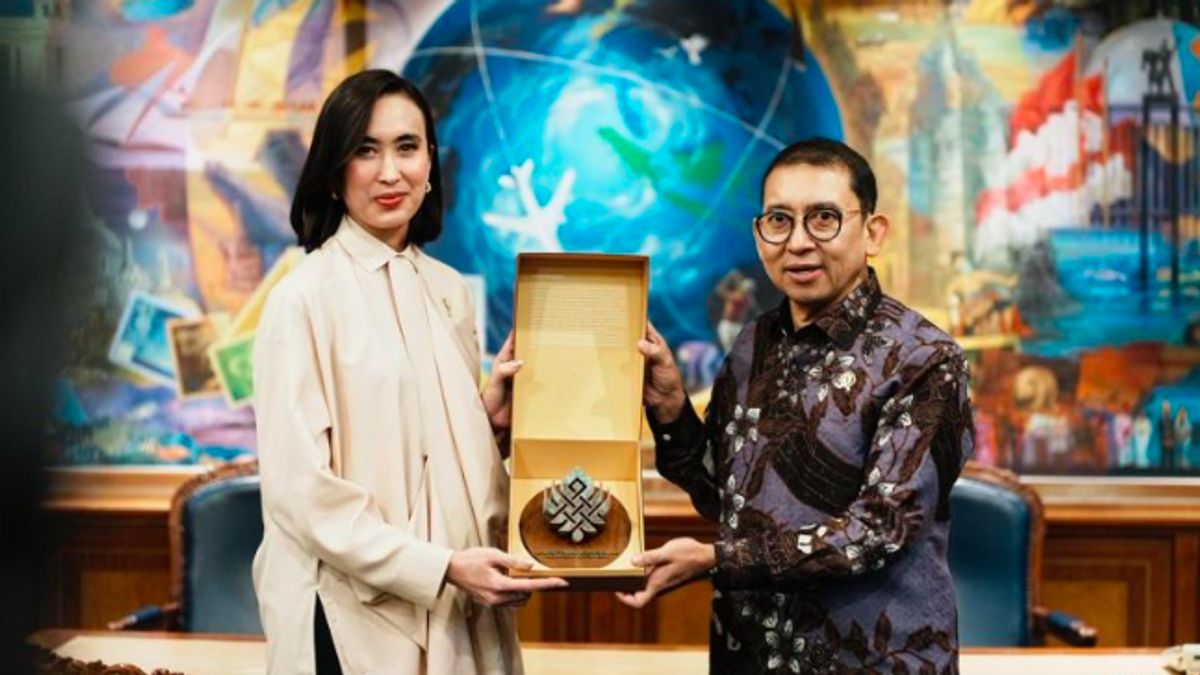


JAKARTA - Indonesia with its long history and diverse living traditions, is now pushing culture as the heart of national tourism development.
This step was emphasized through collaboration between the Ministry of Culture of the Republic of Indonesia and the Ministry of Tourism of the Republic of Indonesia in strengthening the synergy of the development of cultural-based tourist destinations.
Minister of Culture Fadli Zon conveyed the importance of coordinating the programs of the two ministries so that they have a real impact on the community and the growth of the national tourism sector.
"Culture and tourism have a very close relationship. This collaboration is the key to ensuring that our cultural potential really has an impact on increasing tourist visits," said Minister of Culture Fadli in a press statement received in Jakarta, Wednesday.
In the meeting, Fadli Zon and Minister of Tourism Widiyanti Putri Wardhana discussed the integration of data from the National Cultural Heritage and Intangible Cultural Heritage (WBTB), strengthening the cultural event ecosystem, drawing up travel patterns, optimizing digital promotion, to collaboration in cultural diplomacy at the international level.
This effort is positioned as a concrete step to build a comprehensive cultural-based tourism ecosystem ranging from the protection and strengthening of assets, the improvement of the quality of event management, the integration of cross-ministerial data, to promotion on the global stage.
Currently, the Ministry of Culture manages 313 National Cultural Heritage and 2,727 Intangible Cultural Heritage, with an additional 514 new WBTB throughout 2025. This large potential is considered to have not been fully maximized as a tourist attraction for culture, history, religion, and cuisine. Therefore, the strategy of packaging (packaging) and strengthening the narrative is the key to ensuring that cultural wealth is not only stored as an archive, but is present as a living experience.
For the management of priority sites, a number of areas such as Borobudur Temple, Prambanan Temple, Ratu Boko Complex, and Plaosan Temple have been in a cooperation scheme with InJourney.
The government has also strengthened the Percandian Dieng and Percandian Muara Jambi areas, including the construction of Kedaton and Koto Mahligai temples and plans to inaugurate the Sriwijaya Dharmakirti Museum next year.
Regarding Borobudur, Menbud Fadli assessed that the capacity of visits could still be optimized. Currently, the quota for visitors who can climb to the main structure is around 4,000 people per day.
"The installation of the chattra is expected to make Borobudur a living heritage that has spiritual meaning as well as global appeal. We hope this will increase domestic and foreign tourist visits," he said.
In addition, attention is also directed to historical and archaeological destinations such as Banda Neira with the Spice Route narrative, colonial forts in Maluku, to the Leang-Leang area in South Sulawesi and Leang Metanduno in Muna which is around 67,800 years old and has been published in international scientific journals.
The big narrative about civilization and history is considered very potential to be arranged in a pattern of integrated tourist travel, so that tourists not only visit, but also understand the context and meaning behind each site.
In the field of film and fine arts, the Ministry of Culture also continues to encourage the participation of Indonesian filmmakers in various international festivals as well as hosting the Jogja-NETPAC Asian Film Festival (JAFF). This year, Indonesia is scheduled to participate in the Venice Biennale by sending 14 artists as part of cultural diplomacy as well as tourism promotion.
Responding to the synergy, Minister of Tourism Widiyanti Putri Wardhana emphasized her ministry's focus on strengthening destination promotion and infrastructure, including through digital platforms.
"We need data support and storytelling from the Ministry of Culture so that museums and cultural heritage can appear stronger on our digital platforms. Young people are looking for information online, and we must make the most of this," said Minister of Tourism Widiyanti.
The target of increasing visits by 14 percent with a target of 17 million foreign tourists is considered to require an experience-based tourism promotion strategy. The Kharisma Event Nusantara (KEN) program, which this year includes 145 events, is a space for integrating various cultural agendas to provide a wider economic impact.
The synergy of these two ministries is expected not only to increase the number of visits, but also to strengthen Indonesia's position as a center of world civilization and culture - where each destination is not only a place to take photos, but a space to meet history, identity, and the future.
The English, Chinese, Japanese, Arabic, and French versions are automatically generated by the AI. So there may still be inaccuracies in translating, please always see Indonesian as our main language. (system supported by DigitalSiber.id)
Most Popular Tags
#Prabowo Subianto #donald trump #Febrie Adriansyah #8791 #giias 2026Popular


