
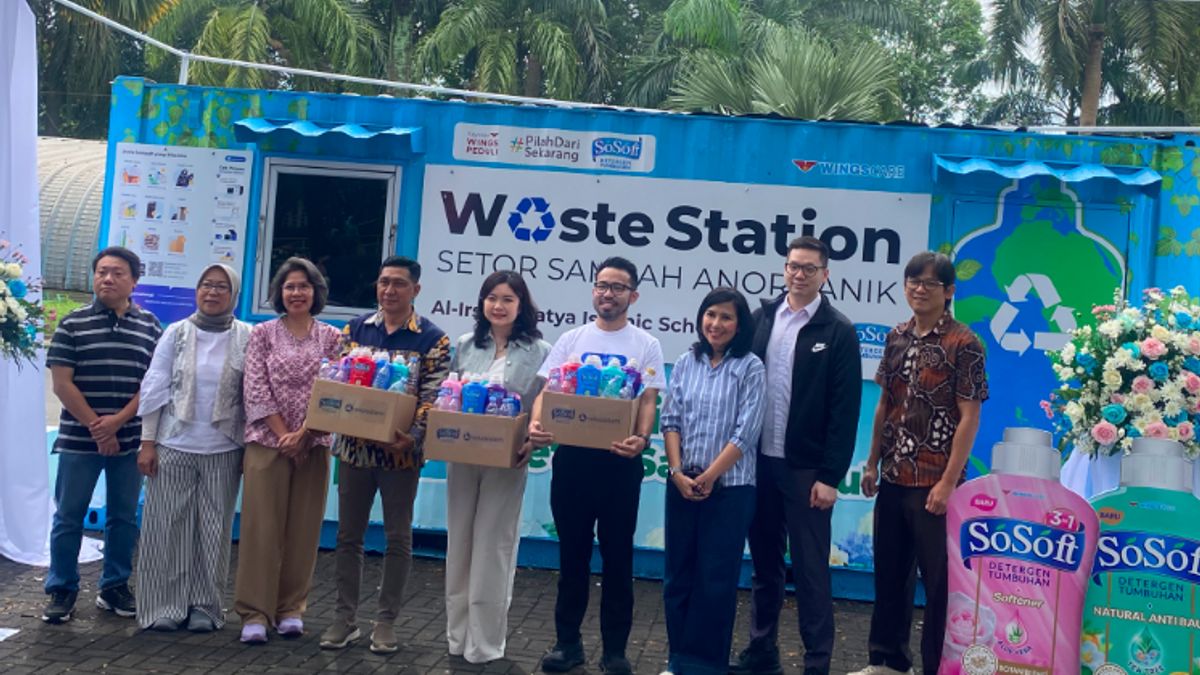


BANDUNG - The issue of waste in Indonesia is still a major challenge. Many inorganic waste such as plastic, paper, glass, and metal that actually have reuse value, but have not been properly sorted since the household.
This condition is exacerbated by the low awareness of the public regarding the types of waste that can be recycled and how the processing process is carried out.
Through the #AlamiSoSoftUntukBumi campaign, SoSoft from WINGS Group Indonesia seeks to encourage behavioral changes in managing waste. This initiative not only highlights the use of products made from active plant ingredients, but also emphasizes the importance of sorting and recycling post-consumption packaging.
The issue of waste today is not just about volume, but also about the reuse of materials that still have economic value. Many household plastic packaging such as HDPE bottles, multilayer sachets, cardboard, to cooking oil can actually be reprocessed into new materials or alternative energy sources.
"If we look at the phenomenon that is happening, there is a lot of waste that actually still has a use value, but it has not been known by consumers," said Anastasia Pamela, Head of Fabric Care Category WINGS Group Indonesia when met at the Waste Station of the Islamic School Al-Irsyad Satya, Cipeundeuy, Padalarang, West Bandung on Friday, February 13, 2026.
"This is what we are concerned about in presenting education and facilities so that the community can more easily participate in recycling," he continued.
According to him, changing habits must start with a simple step at home: sorting garbage by type before throwing it away.
As part of the implementation of the campaign, SoSoft collaborated with Rekosistem to present the Waste Station in the Kota Baru Parahyangan area, specifically at the Al-Irsyad Satya School complex, Padalarang.
This Waste Station accepts various types of inorganic waste, not limited to certain product packaging. Other packaging plastics, cardboard, paper, glass, metal, oil sludge, to electronic waste can be deposited according to the categories that have been determined. Through the Recosystem application, the public can find out what types of waste are accepted and how to sort them properly.
"This facility is in line with our vision of making the Parahyangan New City area a beautiful and sustainable environment. With the easy-to-access waste station, we hope that residents will get used to sorting garbage from home," said Zaenudin, Assistant Manager of Sanitation and Transportation of Parahyangan New City.
This collaboration is also supported by the presence of a processing hub located around the area. The collected waste will be weighed, digitally tracked, then processed before being distributed to the beneficiary partners to be processed into new materials.
In practice, each type of waste is processed according to its material characteristics. For example, HDPE bottles will be sorted and processed into plastic pellets for industrial raw materials.
Furthermore, multilayer sachet packaging can be processed into RDF (Refuse Derived Fuel) as an alternative energy source in the waste-to-energy scheme. Cardboard and paper are processed into pulp to be recycled into new paper products.
"We see that an area must have a clear vision of the intestine before building a waste management ecosystem. In the New City of Parahyangan, the vision already exists and is running. From there, we can build an integrated system for collecting, tracking, and distributing food results." explained Ernest Layman, CEO & Co-Founder of Rekosistem.
Currently, the Waste Station Recosystem network has spread to around 40 points in various cities, with a management capacity of almost 100 tons of garbage per month from various collaboration areas.
To increase community participation, the waste collection system interacts with a digital point mechanism (Rekopoin). Each deposit of certain packaging will get additional points, which can be converted into digital balance or exchanged for various forms of benefits through the application.
However, this incentive aspect is placed as an initial trigger for behavioral changes. The long-term goal remains on the formation of habits of sorting waste independently and consistently.
The problem of waste in Indonesia is still at the stage of increasing public awareness and participation. Cross-sector collaboration between companies, area managers, and environmental technology startups is one of the approach models that can be replicated in other regions.
Initiatives such as the Waste Station in Kota Baru Parahyangan show that when facilities are available and the system is clear, people tend to be more easily moved to get involved.
Continuous education, transparency of the recycling process, and ease of access are key in building a culture of responsible waste management.
In the end, waste management is not only about reducing the burden on the environment, but also about creating a circular economic cycle, where materials do not stop being waste, but rather return to being a resource.
The English, Chinese, Japanese, Arabic, and French versions are automatically generated by the AI. So there may still be inaccuracies in translating, please always see Indonesian as our main language. (system supported by DigitalSiber.id)


