
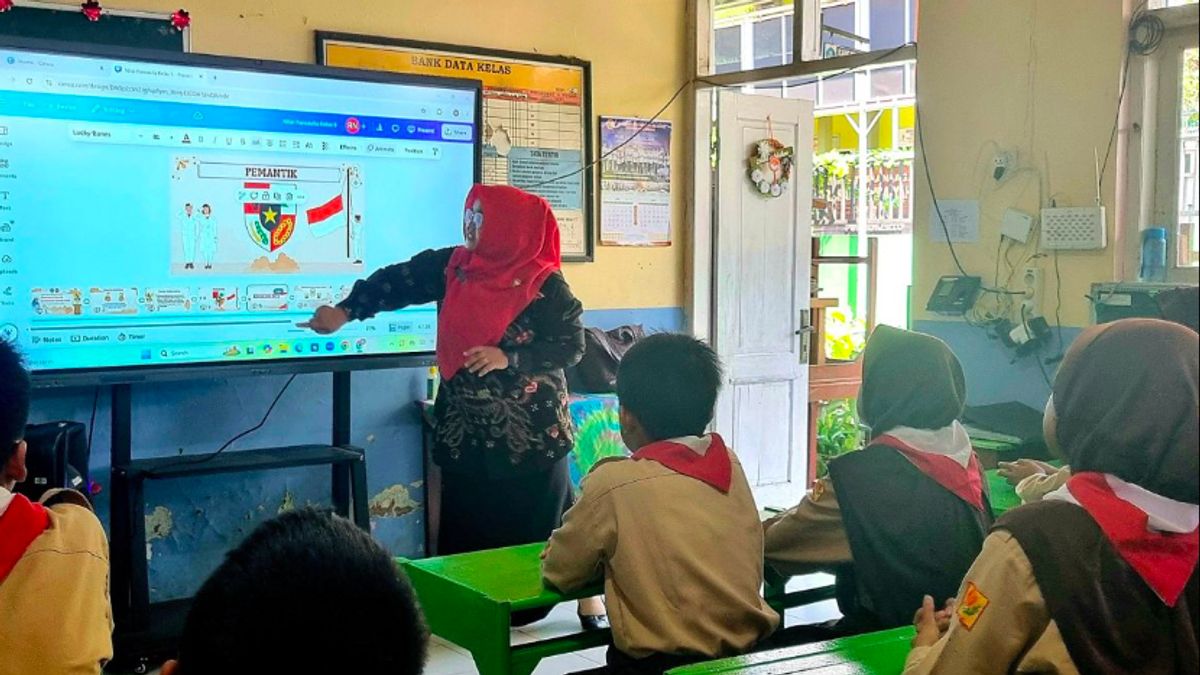


JAKARTA - Improving the quality of education in Indonesia is still an important agenda, especially in the midst of the challenge of the quality gap between learning between regions.
For the younger generation, the quality of education is not only determined by the curriculum, but also by the extent to which teachers get support to continue to develop and adapt to the learning needs of students.
Therefore, strengthening the education system at the regional level is the key so that the changes that occur are not temporary. In this case, the Bakti Barito Foundation together with STiR Education continues to strengthen learning in Indonesia by entering Phase 2 of the program implementation through the signing of a Memorandum of Understanding (MoU) with the National Agency for the Guarantee of Education Quality (BBPMP), an institution under the Ministry of Basic and Secondary Education.
This collaboration marks an effort to expand the impact of the program through closer integration with the national education quality assurance system.
After more than four years of learning, adapting, and implementing processes in various regions, Phase 2 is designed to ensure that the approach that has been implemented can be sustainable and reach more areas.
BBPMP acts as a main partner in the implementation in East Java, while program assistance also continues in West Java, East Java, and East Nusa Tenggara. This approach places the local government as the main actor in the management and development of the quality of education.
The Executive Director of the Bakti Pendidikan Unggul Foundation - STiR Indonesia Program, Yoni Nurdiansyah, explained that the main focus of this cooperation is to strengthen the motivation and capacity of educators as the foundation for long-term change.
According to him, the experience over the past four years shows that the improvement in student learning outcomes is closely related to consistent support for teachers.
"This second phase allows us to work more closely with government partners to drive comprehensive system improvements, so that teachers have the space and support they need so that every child can learn and develop optimally," he said.
The approach developed by STiR Education focuses on behavioral change and strengthening the intrinsic motivation of teachers, principals, and supervisors. Instead of relying on one-time training, this approach encourages continuous learning through a cycle of learning improvement that involves reflection, mentoring, and the use of data as a basis for improving teaching practices. This model aims to build a culture of learning in the school environment and the education service.
The impact evaluation independently conducted by Deloitte in 2024, and academically reviewed by Northeastern University, shows that districts and cities that implement this approach record higher literacy achievement compared to the comparison area.
In addition, improvements can also be seen in the aspect of social-emotional learning of students as well as the level of autonomy of teachers in managing the learning process.
In terms of strengthening the system, the partnership with BBPMP is expected to accelerate the process of institutionalizing the approach at the regional level. BBPMP takes a greater role in coordinating and managing programs in East Java, so that good practices that develop in schools can be directly connected to the framework for ensuring the quality of education.
Director of the Bakti Barito Foundation, Dian A. Purbasari, assessed that the sustainability of quality education depends very much on the strength of the system and the empowerment of educators.
"Improving the quality of education cannot be separated from the role of teachers and consistent system support. Through this partnership, we hope that the local government will be stronger in leading efforts to improve the quality of learning sustainably," he said.
This collaboration reflects a joint effort to build a more resilient education system, where teachers feel supported and learners gain meaningful learning experiences.
The English, Chinese, Japanese, Arabic, and French versions are automatically generated by the AI. So there may still be inaccuracies in translating, please always see Indonesian as our main language. (system supported by DigitalSiber.id)


