
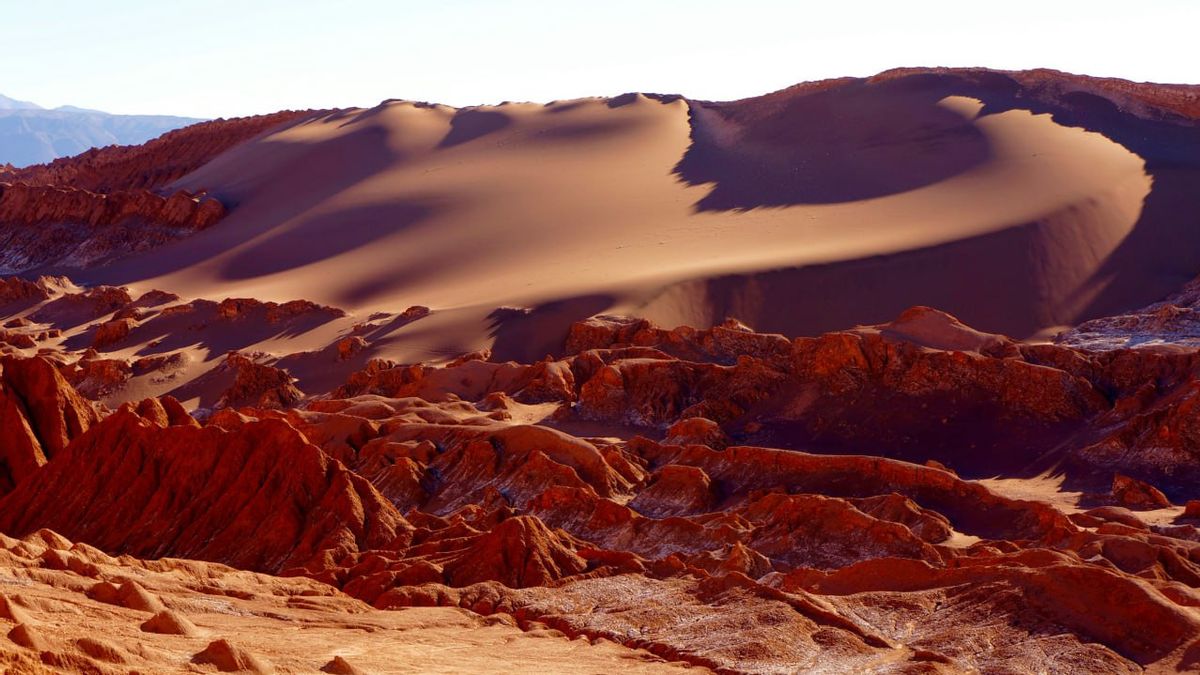


YOGYAKARTA - Have you ever imagined what it would be like to stand in the driest place on Earth, where some areas are never touched by rain for hundreds of years? A place where the land is so dry that it barely gives room for life. That is the Atacama Desert.
If you are familiar with the image of the planet Mars (dry, dusty, and reddish), then you already have an idea about the Atacama Desert. However, behind the title as the driest place on Earth, there is an unexpected beauty. Curious? Here's the discussion.
Atacama Desert: The Driest Place on Earth, Its Life, and BeautyThe Atacama Desert is located in the northern part of Chile, South America. Reported by NDTV, this desert has a steep terrain, consisting of volcanic peaks, salt plains, canyons, colorful sand dunes, and rocky plains.
The Atacama Desert stretches over 4,800 square kilometers and holds almost no trace of water. The Andes Mountains and the Coastal Mountains surround it, making it difficult for rain clouds to enter this region. As a result, Atacama has experienced extreme dry conditions for about 10 to 15 million years.
Some parts of the Atacama Desert have never been rained on for more than 400 years. Records show no rain at all between 1570 and 1971 in certain areas. In other areas, rainfall ranges from only 0.01 to 0.04 inches per year according to NASA data.
This condition makes Atacama the focus of scientific research in the world. Researchers study the soil to find out how little water is needed for life to survive. This study is important because it is used as an analogy to understand the possibility of life on Mars.
In a NASA report published in April 2022, it was stated that the soil in the core of the Atacama Desert is the most Mars-like on Earth. "The soil in the very dry core region of the Atacama seems to be the most lifeless and most Mars-like soil on Earth," a researcher said.
If you explore other deserts, you will still find cyanobacteria (green photosynthetic microorganisms) living on rocks or under rocks. But even cyanobacteria are not in the Atacama Desert.
Even so, the Atacama Desert is not completely dead. Certain regions still harbor an incredible life of adaptive micro-organisms. This fact adds to the scientific value of the extreme region.
According to a report by the Times of India, in 2018, scientists from Washington State University discovered unique bacteria in the Atacama Desert. These bacteria are able to survive in a dormant state for decades without water. When the monsoon comes and the ground becomes moist, the bacteria become active again and reproduce.
This discovery opens up new possibilities in astrobiology studies. If life can survive in the Atacama, scientists believe Mars may have similar opportunities.
The Atacama Desert in Chile is not only a place that scientists can visit. This desert is also often visited by tourists who want to experience an ecosystem like Mars on Earth.
If you are interested, you can camp in the Nevado Tres Cruces National Park, but you must bring a water bottle. Then, you can hike to the Santa Rosa and Negro Francisco lagoons. From there, you can see the Nevado Ojos del Salado volcano and its towering peaks.
Continue the journey until you arrive at San Pedro de Atacama, the green lungs of the desert, a small town on the banks of the Loa River surrounded by carob trees. Not far from there, Geyser El Tatio presents the largest field of geysers in South America. Behind the title of the driest place on earth, the Atacama Desert turns out to hold stunning panoramas that are a shame to miss.
In addition to discussing the Atacama Desert as the driest place on Earth, follow other interesting articles at VOI.ID. So as not to miss the latest news, follow and monitor our social media accounts!
The English, Chinese, Japanese, Arabic, and French versions are automatically generated by the AI. So there may still be inaccuracies in translating, please always see Indonesian as our main language. (system supported by DigitalSiber.id)


