
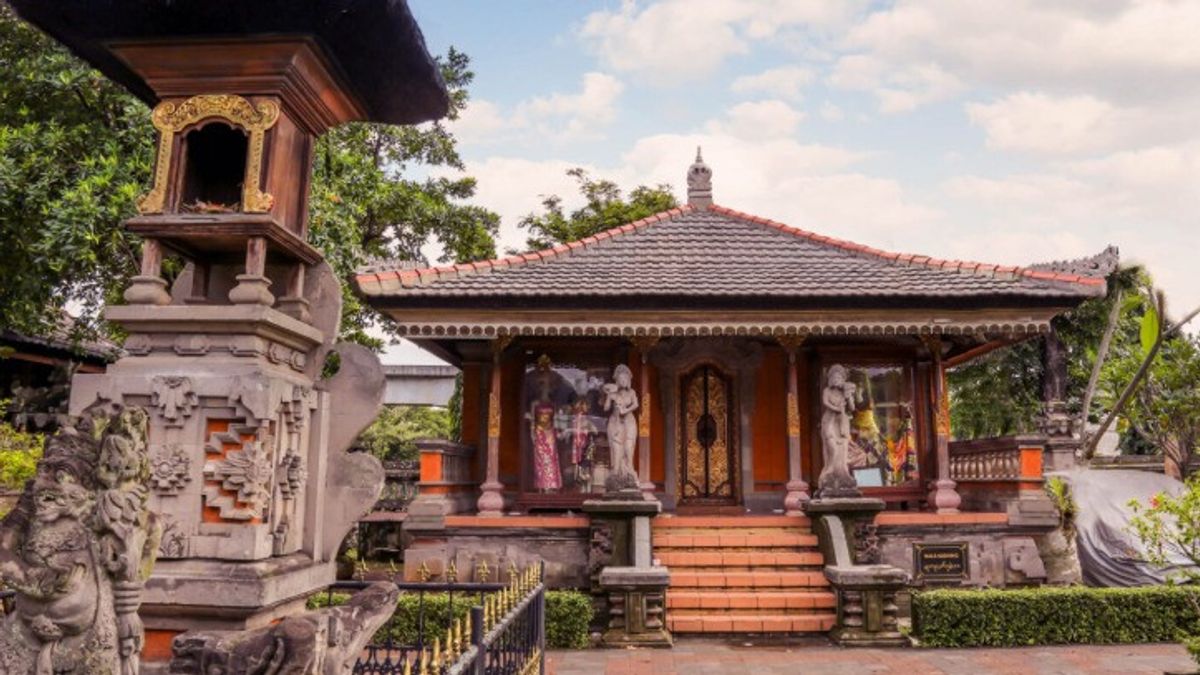


YOGYAKARTA - When you go on vacation to Bali, you will certainly be presented with beautiful natural scenery and also a variety of delicious culinary delights. In addition, you will also meet a unique Balinese traditional house.
For those of you who have visited Bali, you must have seen a local traditional house with offerings provided around it. Well, apart from being a characteristic of Balinese culture, there are also a number of philosophys contained in it.
According to Prof. Dr. Ir Putu Rumawan Salain as a lecturer at the Architecture Study Program of the Faculty of Engineering, Udayana University, Balinese traditional house has a philosophy called Tri Hita Karana. This philosophy is applied so that a house building has useful functions but still contains cultural values.
For information, Asta Kosala Kosali is the rule of establishing a house in Balinese society. In the regulation, it is explained how to build a house by determining the area and layout in the room.
SEE ALSO:
-
 | BERITA
Imigrasi Bali Deportasi Artis Porno Bonnie Blue Usai Disidang Tilang Pikap BangBus
11 Desember 2025, 13:59 -
 | BERITA
Hujan Ringan Guyur Banyak Wilayah Indonesia Hari Ini, Waspadai Petir di Sejumlah Kota
11 Desember 2025, 07:25

After understanding the aspects and philosophy in establishing Balinese traditional houses, here are some Balinese traditional houses along with their uniqueness and characteristics as reported by Antara.
Alling-aling is part of the Balinese traditional house that can be found on Pulau Seribu Pura. The Alling-aling house building is useful as a barrier between the outside and the angkul-angkul.
Allings have a meaning as a manifestation of positive energy and good energy for the harmony of the house. A distinctive feature of this traditional house is that there is a barrier wall in the form of a stone with a height of about 150 cm which is often called a manager.
In addition to being used as a barrier between the outside, Alling-aling traditional houses are generally used as barriers between angkul-angkul and places of worship. Allings are identical as the privacy of the owner of the house, because guests who come must enter through the left side and if they leave the house through the right side.
Bale Manten is one of the traditional Balinese houses which is generally intended for the heads of families or daughters who are not married. The purpose of developing this traditional house is as a form of family attention to girls so that their purity is maintained.
A distinctive feature of Bale Manten's traditional house is that it has a rectangular building located north of the main building. In addition, this traditional house has two rooms, namely the right bale and left bale.
The next list of traditional Bali houses is Angkul-angkul. If you are visiting the island of the Gods, you can find people's houses shaped like Bentar Temple and located in front of a house that functions as an entrance.
The characteristic feature of the Angkul-angkul traditional house is that it has a connecting roof made of dry grass. However, along with the times, now many people have replaced it with tiles and there are carvings on the walls.
Bale Sekapat is part of the Balinese traditional house which functions as a family relaxing place. The characteristic feature of this Balinese traditional house is that there are four poles that function as a buffer, and the roof is in the form of a saddle.
Bale Sekapat has his own philosophy, with the existence of this building it is hoped that a family will have a harmonious and closer relationship with each other.
Bale Dauh is a Balinese traditional house that functions to receive guests and also as a bed for teenage boys. Bale Dauh is located in the west of the main house with a lower floor height than Bale Manten.
The uniqueness of Bale Dauh is in the number of different poles between one house and another. In addition, there is a special name for the number of poles.
If a house has a pole of six, it is called a tonem, and if there are eight poles, it is called a pocket or antasari. Meanwhile, if there are nine pillars of the house, it is called Sangasari.
The Jineng Clump is a Balinese traditional house that functions as a place to live as well as a place to store or a rice barn. The characteristic feature of the Jineng Clumpu is that it has a stage building structure with roofs and walls on the outside covered with dry straw. Generally used as a grain barn after being dried in the sun.
Bale Gede is a Balinese traditional house that has the largest room in between other Balinese traditional houses. This traditional house is useful as a place to celebrate traditional ceremonies, either for family or the surrounding community.
Pura Keluarga yaitu rumah adat Bali yang sering digunakan oleh pemiliknya sebagai tempat ibadah. Keberadaan bangunan ini wajib dimiliki oleh semua masyarakat Bali, baik itu dalam ukuran kecil atau besar.
Pura Keluarga terletak di area timur laut rumah. Selain dijadikan sebagai tempat ibadah, Pura Keluarga juga disebut sebagai pamerajan atau singgah.
Pawarengan is a Balinese traditional house that functions to store and process food, or it can be called a kitchen. This traditional house is located in the south or northwest of the house.
The characteristic feature of Pawarengan is that the house is divided into two, the house is first used for cooking, while the second house is used to store food, kitchen utensils, and so on.
This Balinese traditional house is used to store staple foods, including rice, corn, vegetables, and so on. Because it is only used as a place to store staple food, the lumbung area is smaller than Bale and his house is also separated from the main building.
That's a review of the types of traditional Balinese houses. Hopefully useful. Visit VOI.id to get other interesting information.
The English, Chinese, Japanese, Arabic, and French versions are automatically generated by the AI. So there may still be inaccuracies in translating, please always see Indonesian as our main language. (system supported by DigitalSiber.id)


