


JAKARTA - Entering the world of lectures is one of the largest phases of transition in a teenager's life. In this period, they are not only faced with a new environment, but are also required to understand themselves, manage time, make decisions, and determine future directions.
In the midst of the change, the presence of parents as closest supporters still plays an important role even though the role is no longer as strict as during school.
Several things such as emotional, communication between family members, and understanding of the needs of children are the foundation for their adaptation process in the world of campus.
Clinical psychologist and UGM lecturer, Wirdatul Anisa, M.Psi., explained that parents have a big role in helping children optimize their potential when entering campus life.
According to him, support from the closest environment, especially family, is one of the sources of strength for students who are currently pursuing the new development stage.
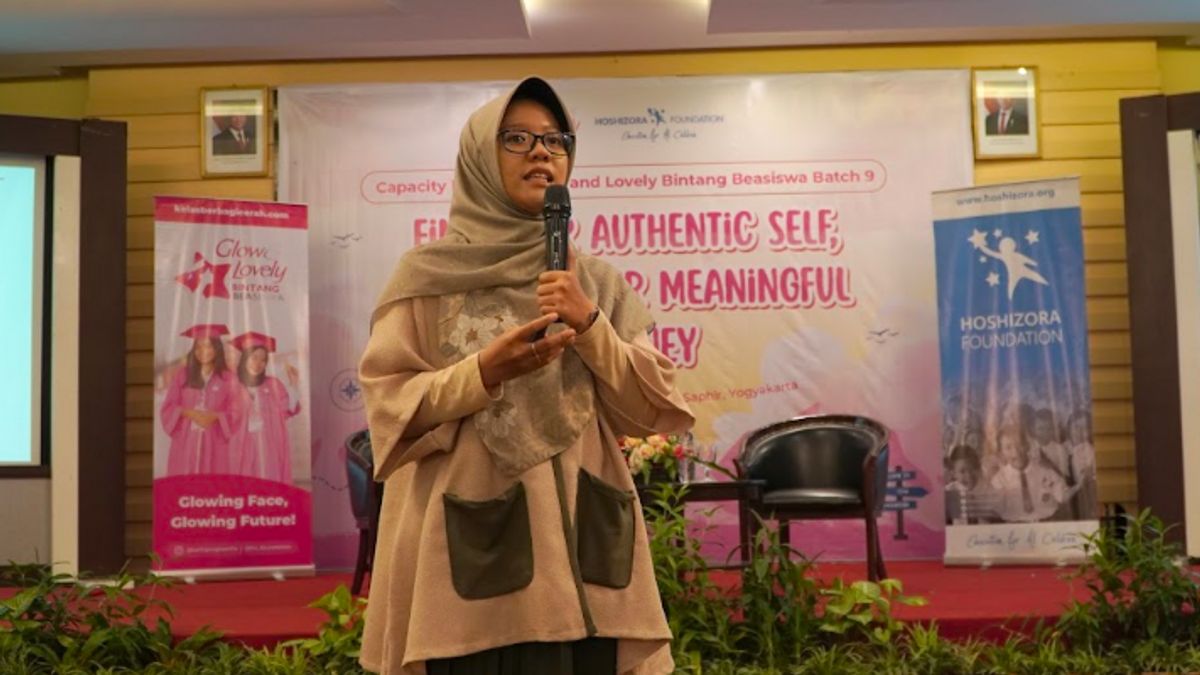
"If parents actually really have a very important role, yes, in terms of providing emotional support, social support, continuing to be financially. That also has a very big role," he explained in the capacity building session "Find Your Authentication Self, Navigate Your Meaningful Journey" which was held by Glow & Lovely in Yogyakarta, recently.
This support is not only given in general, but should be adjusted to the direction and needs of the child. Parents need to understand children's interests, goals, and capacities so that the assistance provided is relevant and does not lead to pressure.
However, on the other hand, Wirdatul emphasized that children also need to know what they need from the surrounding environment.
"They also actually need to know where this child has a direction, then what kind of support parents can provide. Well, on the other hand, children also need to know what kind of support they need from their environment," he added.
According to Wardatul, the process of understanding each other's needs is an important part of the journey of growing up. Children also need to map the need for support from various parties around them, both parents, friends, and lecturers because each party has a different role in shaping their academic and social experiences.
SEE ALSO:
-
 | INFO SEHAT
Sule Dirawat karena Sakit Tipes, Kenali Gejala, Penyebab hingga Cara Pencegahannya
12 September 2025, 18:25




That will also be the activity of friends to map, if you look at your parents, what kind of support is that, if you're friends, what if you're at the lecturer for example.
Student travel every year of college also has different challenges. In the first year, they generally face the adaptation process, including adapting to the new environment and academic expectations.
Entering the second and third years, challenges have changed to task management, time management, and priority arrangements. Meanwhile, in the final year, the focus of students is more focused on completing the final task.
"Indeed, parents have an important role to play in supporting friends to adapt. Because every year the challenges will be different. The first year the challenges are adaptation, adjusting expectations. The second year, the third year the challenges are more about task management, time management, priority management. Later the challenge of the fourth year is the final task," he explained.
Overall, the role of parents in the lecture phase is no longer controlling, but is a place to return for children when they need support.
Assistance in favor of children's needs, open communication, and empathy for academic expenses can be the key so that students are able to develop more independently and confidently.
The English, Chinese, Japanese, Arabic, and French versions are automatically generated by the AI. So there may still be inaccuracies in translating, please always see Indonesian as our main language. (system supported by DigitalSiber.id)
Most Popular Tags
#Prabowo Subianto #donald trump #firearm #8791 #giias 2026Popular


