
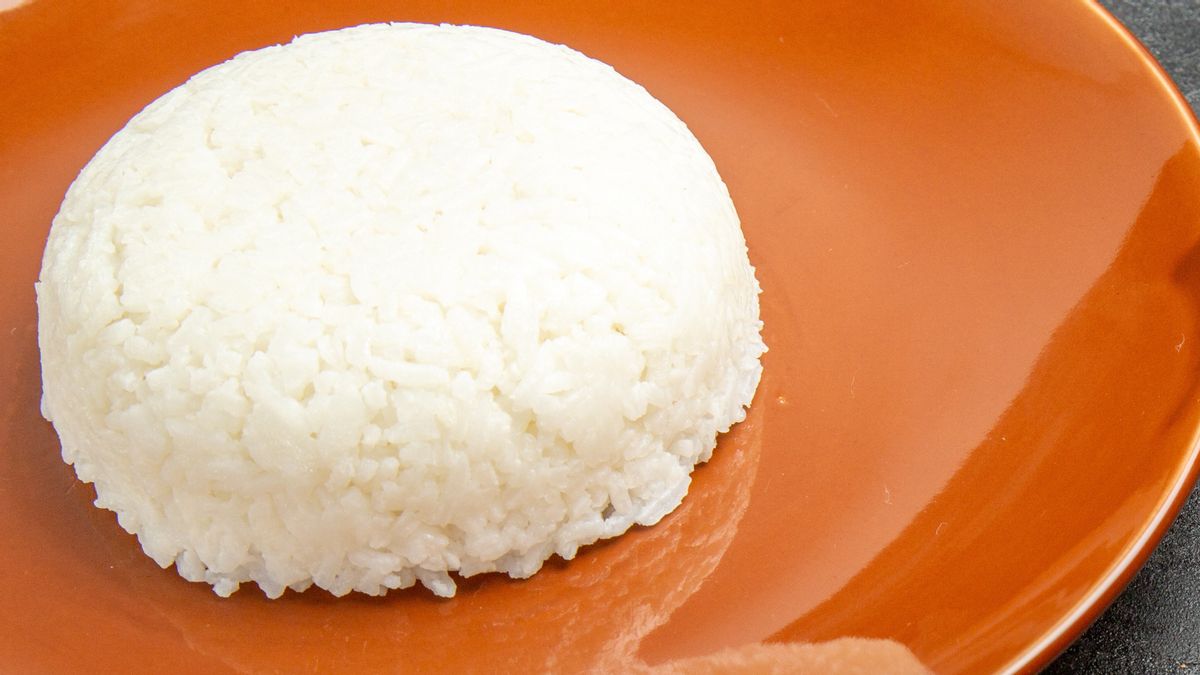


JAKARTA - Recently, there have been many claims on social media that frozen rice is then reheated healthier than regular warm rice.
To respond to this, dr. Dion Haryadi, a doctor who is an expert in nutrition and Fitness, gave his explanation through the Instagram account @dionharyadi on November 9. According to dr. Dion, rice actually contains two types of starch, namely easy to absorb and resistant starch.
"The rice contains two types of starch, the star is easy to absorb and resistant. The process of cooling rice can increase the content of the resistant regent," he said, quoted from the Instagram account @dionharyadi.
He added that this does not only apply to white rice, but has also been studied in bread. The higher the resistance star content, the slower the spike in blood sugar when consumed.
"This is not only in white rice, yes, there is also research on bread that produces the same response. The higher the resistance star, the slower the increase in blood sugar when we consume," said dr. Dion.
Pati resistance itself is a type of star that cannot be digested by the body. This rice freezing process has been researched at the University of Indonesia.
SEE ALSO:
-
 | LIFESTYLE
Budaya Kerja Sehat yang Bikin Karyawan Betah dan Semakin Produktif
28 Agustus 2025, 19:35



"Because the regent cannot be digested by our bodies. This process has also been researched at the University of Indonesia," he added.
dr. Dion said that the frozen and reheated quarantine did provide a lower glycemic response.
"For rice that has been frozen and then reheated, it does provide a lower glycemic response," continued dr. Dion.
However, the increase in the resistance regent is actually not too significant, only up from 0.6 grams per 100 grams to 1.6 grams per 100 grams.
"Even so, actually the increase in the resistance regent is actually not too much, only from 0.6 grams per 100 grams, so 1.6 grams per 100 grams," he explained.
He also highlighted that the study did not explore further the content of calories and carbohydrates in cold rice, but the possibility of changes was not significant.
"Unfortunately in the study, there is no further search for calories and carbohydrates in cold rice. But if you look at the existing data, it looks like there are not many changes," he said.
Some of the claims circulating suggest that cold rice can reduce calories by 50'60 percent, even though the facts are not so.
"He said that the cooled white rice can have a much lower calorie content, when it's actually not. The calorie number is not much different and still has to be consumed sufficiently," said Dr. Dion.
"In several other videos, it is also claimed that 50-60 percent of the calories can be lost. If that's the case, people can eat up to 2 times as much, even though warm white rice is actually the same as healthy," said dr. Dion.
According to him, the most important thing is the overall diet and consumption of rice with balanced side dishes. This combination can reduce the food glycemic index.
"If consumed with complete and balanced side dishes, it will not increase the blood sugar response excessively," he said.
"In terms of research, they (participation) usually only eat white rice. So if we, who here only eats white rice? It must be the same as vegetables and side dishes. And it will all lower the glycemic index," he continued.
dr. Dion emphasized that comfort in rice consumption is also important. If you feel practical with frozen rice, that's fine, but that doesn't mean you're healthier.
"If you are comfortable eating frozen rice, it makes your life easier, more practical, please. No healthier, but make it easier for your life, go ahead. If you eat warm rice, go ahead," he explained.
Finally, he emphasized that the consumption of white rice must remain sufficient.
"In the end, this returns to your overall diet. White rice must be consumed in moderation." he concluded.
The English, Chinese, Japanese, Arabic, and French versions are automatically generated by the AI. So there may still be inaccuracies in translating, please always see Indonesian as our main language. (system supported by DigitalSiber.id)


