




JAKARTA - Actress Dinda Anya Dewi again tried out the antagonist role in her latest film entitled Book Sijjin and Illiyin. Playing a character named Laras, Dinda did not want to display a evil figure who was flat, but instead explored the complex layer of emotion behind her character actions.
"What stage will I show in my role as a Laras in the Sijjin and Illiyin Books, although it can be said that he is also antagonist or evil, maybe more about his emotional layer," said Dindaanya Dewi to VOI, recently.
According to Dinda, this film will explain the reasons behind Laras's anger and dominant nature, which made her an abuse to her sister. According to him, this is the attraction of the character, a cycle from the victim to become the perpetrator, and again become a victim.
"It means that we can also see why Laras can be so angry, like her abuse to her sister, why is she so dominant, what hurts her heart is quite explained in this film too. So it's interesting. So from the perpetrator, the victim became a victim again. Because in the end, he also fought to protect his family like that," he continued.
Deepening the role of Laras provides two deep emotional lessons for Dinda. First, he realized how damaging the anger that was kept and didn't need to be heard.
"Maybe if I do, there are two of them (who are emotional about this film). One, that anger is something we don't need to listen to. It means it's a shame if for example life is full of anger because it will be tiring. So to keep my anger is something that seems like I don't want to be like Laras. Because he is really tired, he lives with a grudge, gets angry, doesn't forgive that. So maybe if I find peace, it must be released, those feelings must be released," said Dinda.
The second lesson he learned was about the concept of tuaki sowing. Dinda believes that every act will get a reply, whose impact is not only felt by oneself, but can also have an impact on the family.
"The second is more about sometimes em, yes, we are well aware of the concept of tuami sowing. What we are doing now, there will definitely be a reply, including what we are doing now, maybe the reply is not necessarily directly to us, but it can be to our family, our child or anyone else like that," he explained.
This, according to him, is very relevant to the story of Laras, where the suffering she experienced was the impact of her parents' actions in the past.
Just like Laras, what Laras experienced, all the suffering he experienced was not because it was not because he was the one who did that, but because of the impact of the past that was done by his parents. So you have to be more careful to behave," he continued.
SEE ALSO:
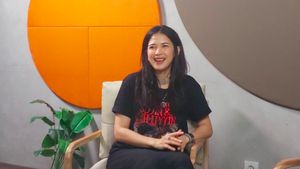
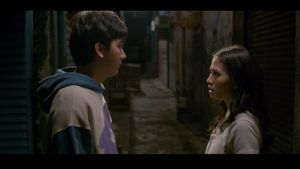
Actress Dinda Kunya Dewi revealed a personal side that contrasts the character Laras, who grew up with childhood trauma. Dinda actually admitted that she had a beautiful childhood and only felt traumatized as she grew up, an experience she never prepared.
"Okay, if Laras grows traumatized, do I have trauma too? It seems that from childhood I didn't have it at all. In fact, my childhood was the most beautiful time in my life, I thought so. Eh, my parents are still complete, they are still there and eh, so if you say childhood trauma, I don't have any. In fact, there was trauma when I was an adult. Something I didn't prepare, it turned out to be me, I thought I was ready, it turned out that I wasn't ready," said Dinda Nanya Dewi.
The trauma phase, according to Dinda, came when she had to face the loss of her parents. The moment became a turning point that made her feel unable to function normally.
"So there was a sense of fear and maybe I had entered a trauma phase when I was an adult. So when I lost two of my parents that was quite good, like, "Ah, what is this trauma?" like for example I can't eh function normally, I keep people away because I always feel better not not not having it than feeling lost again, "the story.
Dinda firmly rejects the notion that trauma can make a person stronger. For him, trauma has the potential to bring down and take someone down the wrong path.
"It means that maybe the trauma is eating away at him, but yes still, it's still a process, but I'm well aware that yes, pain and trauma are things that I should have distinguished you. I can't believe that trauma makes you strong, no, no, no. No, trauma will make you fall more and more, you know. The more wrong it is, the wrong way is that," continued Dinda.
One of the big influences of the trauma he feels is the emergence of pain that is difficult to explain the source. Now, he learns to be more aware and identify every pain that arises.
(The effect of the trauma) means that sometimes you feel pain, the big influence of trauma, feeling you feel pain but you can't explain where the pain came from. So until now I'm more about identifying the pain I feel like that," he said.
By identifying the pain, he hopes that the emotions don't settle and explode at an unexpected time. "So that it doesn't settle and until finally I like to get out I don't know where it comes from. So if I still feel something, I'm just more aware of the pain. For example, before that, I might feel a pain, but it can take a long time to get out in unexpected things, you know," he continued.
Dinda then shared her way of making peace with trauma. The key is not to limit oneself to feeling and emitting emotions, and identify existing pain.
"How to make peace with trauma. It doesn't limit, it doesn't limit us to it. He made me one, I identify the same pain, I feel the same feeling. When I want to cry, just cry. Don't, don't hold it back, don't be like suddenly, it's like crying, 'No, I can't cry, I have to be strong, I have to forget'. No, if you really want to cry, just cry. If you really want to be angry, you're angry, if you want to be sad, just be sad. It's okay, "said Dinda.
For him, this process is a form of loving himself by realizing and accepting every pain that ever existed. When all efforts were felt to be maximized, he left everything to God.
"So, I really love myself more and that's what I said earlier, one way is that you have to know if, for example, you are more aware of the pain that has been there, that's all. So that's okay. It's okay, it's okay to feel it all and yes, if you have knocked, for example you can't, remember God. It's been the last time like that, remember God, everything has already arranged, that's it. That's fine. Just keep on swimming if Dori said in Finding
The English, Chinese, Japanese, Arabic, and French versions are automatically generated by the AI. So there may still be inaccuracies in translating, please always see Indonesian as our main language. (system supported by DigitalSiber.id)
Most Popular Tags
#Prabowo Subianto #donald trump #Febrie Adriansyah #8791 #giias 2026Popular


