
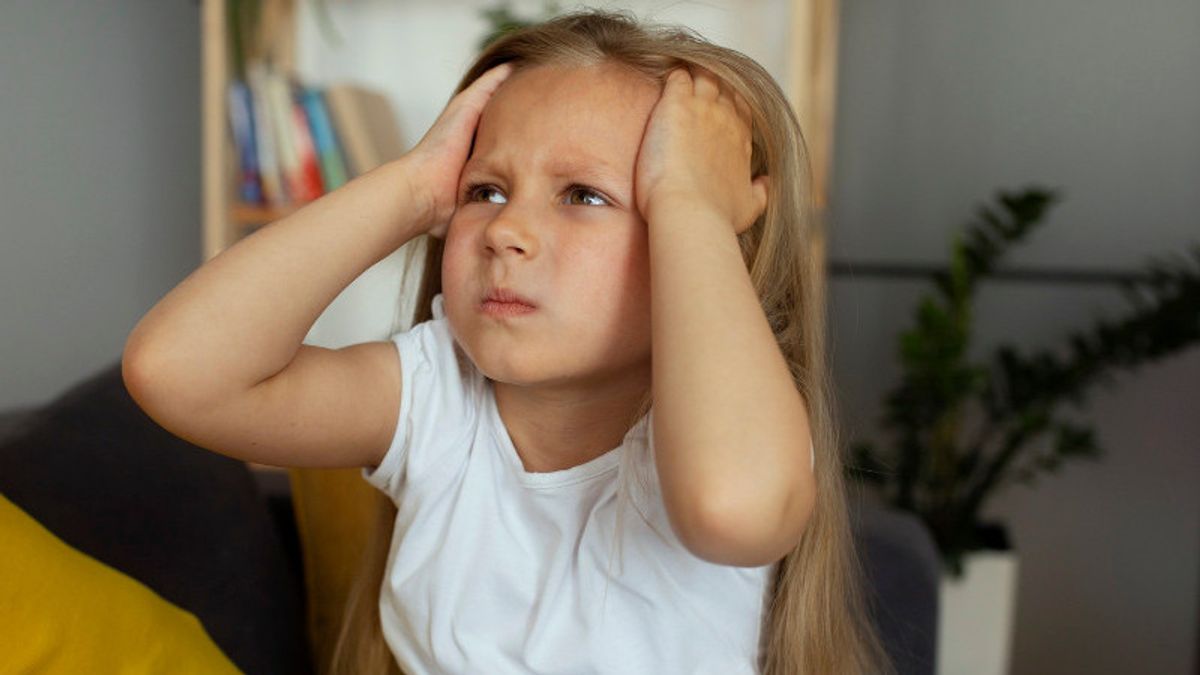


YOGYAKARTA - Children who criticize themselves often can feel sad and make parents worry. This behavior is usually not without reason. There is a combination of factors that affect how they judge themselves. Understanding the causes can help you as a parent in guiding your child towards a more positive and healthy self-understanding. Here, the cause of a child becomes hard on yourself that your parents need to know.
According to Sarah Kipnes, LSCW., a clinical licensed social worker based in olahraga, California, some children are born with perfectionist traits that make them very sensitive to minor mistakes. When they get the wrong answer at school or do something a little less imperfect, their inner reaction can immediately respond with a self-assignment statement "I'm stupid".
This causes children to see mistakes as a complete failure, not as a learning process. If it is not controlled, it can reduce self-confidence and increase anxiety gradually.
Jocelyn Bibi, LSCW., reported by Parents, Wednesday, July 23, said that children imitate the negative language of those around them. For example, if parents often demean themselves, for example, they often grumble 'I'm really bad', children can take this mindset and apply it to themselves. In addition, high pressure from home or school about achievement can also make children too demanding themselves. An environment full of criticism, even without realizing it, can encourage children to become hard on themselves.
Children who are easily anxious and afraid are not good enough to be often harsher on themselves. For example, one bad value at school can make them feel like a ' stupid kid'. Social factors, such as comparisons with classmates or the image of 'perfect' on social media, exacerbate this condition. As a result, children can feel less confident and start comparing themselves frequently with others.
Sometimes children use self-criticism as a way to protect themselves. Like when they say bad things about themselves before other people. Quoting the Child Mind Institute, this is a form of immature coding, where children try to control narratives so that shame or ridicule doesn't hurt too much. These tactics can turn into a habit if they are not reminded that their feelings are valid and part of normal development of children.
Children who experience repeated emotional stress without assistance can become self-criticism excessively. When children are not taught how to recognize or manage emotions, such as disappointment, anger, or shame, they tend to blame themselves for the reaction. Without guidance on self-confining or compassion for themselves, this pattern can be carried to adulthood and hinder healthy mental development. Several things can be done by parents to help a child who is hard on themselves in the following way:
When a child says, 'I'm stupid,' talk about empathy. For example 'Are you disappointed? You can tell me why you feel that way'. Don't immediately deny your feelings. Try to validate your child's feelings and find out why he feels disappointed or sensitive to small mistakes.
Help children turn self-criticism into a more friendly sentence. For example: 'I failed this time, but I can learn better'. It needs to be understood by parents, being compassion for themselves, does not mean just accepting mistakes. But also wanting to be better by learning.
Encourage children to understand that their job is a learning process, not to be perfect. Tell me about your failed experience and how to learn from it.
SEE ALSO:
-
 | LIFESTYLE
5 Penyebab Ortu dan Kakek-Nenek Kerap Berselisih Soal Pengasuhan Anak
10 Juli 2025, 15:47




Every day take time to ask what they want to celebrate today. Invite me to make a list of positive things that have been done.
If children often criticize themselves, pay attention immediately. It could be a symptom of higher anxiety or a decrease in mood.
If self-criticism lasts continuously and is seen disturbing daily activities, consider child psychologist counseling or guidance at school.
Children can be hard on yourself because of the combination of perfectionist traits, environmental pressure, anxiety, and lack of emotional regulation. You as parents have an important role to play in straightening out this pattern through support, validation, and self-tightening. With an empathetic approach and guidance, children can learn that mistakes are not evidence of weakness, but an initial footing towards growth and development. If this behavior continues, professional assistance can be the right solution.
The English, Chinese, Japanese, Arabic, and French versions are automatically generated by the AI. So there may still be inaccuracies in translating, please always see Indonesian as our main language. (system supported by DigitalSiber.id)
Most Popular Tags
#Prabowo Subianto #donald trump #Febrie Adriansyah #8791 #giias 2026Popular


