

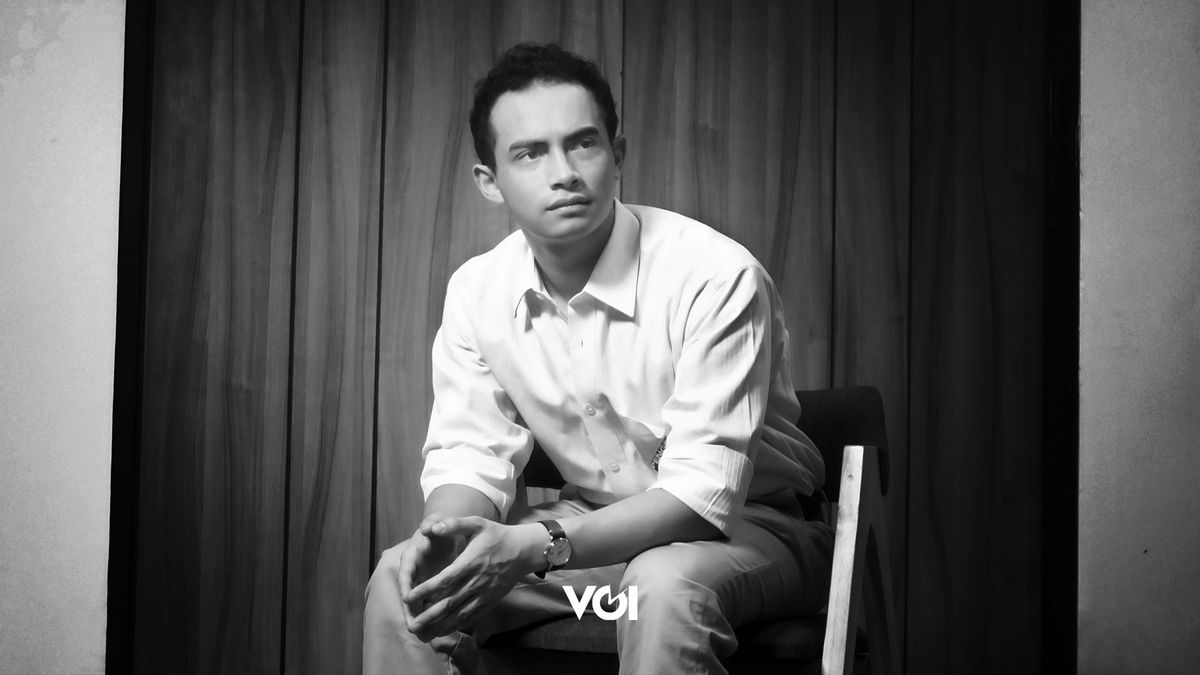


JAKARTA - Debut acting since 2011, Omara Esteghlal has had luck because she often plays the character of school children. Various roles he plays, sometimes his role is in the spotlight but not infrequently he becomes a shadow of the main character.
However, there is something different about Omara's latest role. He became Jefri, one of the high school students in the latest film by director Joko Anwar, the Extinction in Bukit Duri. Jefri is told to be Edwin's rival (played by Morgan Oey), a teacher who has just entered Bukit Duri High School.
I often play (the role of) school children, especially high school. Maybe the one who distinguishes my role here from the previous role, often slices of life about the lives of school children we see as faces," Omara Esteghlal said while speaking with VOI, some time ago.
Some of the films where Omara plays a high school student include Balada si Roy, Galaxies, Budi Pekerti, to the Dilan 1990 franchise which made her name known. He realized that he played many roles in high school children, but this time his role could take into account his current acting.
(The role is always) to stand out to one by one but very few where I highlighted the violence and violence is one thing that is very fragile, vulnerable and but there is once in these school children. Violence, hatred, and destruction are the point of weight in Snaking in Bukit Duri he said.
The violence in this film was not created for something cool. We don't watch superhero films, we don't watch war films. Here, violence is made raw, very sick and even from movements it is technically designed so that violence is not beautiful, all the violence that is highlighted in this film is what happens. Bang Joko (Anwar) often tells, we don't want violent scenes like watching action films," explained the man who was born on August 10.
As one of the players, Omara was worried that her role and film was considered to be glorifying violence, but she had a lot of discussions with the players and directors. They show that violence in this film is a reflection of the reality that occurs where brawls and violence are normalized.
"I'm looking for human emotional spectra here; anger, anxiety, sadness, I inject everything at Jefri's point seen as a person who can't come back anymore, but to continue, he doubts. He knows, he's so far an unnatural human being but if he comes back, he will be a coward and doesn't know what to do. That anxiety is when point of no return, despair and carelessness, which I try to make by reading psychology theory, philosophy of human life and of course trying to feel myself, "continued Omara.
First, the approach that we do to all the characters and scripts is very scientific, we even learn not only to make but we learn psychology, politics, Indonesian history, before we can approach and that is 'necessarily' about learning this history, there will be reading, a spectacle that is given to us. Second, from the character sheet, we are given a very extensive breakdown character and script. Third, a very detailed and very adaptable board of directors to the scene. Fourth, a very, very healthy work environment and culture. We shoot sometimes only 5 hours, 3 hours and even a maximum of 5 days have gone home, so it comes from a very much anticipated and planned production, "he said.
Before continuing his career as an actor, Omara Esteghlal had an education in the United States where he graduated from two majors from higher education, namely philosophy and psychology. The man who was born in 1999 felt the difference while studying in two countries also reflected on the way he studied. That rifle he brought to explore Jefri's role.
"Pas (schools) in Jakarta also live in schools that strongly reject the existence of brawls, if brawlers must be issued - there is no tolerance for violence, but when we say what is the significant difference between Indonesian and American learning culture. I learned that in America there is a dialogue between teachers and students to be teachers to talk about ABC, we don't agree, we can raise our hands and say, while in Indonesia, teachers say ABC, we agree that we don't agree, we just disturb it because of what? He's a teacher, "said Omara.
Maybe many of the root systems have talked about this on social media. There is a famous indo philosopher who once talked about this that the feudalism in Indonesian learning where when teachers teach something is one direction, students just obey. Regarding brawls and violence, in America, we read the news that there is an alley violence, school shooting, when children from minorities are hit, it enters international news. In Indonesia, brawls are quite natural and I think they are quite stupid because why do we teach brawls? He said with enthusiasm.
Omara continued, he saw that brawls and violence in Indonesia were considered a culture in the social environment of students so that violence seemed to be the answer to the conflict. The feodalism culture can also be seen from the phenomenon of college spectral activities that show the emphasis of seniors on juniors.
In America, when I feel that violence is not only in the news and subpoenas and imprisoned but also out of school, while in Indonesia, Oh, there is a brawl! tomorrow there will be more. People who join the brawl are not justified. Society, we have to be more responsive," he said.
"I'm sorry, the existence of physical inspections is also the first point of a brawl and this starting point for children to enter school, so for life they dream of entering school to learn, continue to be beaten by seniors in the name of seniority. What's the point? Because they can respect older, they don't respect that, there is a way. Be an honorable person. With non-joking perspectives of people, seniors have participated in brawls, gangs, things like that are actually reflections that maybe our children need recognition. Children need individuality, recognition, identity that they are someone and seen by society, "said Omara.
The counter that Omara gives to reality as a student, played by her as Jefri in her latest film. He admitted that there were many harsh words that he used for his character, but again, he explained that the character was a relevant real-world reflection.
For those of you who have watched the Suspension in Bukit Duri, may be wondering why Jefri's character is very reactive and temperamental about things around him, as if there is no positive motivation for his character. Omara as the actor views Jefri as someone who is still growing. Not teaching, but trying to understand the background of his character that viewers can miss.
Jefri is a person who has dark eyes. Why is the personification so interesting, because he is still in high school. His anatomicy brain is also still growing, still at a age that can increase height. The process of developing it has not been completed but what is around it has taken a snap. What is viral, it goes viral. Wow, it's easy to blaspheme A, it's also not very reactive. When it requires work, it's reactive when looking at what governs the system is also questioned - as Jefri," he continued.
Even the world of Jefri's system has also plummeted, the government in this film is also not okay. The society is also not fine, so it is destroyed. Because historically it is destroyed, yes, it is also destroyed for teenagers whose population is large in the country, yes, the thought is only if A is yes B, it's fast. The more adults may realize that our process of thinking is getting longer," said Omara again.
Omara wants her character not to be glorified or seen as a hero because Jefri's character is a picture of a system that fails to protect society, the environment and education. Jefri who was exiled to Bukit Duri High School became a reflection for the audience or the public in seeing the development of society. Omara, as an actor, wants to continue to be involved in discussions, including starring in films that have the content to build discussions in the future.
"Art work is something beautiful whatever the shape is, and when we are artistic, we have discussed the audience. As simple as I said a few years ago, I wanted the film romance, which has no political social weight, we have served two hours where people sit in cinemas and discussions. Everyone has their own portion in society and is equally important," he said.
When we know what we do in our work, our skills and we continue for the sake of the welfare of ourselves and others, I believe we are something better. As an actor, I will continue to act in films that I think are good. Political people will continue to create and must continue to create a prosperous state of state for people who live, who? Not just them but the people. We have each share into this world. We have to be responsible to ourselves and others for continuing to be good, "said Omara Esteghlal closing the conversation that afternoon.
SEE ALSO:
-
 | LIFESTYLE
Kalah dari Mikey Madison, Demi Moore Akui Sempat Kecewa Gagal Oscar
24 April 2025, 14:10 -
 | LIFESTYLE
Skandal Hubungan Kei Tanaka dan Mei Nagano, Kim Moo Joon Ikut Terseret
23 April 2025, 18:10


The English, Chinese, Japanese, Arabic, and French versions are automatically generated by the AI. So there may still be inaccuracies in translating, please always see Indonesian as our main language. (system supported by DigitalSiber.id)


