
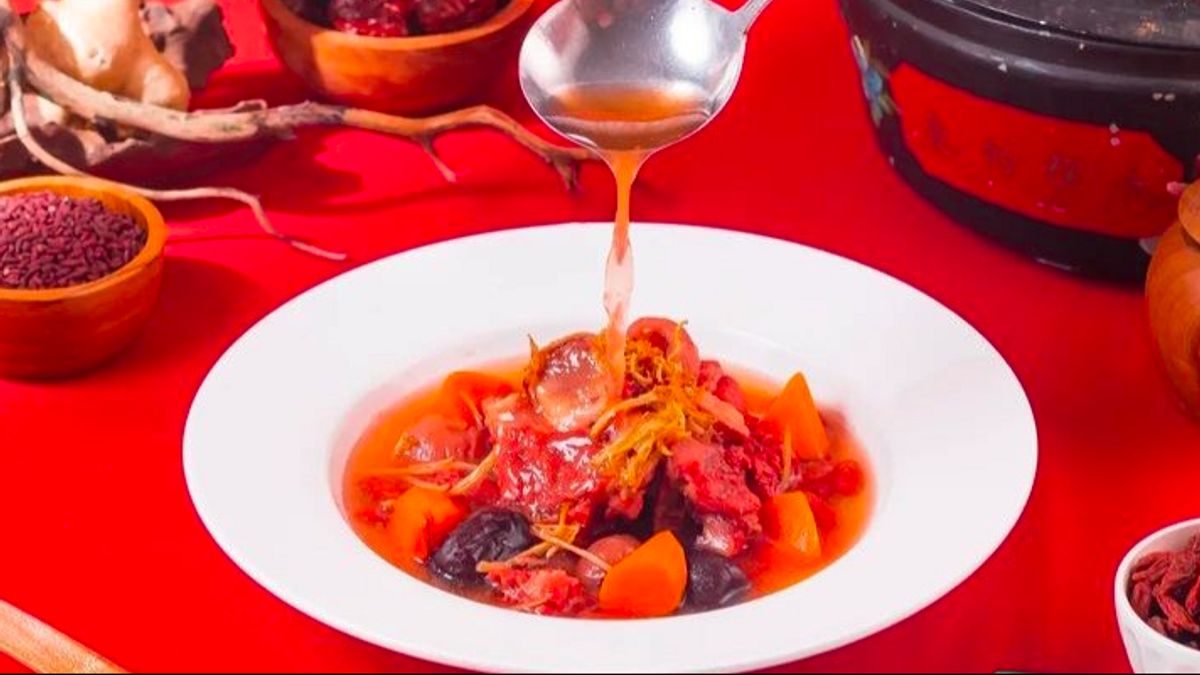


JAKARTA - Chicken soup with angkak has recently become known as one of the local food products that are believed to help overcome anemia. The combination of chicken with angkak in the form of fermented brown rice not only produces a distinctive taste, but also offers nutritional benefits.
The combination of chicken and angkak has iron, vitamin B12, and folic acid which play a role in the formation of red blood cells. This simple menu innovation is an example of how traditional ingredients can be processed into functional foods that are easily accepted by the community.
The idea also emerged in the Nutrition Education Presentation Competition held by the Indonesian Nutritionists Association (PERSAGI) together with the Nutrition Department of the Ministry of Health's Poltekkes Jakarta II and the Nutrition Alumni Association 1971-1972, Friday, January 23, 2026.
This activity was held in commemoration of the 66th National Nutrition Day (HGN) as well as strengthening the role of nutrition education in improving the quality of human resources towards the Golden Indonesia 2045.
The Chairman of the DPP PERSAGI, Doddy Izwardy, said that Indonesia has recorded significant progress in reducing the prevalence of stunting in the last decade.
"From 30.8 percent in 2018, now based on the Indonesian Nutrition Status Survey it has dropped to 19.8 percent," said Doddy, when met at the Nutrition Education Presentation Competition agenda, in the 2026 National Nutrition Day Commemoration, Friday (23/1/2026).
However, he emphasized that the challenges ahead were not easy. The effort needed was not only to maintain achievements, but also to continue to reduce stunting rates to reach the long-term national target.
"Our target for 2029 is 14.2 percent, and by 2045 we want it to be 5 percent. Well, how is it innovative? This is where PERSAGI and nutritionists play a role in carrying out continuous education," he explained.
Only 5 percent of Indonesians eat fruits and vegetablesDoddy also highlighted the low consumption of fruits and vegetables in Indonesia. According to him, nutritional problems are not always related to food availability, but rather to people's eating behaviors and habits.
"The balanced nutrition guidelines are clear. But nutritional education is not easy. We have papaya, mango, avocado in the market, but our fruit and vegetable consumption since 2007 has been low, only about 5 percent," he said.
He added that although many people can grow their own food such as papaya or cassava, this is not necessarily followed by the habit of consuming it regularly. Even in the free nutritious meal program (MBG), there are still fruits and vegetables that are not eaten.
"Even though fruits and vegetables are sources of vitamins and minerals. We must get used to seeing 'my plate', what percentage of carbohydrates, what percentage of protein, vitamins, and minerals. This is about changing behavior," he said.
In this context, the role of nutritionists is considered very crucial, ranging from menu planning, calculation of daily protein needs, to ensuring the balance of nutrients in one day of consumption, not just at one meal.
The nutrition education competition organized by PERSAGI was attended by students of the Diploma III Nutrition Program as well as the Applied Nutrition and Dietetics Undergraduate Program. The activity was also attended by the Chairperson of the DPP PERSAGI, the Director of the Jakarta II Ministry of Health Poltekkes, and nutrition alumni of the 1971 and 1972 classes.
The National Nutrition Day commemoration on January 25 is an important reflection momentum, considering that the nutrition problem in Indonesia is still complex. In addition to stunting, other challenges faced include undernutrition, anemia, obesity, and the increase in non-communicable diseases.
Through this competition, students are encouraged not only to excel academically, but also to be able to convey nutritional messages in a communicative, persuasive, and scientifically evidence-based manner. This effort is in line with the theme of HGN 2026, namely "Optimal Nutrition to Create a Golden Generation 2045" and the theme of the Indonesian Ministry of Health "Fulfill Balanced Nutrition from Local Food".
One of the materials that attracted the attention of the jury and participants was the innovation of the chicken angkak menu as an alternative to helping overcome anemia, especially in teenage girls.
World Health Organization (WHO) data shows that around 191 million adolescent girls in the world suffer from anemia. In Indonesia, the number of people with anemia is estimated to reach 7.5 million people, placing Indonesia in 8th place out of 11 countries in Asia.
A 2020 study showed promising results. The administration of angkak capsules to 42 eighth grade female students at a boarding school in Klaten showed that of the 30 respondents who had anemia, as many as 75 percent of them had normal conditions after intervention.
The English, Chinese, Japanese, Arabic, and French versions are automatically generated by the AI. So there may still be inaccuracies in translating, please always see Indonesian as our main language. (system supported by DigitalSiber.id)
Most Popular Tags
#Prabowo Subianto #donald trump #firearm #8791 #giias 2026Popular


