
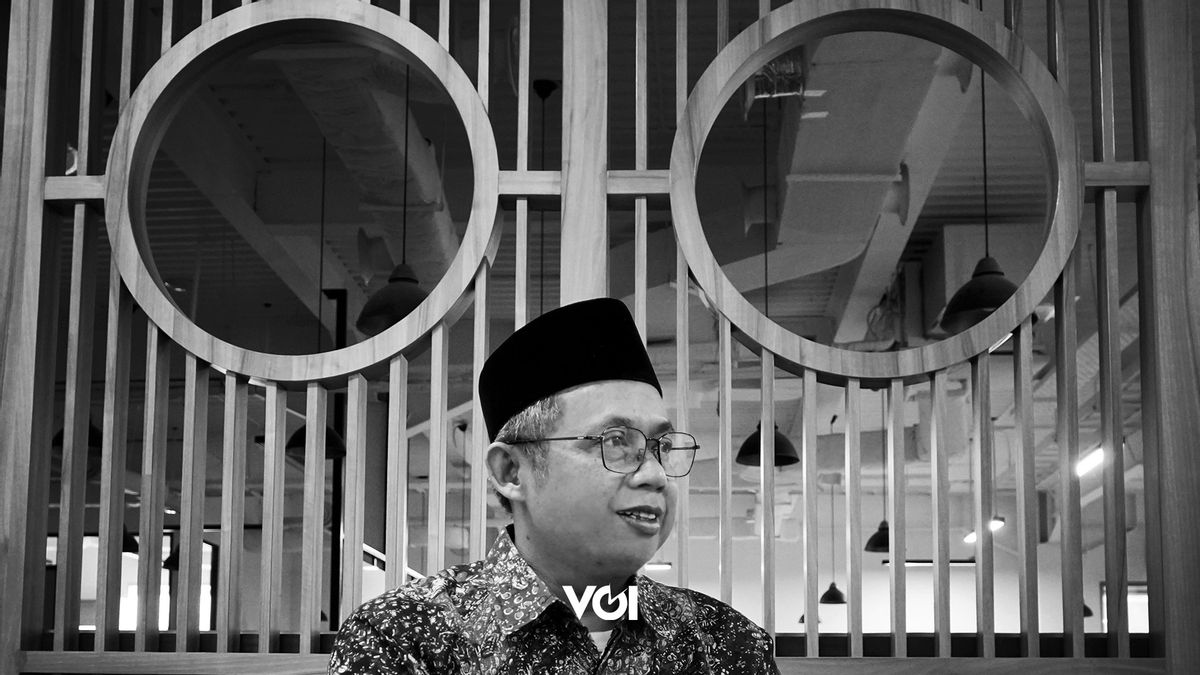


President Prabowo Subianto is very serious about seeing the problem of garbage which is a big problem for this nation. According to the President Director of the Association for the Development of Pesantren and Society (P3M), H. Sarmidi Husna, MA, the president's commitment is a positive signal. However, the ranks below him must be in line with the president's good will. This means that all parties must consistently enforce the rules that have been made regarding waste management.
***
According to Sarmidi Husna, this country does not have laws or regulations under it that regulate waste. Starting from Law No. 18 of 2008 concerning Waste Management, to Decree of the Minister of Environment and Forestry No. 59 of 2016 concerning the quality standards of landfill leachate and Decree of the Minister of Environment and Forestry No. P.90/2016 concerning the standards of public facilities hygiene services.
"Everything has been clearly arranged, but what is not yet optimal is the implementation of ministerial laws and regulations that complement the law. The legal rules are enough, what is not yet is its implementation. And the government must be consistent in enforcing the law if the waste problem is to be overcome," he said.
Sarmidi also emphasized that the problem of waste must start from the awareness of each individual. Everyone has a minimum obligation to manage their own waste.
"The activity of sorting garbage is simple, but the impact is devastating. From sorting garbage, commodities such as paper and plastic will be produced that can be sold. Waste that really can't be sorted, then it goes into the garbage can and is thrown into the landfill," he said.
The world of pesantren, continued Sarmidi Husna, is also very serious in dealing with this issue. That is why the term "Garbage Jihad" emerged. "Garbage is an emergency and can cause harm. In the language of fiqh it is called mudarat. So, things that are harmful must be eliminated. To eliminate the danger, it takes a serious effort, in the context of fiqh it is called jihad. So, efforts to eliminate the danger of garbage include jihad," he told Edy Suherli, Bambang Eros, and Irfan Meidianto when visiting the VOI office not long ago.
Before we get into the core issue, can we explain what P3M is?
P3M is a community-based organization that was established on May 18, 1983, at the initiative of Mr. Dawam Rahardjo from LP3ES. This institution has a program for the development of pesantren and society. He invited Gus Dur, who at that time had not yet become the General Chairman of PBNU; he was still in Jombang as the rector of a university at Pesantren Tebuireng, Jombang.
Then Gus Dur invited the kiai who had boarding schools and had a vision of empowering the community. Among them were Kiai Sahal Mahfudz (Central Java), Kiai Faqih (Langitan), Kiai Basid Lukguluk (Sumenep, Madura), Kiai Hamam Ja'far (Pabelan, Magelang), Kiai Ilyas Ruchiyat (Cipasung, West Java), and Hj. Tutty Alawiyah (Bekasi). There are also LP3ES figures such as Pak Adi Sasono, Utomo Dananjaya, Soetjipto Wirosardjono, and several other figures. They are the ones who founded P3M. One of the P3M programs is empowerment and assistance in waste management at boarding schools.
Not long ago, President Prabowo spoke about garbage. Some say it's a garbage emergency, is it true?
The president knew there was a problem, until he gathered his aides to discuss the garbage issue. This garbage is one of our biggest problems. More than 350 districts and cities in Indonesia are already "yellow", meaning this is an emergency. That means there are more than 60% of the existing districts/cities. In Java, 90% of the districts/cities are garbage emergencies. If this is not handled, 6 years from now all landfills (final processing places) will be overloaded. If that happens, people will throw their garbage on the streets. Not long ago in South Tangerang, more than a week of garbage was not picked up, so the garbage piled up on the streets.
"When I asked the Environment Service in districts and cities, the height of the pile at the landfill was 25 meters, 30 meters, and even 50 meters. The highest one was in a landfill in Yogyakarta which was 100 meters high.
With this condition, can the regent and mayor not handle this garbage problem?
They don't have a comprehensive perspective on waste management. I think the Environment Service understands this, but they don't implement it. Whether it's because of the budget or for some other reason, I don't know. The regents and mayors can copy the areas that have successfully handled waste, then replicate it in their areas.
According to you, what is the root of the problem so that garbage becomes the main problem in Indonesia?
Waste in Indonesia has not been handled from upstream to downstream. What happens, all the garbage is piled up in the landfill. The public is not taught and invited to manage waste properly. Something is said to be garbage if everything is mixed, but if it can be sorted, it becomes a commodity. For example, paper is combined with paper, plastic with plastic; it becomes a commodity and is sold. So, household waste is sorted into commodities and not thrown into the landfill.
"So we haven't sorted the garbage yet, right?
"Some have done it, but not many. There are still many who throw their garbage into the river. From the upstream, there are still many people who don't know how to process garbage. From the downstream, if you don't sort the garbage, the landfill will be overloaded and this will be a big problem. So, after being sorted, only the rest of the residue is thrown into the landfill.
How is waste management in developed countries?
In developed countries, awareness of waste management is very high, unlike the Indonesian people. In Japan, littering is fined; in our country it is not. Throwing garbage in the river is not considered a problem here. In Singapore, littering a cigarette butt is also fined.
"Does that mean there must be rules that make people afraid if they violate it?
"We already have rules, but the implementation is not yet optimal. There are laws and ministerial regulations on waste (Law No. 18 of 2008, Permen LHK No. 59 of 2016 concerning the quality of raw water for TPA, and Permen LHK No. P.90/2016 concerning the standards of public facilities hygiene services). There it is clear that the problem of waste and sanctions for violators are regulated. This is the state's duty to implement the law.
At the community level, there needs to be reward and punishment. For example, those who sort out garbage will get points or money, while those who do not sort out are fined for paying twice as much for garbage fees or other forms of sanctions.
"Andantara is planning a PLTSa (Waste Energy Power Plant) program, how do you see this?
"I think this is one solution to overcome the waste problem. Each PLTSa point needs about 1,000 tons of waste. Jakarta produces about 9,000 tons of waste per day; this can significantly reduce the waste pile at the landfill. For Jakarta with that amount of waste, it needs 9 PLTSa points. But this is a big investment, one point if it's not wrong about Rp. 3 trillion. However, there is a negative side: people can be lazy to sort waste because they feel that everything will be burned.
Because the investment is large, the sustainability of this project must be calculated properly, especially regarding the supply of waste that is the raw material for PLTSa. Don't let it be like TPS 3R (Reduce, Reuse, Recycle) which is often broken. Pity, from around 3,500 TPS 3R units, 90% are broken; that means the APBN money is wasted.
So even though this PLTSa is one solution, sorting garbage still has to be a culture?
Yes, so that valuable goods remain commodities, and the rest just become garbage. The reason is, there are many factories that process materials from sorting garbage. If they do not get raw materials in the country, the choice is to import garbage. So, Europeans who sort garbage, then exported to Indonesia. We have to optimize the movement of sorting garbage ourselves. The key is in the Ministry of Trade, whether it is allowed to import or not. This must be monitored so that it does not continue to import garbage, while garbage in Indonesia itself is not handled.
Why did P3M choose the term "Jihad Santri" for the earth preservation program? What is the theological message that wants to be conveyed to the students and the community?
Garbage is an emergency and can cause danger. In fiqh language it is called mudarat. So, harmful things must be eliminated. Garbage must be overcome because it is dangerous for health and the environment. To eliminate the danger, serious efforts are needed; in the context of fiqh, it is called jihad. So, efforts to eliminate the danger of garbage include jihad.
In the pesantren, there are many terms for jihad. There is jihad fisabilillah to uphold the religion of Allah, there is also jihad daf'u ad-dharar (jihad against danger), both for Muslims and non-Muslims. Jihad against garbage is included in this context: Jihad for students to preserve the earth. One of them is by managing garbage.
"For jihad to fight against garbage, what is the program like?
The P3M program is based on needs. When I visited the boarding school, one of the problems was dealing with garbage, especially for boarding schools with many students. The cost of disposing of garbage is large, so we made a program to deal with garbage.
"To the students, we ask them to sort the garbage into at least three categories: organic, inorganic, and B3. For plastic and paper, it becomes a commodity that is sold. The rest only goes to the landfill or incineration; the boarding school makes a smoke-free furnace (environmentally friendly incinerator). The ash is then made into bricks. With this model, the boarding school can deal with waste independently.
Can you give an example of a successful pesantren?
Some of them generate Rp1 million to Rp1.5 million per month from sorting waste. Large boarding schools such as Lirboyo Boarding School, Kediri, can even generate up to Rp35 million per month. This is not only a solution to dealing with waste, but also a new income potential. There are many more boarding schools that we have attended in East Java, West Java, Yogyakarta, and Banten. Hopefully this can spread to boarding schools that have not managed waste and the community in general.
So far there has been a garbage bank program and a plastic bag diet. How do you see this program?
The program does exist, but it often doesn't work. The obstacle I see is that the program is run by volunteers, even though it should be managed by professional personnel. So, they should be paid by the village or the Environment Service. If the garbage bank is running well, the employee's salary can be taken from the management income.
So the slogan "turning garbage into gold" is not impossible, right?
"It is not impossible at all, there is already evidence that it works. So, we manage waste and get blessings because there is economic added value.
What do you expect from the government to be more serious about dealing with garbage?
What the public says must be a concern. There is one NGO that is conducting research on the use of funds in the Department of Sanitation; the budget is minimal. This means that the regional head does not have special attention to this waste problem. As a result, they cannot move to carry out massive socialization to the public to sort out the garbage. So, the budget needs to be increased for socialization and accompaniment.
Then for officers, their mindset (mindset) must be updated. Don't just focus on procurement programs. Indeed, the procurement program is often considered "wet", but it does not have a direct impact on the community. What is more important is socialization so that the community wants to sort out the garbage.
For the community, what are your expectations?
"This garbage is not only a state problem, but a problem for us all. If we have a sense of responsibility, we must contribute. It must be instilled in all individuals that "my garbage is my responsibility". If we still leave it entirely to the officers, when will this problem be solved? So, if it can be sorted out to become a commodity, then the residue is really called garbage.
Connoisseur of Robusta Coffee and Environmental Fighter, Travel Notes of Sarmidi HusnaIn addition to being the President Director of the Association for the Development of Pesantren and Society (P3M), H. Sarmidi Husna, MA is also active in the General Board of Nahdlatul Ulama (PBNU) as a Katib Syuriyah, Deputy Secretary General of the Indonesian Ulema Council (MUI) Pusat, and in one of the philanthropic institutions. In the midst of high activity, how does he divide his time for personal, family, and organizational matters?
His days are filled with mobility at the three institutions. "Yes, if you want to find me, you can easily find me at P3M, PBNU, or MUI. But maybe also in the zakat and waqf institutions (Ziswaf CT Arsa Foundation). The reason is, after receiving the mandate of the organization, I have to carry out that mandate," he said.
"Meetings in the institutions I entered were scheduled regularly. PBNU and MUI are well scheduled. Well, in P3M adjust, it means outside the schedule of MUI and PBNU meetings," he said.
If the time is divided, according to Sarmidi, the largest portion is still to serve institutions such as PBNU and MUI. "The reality is like that, I have more time to serve religious organizations," he said.
Between Magelang and JakartaEven though his activities are more in Jakarta than in Magelang, his domicile based on state documents is still in Magelang. "I'm still a 'roker', alias a train entourage. If there are no important activities in Jakarta on Friday and Saturday, I will go home to Magelang in the afternoon on Thursday through Semarang or Yogyakarta. Sunday afternoon I will return to Jakarta. If Monday there is no activity in Jakarta, the departure will be adjusted. If it's really important, I'll take a plane through the Yogyakarta International Airport," he said.
According to Sarmidi Husna, there are joys and sorrows of being a commuter from Magelang to Jakarta. "Tired, yes. But when you get home, it's nice to be able to meet your family. If you compare it to moving to Bogor or a city close to Jakarta, the calculation time is almost the same. That's why I still feel comfortable living in Magelang," he said.
Even though they have to be separated between Magelang and Jakarta, one key word that Sarmidi has to do is to understand and understand each other. "My wife also teaches from morning to afternoon. In the midst of each other's busy schedules, communication must not be broken," said Sarmidi, who has also implemented waste sorting at his house.
Original Coffee ConnoisseursEven though now there are many packaged coffees that are practical and easy to carry everywhere, Sarmidi is not interested. His choice is still on the original coffee that has not been mixed with sugar or other ingredients.
"I prefer original coffee because I know the ingredients, while I don't know the ingredients of sachet coffee. Sometimes there is too much sugar, it's not healthy, hehe," he said.
Sarmidi is very proud of his local coffee whose taste is famous everywhere. "In Magelang and its surroundings there is Mount Sumbing coffee which is famous for its deliciousness. There is arabica coffee and there is also robusta coffee. Please adjust to your taste," he said in a promotional tone.
For his personal taste, Sarmidi prefers robusta coffee. "Why do I like robusta coffee? For me, this type of coffee is more comfortable in the stomach. For arabica coffee, I'm not comfortable. That's why I choose robusta coffee," he said.
The love for coffee and tobacco had prompted Sarmidi to hold a coffee and tobacco festival. "We present coffee and tobacco from various regions in Indonesia, we leave it to the visitors to choose. It turns out that their tastes are diverse, and we don't have to direct the best coffee in this area. What is clear, the best coffee is the original coffee," said Sarmidi Husna.
"Garbage is an emergency and can cause danger. In fiqh language it is called mudarat. So, harmful things must be eliminated. Garbage must be overcome because it is dangerous for health and the environment. To eliminate the danger, it takes a serious effort; in the context of fiqh, it is called jihad. So, efforts to eliminate the danger of garbage include jihad,"
H. Sarmidi HUsna, MA
The English, Chinese, Japanese, Arabic, and French versions are automatically generated by the AI. So there may still be inaccuracies in translating, please always see Indonesian as our main language. (system supported by DigitalSiber.id)
Most Popular Tags
#Prabowo Subianto #donald trump #firearm #8791 #giias 2026Popular


