
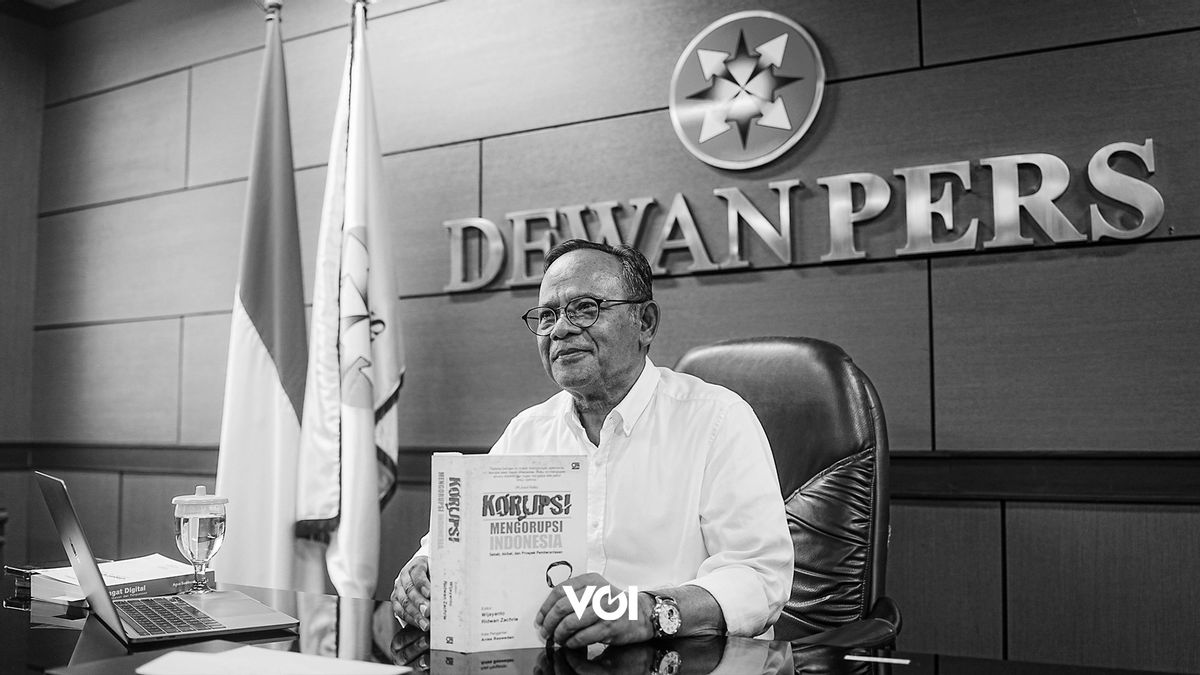


According to the Chairman of the Press Council, Prof. Dr. Komaruddin Hidayat, it's currently difficult to find inspiring news. This isn't because there's a shortage of news—quite the opposite, there's an abundance of it. However, only a small amount of it has value. Therefore, he desperately longs for quality, inspiring news.
***
As an academic who once pursued a career as a journalist, Komaruddin Hidayat is deeply concerned about the current situation. While the volume of news produced and published is immense, its quality is extremely concerning. "I've observed that there's a lot of news coming out now, but the quality is low. It's like air pollution," he said.
For him, the existence of the media—both print and electronic—is crucial. Therefore, he appreciates all the work done by journalists in producing and disseminating news to the public.
"The media also provides education and entertainment, although many also spread hoaxes and sensationalism. I really miss press content with an intellectual and inspiring nuance, which makes people optimistic about the future," he emphasized.
Furthermore, the recent rise of social media has slowly eclipsed the prestige of the press, which was previously the public's primary source of information. This situation has made it easier for hoaxes or false information to spread through the various social media platforms available today.
According to Komaruddin Hidayat, combating hoaxes cannot be left to one party alone. All parties must be equally aware that hoaxes are a common enemy. The government, the Press Council, press organizations, press companies, journalists, academics, and the public—all must work together to combat hoaxes to minimize their content.
"In addition to the involvement of law enforcement agencies, the public must also be able to distinguish between hoaxes and real ones. Don't be quick to believe information on social media without verifying it first before sharing it. This is to avoid misleading others," he told Edy Suherli, Irfan Meidianto, and Karisna Aurelia Tukan of VOI, who met him at the Press Council Building in Kebon Sirih, Jakarta, on July 21, 2025.

How do you assess the current state of press freedom in Indonesia?
What concerns me is not whether the press is free, but rather the current landscape of news coverage in Indonesia. I observe that there is a great deal of news circulating now, but its quality is low—like polluted air.
The existence of mass media, both print and electronic, is crucial in a democratic country like ours. Therefore, I appreciate all the work done by journalists, including news and stories spread through social media. Social media is a medium for disseminating information and expressing ideas. Media also provides education and entertainment, although many also spread hoaxes and sensationalism. I really miss press content with an intellectual and inspiring nuance, which makes people optimistic about the future.
Are journalists still experiencing repression today?
Whoever is in power will not be happy with press freedom. That's a common formula everywhere. But the presence of mass media cannot be stopped—especially in a pluralistic society like Indonesia. This country was born from the people's struggle; Indonesia is the people's child. People are accustomed to movement and association, and these cannot be restricted. Therefore, mass media cannot be banned.
First, the government must establish sound regulations. It is impossible to unilaterally restrict or detain members of the press. Second, the press is a partner in democracy, especially in a country that adheres to a democratic system like ours.
However, our democracy cannot be immediately idealized like the trias politica theory. There are stages that must be passed to get there. The government must oversee this process. Oversight institutions such as the Supreme Audit Agency (BPK), the Corruption Eradication Commission (KPK), the judiciary, the House of Representatives (DPR), and others were established to act as checks and balances. Power without control can be very dangerous.
So, is the Press Council also within the oversight framework?
Yes, the Press Council is a partner of the government in conducting oversight. Can things at the other end be monitored? This is where journalists play a role, as they are more observant of such matters. The government and the public have an interest in the existence of the Press Council, in order to support the independence of constructive, critical voices in voicing their aspirations.
According to the Press Council's records, what cases do you consider to be forms of restraint on press freedom?
Restraints on journalists have actually been going on for a long time. When the reform era began, one of its main ideas was press freedom—as an antithesis to previous practices of restraint.
Currently, as I observe, these restraints still occur, but they often take place covertly, especially in the regions. Restraints are carried out in various ways, making it difficult to determine exact numbers. The Press Council is deeply concerned by the ongoing acts of oppression against journalists.
We urge law enforcement, especially the police, to be fair and support the investigation of criminal acts committed by anyone, especially cases that journalists are trying to uncover.
One of the Press Council's duties is to receive complaints. Could you explain further?
Yes. One of the Press Council's duties is to receive complaints between journalists and those who feel aggrieved. We strive to mediate between the disputing parties. However, if mediation is unsuccessful, we invite the matter to proceed to court.

According to Press Council Chairman Komaruddin Hidayat, press media is currently less popular than social media. (Photo: Karisa Aurelia Tukan – VOI, DI: Raga Granada – VOI)
In the context of alleged repression of journalists, has the state been involved? How is it being implemented on the ground?
This is indeed a common issue. The police are obligated to protect anyone who is harmed or threatened—not just the journalist who reports it. The question is, how responsive are the police in following up on these reports?
The press once enjoyed a period of independence, but its status has declined somewhat. Television, newspapers, and electronic media are now largely owned by businessmen, and these businessmen are partners of those in power. As a result, journalists are less willing to speak out critically. Consequently, the public is less interested. They prefer social media and podcasts, which are perceived as more daring and critical.
The implication is that advertising is increasingly directed at social media and podcasts due to their large audiences. As a result, conventional media, which were once strong, are starting to weaken. Ultimately, layoffs are occurring. This saddens us, as many skilled workers are affected in this media sector.
The reality is that print media and television are currently declining in popularity. How do you see this situation going forward?
In conditions like these, the law of supply and demand applies. If print and television media want to survive, they must be adaptive—they must change with the times to remain loved by the public.
With the rapid development of social media, hoax content is also rampant. What is the Press Council doing to minimize hoax content?
Frankly, our authority is limited. However, we are working with relevant agencies such as the Ministry of Communication and Information Technology (Kominfo), the police, and the prosecutor's office to raise awareness of this issue. All of these parties should not take repressive action, but rather encourage sound regulations. I believe a complete ban is impossible.
However, if hoax content involves ethnicity, religion, race, or intergroup relations (SARA), slander, or other criminal elements, the injured party has the right to report it to the police. Democracy must balance freedom and law enforcement.
In addition to the role of law enforcement agencies, the public must also be able to distinguish between hoaxes and facts. Don't be quick to believe information on social media before verifying it before sharing it. This is to avoid misleading others. There are four groups that are difficult to persuade to think rationally: those in love, fools, those in power, and those who defend them for money (buzzers).
How effective has the Press Council's media verification program been?
Verification is carried out to make the media more responsible. We will continue what we have done so far. We also hold the Journalist Competency Test (UKW) as part of our press training.
Without training, cadre development will not occur. For verified media and journalists who have taken the UKW, it will be easier to track complaints, because everything is well documented.
Meanwhile, social media and podcasts are not our domain. They are private. If there are problems, they must resolve them personally or legally.
Many small media managers complain about the difficulty of the verification process. What solutions or conveniences does the Press Council offer?
In principle, we want to help. For serious and professional media, there are rules that must be followed. However, if you don't want to follow those rules, please go your own way. But remember, if there's a problem, you bear the risk yourself.
Now, artificial intelligence (AI) technology is also presenting new challenges. Will AI kill the journalism profession or strengthen it?
In the past, people communicated directly, then through writing (in the Middle Ages). Now, everything is integrated into one device—read, write, and speak—through gadgets. People easily comment on social media without empathy. Therefore, don't be overly sensitive when reading comments there.
Even though information technology is advancing and now AI is present, I believe the journalism profession will not die. Because humans still need dialogue and the process of gathering information to convey accurate and meaningful news. What needs to be considered is the content. In the era of independence, the content was the struggle. Journalists grew up with that spirit of struggle.
Now, the presence of AI can actually make journalists' jobs easier. Before an interview, journalists can use AI to find initial information about the topic they will discuss. However, for book writers, I see AI as a challenge. Because people no longer need to buy a book to know its contents. This is certainly detrimental to authors and publishers.
In the context of alleged repression of journalists, has the state been involved? How is it being implemented on the ground?
This is indeed a common issue. The police are obligated to protect anyone who is harmed or threatened—not just the journalist who reports it. The question is, how responsive are the police in following up on these reports?
The press once enjoyed a period of independence, but its status has declined somewhat. Television, newspapers, and electronic media are now largely owned by businessmen, and these businessmen are partners of those in power. As a result, journalists are less willing to speak out critically. Consequently, the public is less interested. They prefer social media and podcasts, which are perceived as more daring and critical.
The implication is that advertising is increasingly directed at social media and podcasts due to their large audiences. As a result, conventional media, which were once strong, are starting to weaken. Ultimately, layoffs are occurring. This saddens us, as many skilled workers are affected in this media sector.
The reality is that print media and television are currently declining in popularity. How do you see this situation going forward?
In conditions like these, the law of supply and demand applies. If print and television media want to survive, they must be adaptive—they must change with the times to remain loved by the public.
With the rapid development of social media, hoax content is also rampant. What is the Press Council doing to minimize hoax content?
Frankly, our authority is limited. However, we are working with relevant agencies such as the Ministry of Communication and Information Technology (Kominfo), the police, and the prosecutor's office to raise awareness of this issue. All of these parties should not take repressive action, but rather encourage sound regulations. I believe a complete ban is impossible.
However, if hoax content involves ethnicity, religion, race, or intergroup relations (SARA), slander, or other criminal elements, the injured party has the right to report it to the police. Democracy must balance freedom and law enforcement.
In addition to the role of law enforcement agencies, the public must also be able to distinguish between hoaxes and facts. Don't be quick to believe information on social media before verifying it before sharing it. This is to avoid misleading others. There are four groups that are difficult to persuade to think rationally: those in love, fools, those in power, and those who defend them for money (buzzers).
How effective has the Press Council's media verification program been?
Verification is carried out to make the media more responsible. We will continue what we have done so far. We also hold the Journalist Competency Test (UKW) as part of our press training.
Without training, cadre development will not occur. For verified media and journalists who have taken the UKW, it will be easier to track complaints, because everything is well documented.
Meanwhile, social media and podcasts are not our domain. They are private. If there are problems, they must resolve them personally or legally.
Many small media managers complain about the difficulty of the verification process. What solutions or conveniences does the Press Council offer?
In principle, we want to help. For serious and professional media, there are rules that must be followed. However, if you don't want to follow those rules, please go your own way. But remember, if there's a problem, you bear the risk yourself.
Now, artificial intelligence (AI) technology is also presenting new challenges. Will AI kill the journalism profession or strengthen it?
In the past, people communicated directly, then through writing (in the Middle Ages). Now, everything is integrated into one device—read, write, and speak—through gadgets. People easily comment on social media without empathy. Therefore, don't be overly sensitive when reading comments there.
Even though information technology is advancing and now AI is present, I believe the journalism profession will not die. Because humans still need dialogue and the process of gathering information to convey accurate and meaningful news. What needs to be considered is the content. In the era of independence, the content was the struggle. Journalists grew up with that spirit of struggle.
Now, the presence of AI can actually make journalists' jobs easier. Before an interview, journalists can use AI to find initial information about the topic they will discuss. However, for book writers, I see AI as a challenge. Because people no longer need to buy a book to know its contents. This is certainly detrimental to authors and publishers.
Bored, Komaruddin Hidayat Will Do This

When he's feeling down, Komaruddin Hidayat's go-to method is to step away for a moment and write. After refreshing himself, he returns to the original topic. (Photo: Karisa Aurelia Tukan – VOI, DI: Raga Granada – VOI)
Everyone has their own way of escaping boredom or fatigue from an activity. The Chairman of the Press Council, Prof. Dr. Komaruddin Hidayat, when he's bored with his routine, will take a break from his activities and write. Besides addressing boredom, this habit also results in writing, which he publishes annually on his birthday.
"For me, reading and writing are a necessity for relaxation. If I'm feeling stressed or overwhelmed by an activity, I need to step away from it and write. The theme or material can be anything—for example, a critique of a situation, an examination of social and political conditions. But there are also lighter themes like human interest," said the man born in Magelang, Central Java, on October 18, 1953.
It turns out that from a year's worth of writing, he was able to publish a book beyond the serious writings on campus. "For the past five years, every birthday I've published at least one book containing a collection of my writings," said the former journalist for Panji Masyarakat magazine (1978–1982).
He doesn't need to search far for a topic for his book. He simply observes the phenomena and events around him.
"If I have an idea, I just focus on writing. If I have free time, I write. Within six months, a book can be finished. Because there are so many problems that arise around us," said Komar, noting that his books are published by Kompas Gramedia.
The Key to Happiness

Komaruddin Hidayat maintains a balance between physical and mental exercise to maintain a peaceful life. (Photo: Karisa Aurelia Tukan – VOI, DI: Raga Granada – VOI)
There are many ways to achieve happiness. Some are through physical exercise, then social exercise, then intellectual exercise, spiritual exercise, and even aesthetic exercise.
"If we can do these various things, either individually or together, happiness will come. We will be happy and age more quickly," said the former Rector of UIN Syarif Hidayatullah Jakarta (2006–2010 and 2010–2015).
When asked if that's his way to happiness, he said, "I can't say I can do it all. But I try to do it as much as possible. Teaching is entertaining for me, and hanging out with friends while enjoying culinary delights also makes me happy," continued the former Rector of the International Islamic University of Indonesia (2019–2024).
Komaruddin Hidayat, a frequent golfer, experienced firsthand how, in a single moment on the golf course, he could simultaneously engage in physical and social exercise.
"I really enjoy being on the golf course. Besides the main activity of playing golf, I can also walk, enjoy the sunshine, and chat with my golf buddies. It's a wonderful luxury—I can forget about the political hustle and bustle," said Komar, who also noted that many people use the golf course as a venue for business lobbying.
Golf Courses in the Mountains

One of Komaruddin Hidayat's chosen sports is golf. It not only provides movement, but also allows him to enjoy the beauty of nature while also building social connections with colleagues. (Photo: Karisa Aurelia Tukan – VOI, DI: Raga Granada – VOI)
Komar prefers playing golf in the highlands because of the beautiful views and fresh air. "That's why I mostly play on golf courses in Bogor and the surrounding areas. The mountain views are relaxing, and the fresh air is refreshing," continued the student, who graduated from Pabelan Islamic Boarding School in Magelang (1969) and Al Iman Islamic Boarding School in Muntilan (1971).
Although it's not his primary goal, when he has the opportunity—for example, when he's on assignment out of town or abroad—Komar often makes time to play golf. "So, it's not his primary goal to improve his golf skills. If I have the opportunity, I like to try out the golf courses in the places I visit. I've been to China, Thailand, and the United States. After my main activities are over, I make time to play golf," said Komar, who isn't interested in visiting shopping malls.
According to Komar, one of the things that makes him happy as a golf enthusiast is when his shot hits the target. "That's why before hitting, you have to assess the situation and conditions around you—the contours of the field, the wind direction, and determine the right stick to hit with. That's key. There's an element of analysis involved. If the situation is like this, which stick to use? That's the challenge, I think," said Komar, who can still eat all kinds of food as long as it's not excessive.
"I'm very grateful that at my age I can still enjoy a variety of foods. The important thing is to be mindful and not overindulge. Thankfully, I don't have any dietary restrictions. So, you can treat me to anything—just don't eat anything hard," said Komaruddin Hidayat, adding: "Don't be afraid of challenges. If you want to be a successful sailor, you have to brave the storms. Great sailors are born from the waves."
"The Press Council is deeply concerned by the ongoing oppression of journalists. We urge law enforcement, especially the police, to be fair and support the investigation of any criminal acts committed by journalists."
The English, Chinese, Japanese, Arabic, and French versions are automatically generated by the AI. So there may still be inaccuracies in translating, please always see Indonesian as our main language. (system supported by DigitalSiber.id)
Most Popular Tags
#Prabowo Subianto #donald trump #firearm #8791 #giias 2026Popular


