
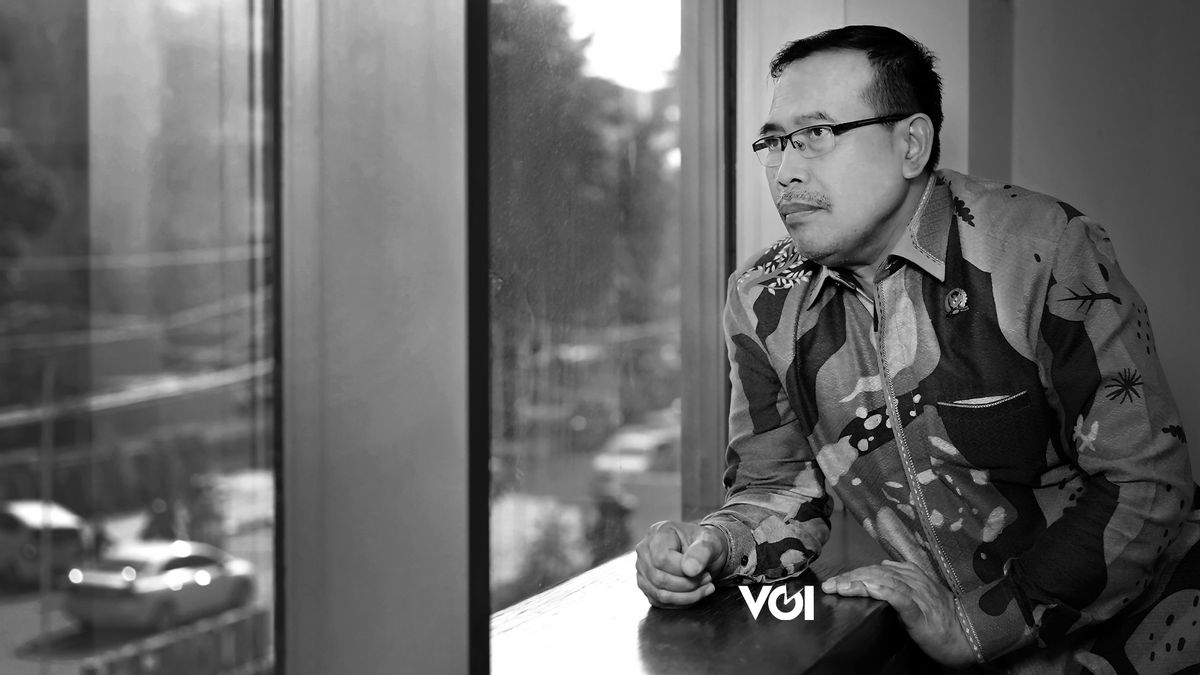


President Prabowo Subianto and Vice President Gibran Rakabuming have been inaugurated. The cabinet ministers have also been announced. The next day, Monday, October 21, 2024, it will be the turn of the presidential aides to be inaugurated. The Chairman of the Ombudsman of the Republic of Indonesia, Mokhammad Najih, SH, MHum, PhD, is optimistic that Prabowo and his cabinet will be able to enforce the law and improve public services.
***
Najih, as he is usually called, has high hopes for Prabowo for a reason. During the campaign and various occasions after being declared the winner of the 2024 Presidential Election, Prabowo has been quite intense in expressing ideas about eradicating corruption and improving public services.
“I have high hopes for President Prabowo Subianto. Moreover, he has announced a program to eradicate corruption. He also pays attention to the public welfare, education, and health sectors. I think these are basic community needs that must be a priority. Because, this has been neglected for a long time,” he said.
According to Mokhammad Najih, a decade ago under President Jokowi’s leadership, the government focused more on infrastructure development. Now is the time to shift the focus to improving public welfare. “In the future, we must focus on improving the quality of life of the community through education, health, and social welfare guarantees. We must support the free nutritious meal program. What is important is that this program is not a political gimmick, but is actually implemented in real terms. With large funds, it should really reach the community,” he hoped.
To the public, he continuously called for the courage to speak up when they find improper public services. “There are many complaint channels, either to the DPR or directly to the relevant agencies. We are collaborating with a number of agencies to respond wisely to public reports. On the other hand, the public need not be afraid to report problematic public service implementation. There is no reason to be embarrassed to report their findings. If you are afraid to report to an agency, the Ombudsman can be an option because the reporter’s identity can be protected,” he said to Edy Suherli, Bambang Eros, Irfan Meidianto, and Dandi Januar when they visited the VOI office not long ago. Here is the full excerpt.

What is the Ombudsman, and what are its duties and functions?
The Ombudsman is a state institution established through Law No. 37 of 2008 concerning the Ombudsman of the Republic of Indonesia. The Ombudsman is tasked with supervising public services carried out by the state, both at the central and regional levels. This also includes BUMN, BUMD, and the private sector that receive state funds to provide public services. Our focus is on supervising the state in public services. In terms of public services, in addition to Law No. 37, there is also Law No. 25 of 2009 concerning Public Services and Law No. 30 of 2014 concerning Government Administration. Our goal is the implementation of good governance in government and state services related to public services.
Is there synergy between the Ombudsman and other law enforcement agencies?
The Ombudsman is a new body established after the reform era. The Ombudsman was established as an independent institution, so there is no structural relationship with the executive, legislative, or judicial institutions. We supervise all government institutions that have public services. We also coordinate and communicate in order to resolve problems or complaints that arise from the public.
Over the past two years, how many complaints have there been from the public and what issues have they complained about?
The most common complaints from the public are related to land issues, especially in terms of land registration. Then there are issues regarding personnel; ASN selection, promotions, and employee transfers. The education sector also receives many complaints, for example, PPDB (New Student Admissions) both at the center and in the regions always receive complaints. We also created a PPDB post to accommodate public complaints.
Our job is to receive public complaints to be resolved, as well as prevent maladministration. What the public reports are allegations of maladministration in public services. When receiving complaints, we conduct inspections and checks in the field. The next step is to mediate between the public as the reporter and the reported institution. To resolve problems, we communicate and coordinate. Our goal is for public complaints to be resolved.
Is there a difference in public services from institutions that existed before and after the Ombudsman?
The Ombudsman was established in 2000 through a Presidential Decree by President Gus Dur, then strengthened by Law No. 37 of 2008 concerning the Ombudsman of the Republic of Indonesia. Validly, we do not yet have a test tool to assess whether the presence of the Ombudsman has had an impact on public services. However, since 2014 we have conducted surveys of public service institutions, and there has been an increase in compliance with public services. This means that public services are getting better. We use a service measurement tool that includes four dimensions: input, output, process, and complaints. That is what we use to assess public services.
The public often criticizes that the law in Indonesia is sharp downwards and blunt upwards, how do you see this reality?
There are four things that we need to pay attention to in law enforcement: regulations/regulations, community culture towards the law, law enforcers, and external factors such as intervention by certain parties. The issue of "blunt upwards, sharp downwards" can be seen from the example of traffic lights. Ordinary people must obey traffic lights, but when an official passes by with a voorijder, they can pass even though the red light is on. This is what makes people jealous, as if the law is blunt to officials.
Another thing is the issue of public attention. If officials do something, many people pay attention; while ordinary people, not so. Therefore, what officials do is often more exposed than ordinary people. The same thing happens to public figures such as artists. The four things above are very influential. Judges will be more objective in deciding cases that do not receive widespread public attention. So, the public needs to correct its assumption that the law is sharp downwards and blunt upwards.

The No Viral No Justice phenomenon has a positive side, but according to Ombudsman Chairman Mokhammad Najih in the long term this must be eroded. (Photo: Bambang Eros, DI: Raga Granada VOI)
Due to the lack of socialization of legal products, laypeople are often imprisoned. The latest case is Nyoman Sukena in Bali who had to be taken to court for keeping a Javanese porcupine which is protected by law. How should law enforcers handle cases like this?
Law enforcement cannot be done immediately. First, see whether the public already knows, understands, and comprehends a legal regulation. Education is very important so that they are not trapped by unknown norms. In other cases, for example, the matter of the president's son who boarded a private plane, whether it was considered a gratification or not, this is the same as the case of keeping a Javanese porcupine. Subjectively, how could the president's son not know that what he received might be a gratification? Or at least (receiving a private jet facility) has the potential to be a gratification. In the case of keeping a Javanese porcupine, I see that the lack of massive socialization of the rules is the main problem.
A similar case also occurred in Malang. There was someone who bought an alligator fish from the fish market. Because it was sold freely, he felt it was okay to keep it. This is also a problem of lack of socialization of the rules. Law enforcers should conduct socialization more often.
Law enforcers should not differentiate whether this is the president's child or not, all are equal in the eyes of the law, your comment?
Yes, there should be no differentiation in law enforcement. Everyone has the same rights and obligations in the eyes of the law.
What does the Ombudsman do to prevent similar cases from happening again in the future?
We make preventive efforts through systemic reviews, rapid assessments, and also policy audits. Every time there is a recurring case, we will examine whether there are obstacles in the regulations. If so, we will provide suggestions for improvement to the relevant institutions. We have done this often. For example, reducing obstacles in processing ID cards, driving licenses, land certificates, and so on. We see that the progress is quite good even though there are still public complaints. However, when compared to 5 years ago, the number of complaints has decreased significantly.
Not everyone dares to openly criticize alleged violations of the law. The sarcasm that is often used is using the term Konoha, a fictional village in the Naruto comic. How does the Ombudsman respond to voices like this?
This is the result of the ease with which people who criticize are charged with legal provisions. Therefore, criticism is often conveyed through satire, such as through stand-up comedy, podcasts, discussions, and so on. The public sometimes feels stuck, not knowing where to channel the problems they encounter. Actually, for cases of public service, the Ombudsman is the right place to complain. Thus, the use of other names or satirical terms such as Konoha can be reduced.
Are critics doing this to avoid legal offenses?
Yes, that's what happened in the end. In a democratic country, this should not happen. The democratic process and differences of opinion should continue to be well maintained.
Has the law in our country become the commander? This is often criticized, because in reality the authorities often use the law for their own interests.
In one phase, politics is often more dominant than law. When politics is more dominant, law seems to be an instrument of power. However, one day I believe law will be more dominant than politics when democracy becomes more mature and open. Now it is indeed more open, but not yet optimal. There are still those who consider politics to be the most dominant.
In addition, the dominance of capital owners or oligarchs with the current political system makes political costs not cheap. The alliance between politicians and oligarchs causes the legal position not to be where it should be. The constitution clearly states that Indonesia is a country of law, not a country of power. However, in practice, we see that politicians greatly determine the direction of the law. And politicians are often influenced by oligarchs. This is why the law cannot be the commander.
There were revisions to regulations that were “based on orders,” for example regarding the age of vice presidential candidates. At its peak, the public was so angry that they demonstrated when the DPR quickly annulled the Constitutional Court’s ruling on the age limit for regional head candidates. How do you see this?
If the new norm is aimed at a certain person, the message is clear. It’s different if the new norm is for everyone. Initially, the public was somewhat willing to accept it (when there was a change in the age limit for presidential and vice presidential candidates), but when there was another change in the age limit for regional head candidates, the public’s sense of justice was disturbed. Everyone moved and acted, until a big demonstration occurred that thwarted everything. When politicians and oligarchs collaborate, they can only be opposed by the moral strength of the united people. They come from various circles, such as academics, students, employees, laborers, mass organizations, and others.
This should be a lesson for those in political control, whether in political parties, the legislature, the executive, or the oligarchy. The oligarchy cannot just think that they have money and can act as they please. The people are the ones who have sovereignty. Don’t be arbitrary when holding power.
In today's era, there is a term "no viral, no justice." How do you see this phenomenon? Do our law enforcers have to go viral first in order to enforce the law?
There are two things that I observe. First, the problems handled by law enforcers are overloaded, so they cannot determine which is a priority. When a case becomes the attention of the wider community or goes viral, only then does it attract the attention of law enforcers. The professionalism of law enforcers must be improved, and the number of personnel needs to be increased so that all cases can be handled. The concept of "no viral, no justice" must be eliminated, it must not be allowed.
Law enforcers also often complain when a case goes viral. They must respond quickly, otherwise, there will be action internally. The Vina case in Cirebon is an example of the unprofessionalism of law enforcers, so that this case becomes long. Another example is the Sambo case. When the first incident was announced, the story was like this, but after it went viral and was investigated, it turned out to be a different story.
Has artificial intelligence (AI) technology been used by the Ombudsman? So far, what has its realization been like?
The advancement of information technology is very fast. We are already using an electronic-based administration system. We already have an internal application, including for public reports, but we have not used AI. We are still in the process of moving towards that. Through the SIMPLE application, the public can report their problems.
What are your expectations for the Prabowo administration in terms of law enforcement?
I have high hopes for President Prabowo, especially since he has announced a program to eradicate corruption. He also pays attention to the public welfare, education, and health sectors. I think these are basic community needs that must be a priority. So far, these things have been neglected for a long time. The focus for the last ten years has been on infrastructure, but in the future we must focus on improving the quality of life of the community through education, health, and social welfare guarantees. We must support the free nutritious food program. What is important is that this program is not just a political gimmick, but is actually implemented in real terms. With large funds, this program should really reach the community. If the results are good, they don't need to campaign to advance to the next term.
The Ombudsman is ready to support President Prabowo in improving the quality of public services. Past weaknesses in public services can be reduced, and in the future, public services will be better.
What is your advice to the public so that they do not hesitate to report if there is a public service that is not right?
There are many complaint channels, it can be through the DPR or related agencies. We collaborate with a number of agencies to respond to public reporting wisely. On the other hand, the public does not need to be afraid to report problematic public service implementation. There is no reason not to report their findings. If you are afraid to report to an agency, the Ombudsman can be an option because the reporter's identity can be protected.
After Work, Mokhammad Najih Transforms Into a Chef

In his office, the Ombudsman of the Republic of Indonesia, or on campus, Mokhammad Najih, SH, MHum, PhD, may be struggling with various legal issues and complaints of alleged improper public services by the public. However, when he is at home, he can change roles to become a chef.
How is that possible? Because when he returned home, his wife and children missed his cooking. He immediately changed his role from lecturer to chef at home.
What does this man who is also a permanent lecturer at the University of Muhammadiyah Malang cook? "I am a villager, I can cook dishes that my mother used to make. For example, sour vegetables, lodeh vegetables, fish soup, fried rice, and others. Basically home cooking," he said.
For Najih, he will feel happy when his children and wife are satisfied and enjoy what he cooks. "It means that what I mix, from raw vegetables, fish, and spices, turns out to be just right. The proof is that they like and enjoy it. For me, it is a satisfaction in itself when the food is finished, hehehe," said the man who was born in Lamongan, East Java, May 17, 1965.
Because he is used to cooking, when he is at home, his children and wife immediately trust him to cook. “If they want sayur lodeh or sambal korek for example, they tell me to make it. Because they already trust me, I end up going into the kitchen,” he said. His wife becomes less confident when Najih is at home.
In cooking, Najih is not too fixated on the measurements of spices. He often improvises. “I often just use my instincts when cooking. So how many shallots, how many garlic, then add coriander, cumin, and others, it’s not fixed on measurements, just guess,” he said.
Because he cooks often, he understands spices and the right measurements without having to open a recipe book anymore. “No need to be afraid or hesitant. Just try it. I am happy because so far my children and wife have never complained about the cooking, for example if it’s too salty,” continued Najih, who loves reading books.
Cooking Qurban Meat

Ombudsman Chairman Mukhammad Najih has high hopes for President Prabowo Subianto in enforcing the law and improving public services. (Photo: Bambang Eros, DI: Raga Granada VOI)
During special moments such as Eid al-Fitr or Eid al-Qurban, Najih will play a role in the kitchen. "When there is usually a lot of meat during Eid al-Qurban. I will process the meat with pepes spices. The meat is cut into small pieces, then given complete kitchen spices; ginger, galangal, pepper, cumin, galangal, coriander, and others, all put together. And I can already guess, if there is this much meat, it means that there is this much spice, so use that instinct. Alhamdulillah, what I do is liked and eaten by my wife and children," he explained.
After being in Jakarta and working at the Indonesian Ombudsman, Najih rarely gets to do his hobby of cooking. "Because I am quite busy. It takes time to find ingredients and spices. In Malang, I just cook, my wife takes over the shopping for ingredients and spices," he said.
Because of his hobby of cooking, when there is a visit out of town, Najih will take the time to chat with the chef of the hotel or restaurant where he eats. “If the chef wants to tell a story and share a recipe, I will listen. Tomorrow if I have the chance, I can also cook with the recipe he gave me. But there are also chefs who keep their recipes and cooking methods secret. Well, if he doesn’t want to. I just enjoy the food,” said the man who studied at Brawijaya University (S1), Diponegoro University (S2), and the National University of Malaysia (S3).
According to him, Indonesian cuisine is very rich in variety and types. “Our cuisine is very rich. Soto alone in various regions has different types and appearances. From Aceh to Papua there is soto. There is clear soup, coconut milk soup, and so on. Our culinary richness is extraordinary,” said Najih, who added that he most often encountered soto Lamongan.
Culinary Tour

According to Mukhammad Najih, the richness of Indonesia's culinary treasures must be maintained and optimized as one of the attractions for tourists. (Photo: Bambang Eros, DI: Raga Granada VOI)
According to Mokhammad Najih, the richness of Indonesia's culinary treasures is actually an added value to attract tourists, both domestic and foreign tourists. "This culinary must be packaged in such a way that it becomes an attractive treat. So it can be offered to tourists who come," he said.
Traditional culinary, continued Najih, must be preserved so that it is not eroded by contemporary culinary. "Contemporary culinary is fine, but let's not forget the culinary of our ancestors. Nowadays our children prefer contemporary cuisine and fast food dishes that are rampant everywhere. Finally, traditional culinary is marginalized," he complained.
It should be reversed, how local and traditional cuisine is prioritized. "There must be a role for the government and entrepreneurs, if necessary local cuisine is supported so that it can develop and can even be franchised to various regions and maybe abroad," he said.
The government must preserve local cuisine because it can support our food security. "Sago, for example, is an abundant ingredient, it's just a matter of how to process it into a dish that can be accepted by many people. We must strengthen the food sources around us. So there is no need to rely on imported food," he said.
There are also sorghum plants that are widely planted in NTT. "Sorghum is also a special plant. It can grow well in dry land. And this sorghum can be processed as a food source with high nutritional value. I think this should be a concern for the government through related agencies," concluded Mokhammad Najih.
"I have high hopes for President Prabowo. Moreover, he has announced a program to eradicate corruption. He also pays attention to the public welfare, education, and health sectors. I think these are basic public needs that must be a priority. Because, this has been neglected for a long time,"
The English, Chinese, Japanese, Arabic, and French versions are automatically generated by the AI. So there may still be inaccuracies in translating, please always see Indonesian as our main language. (system supported by DigitalSiber.id)


