

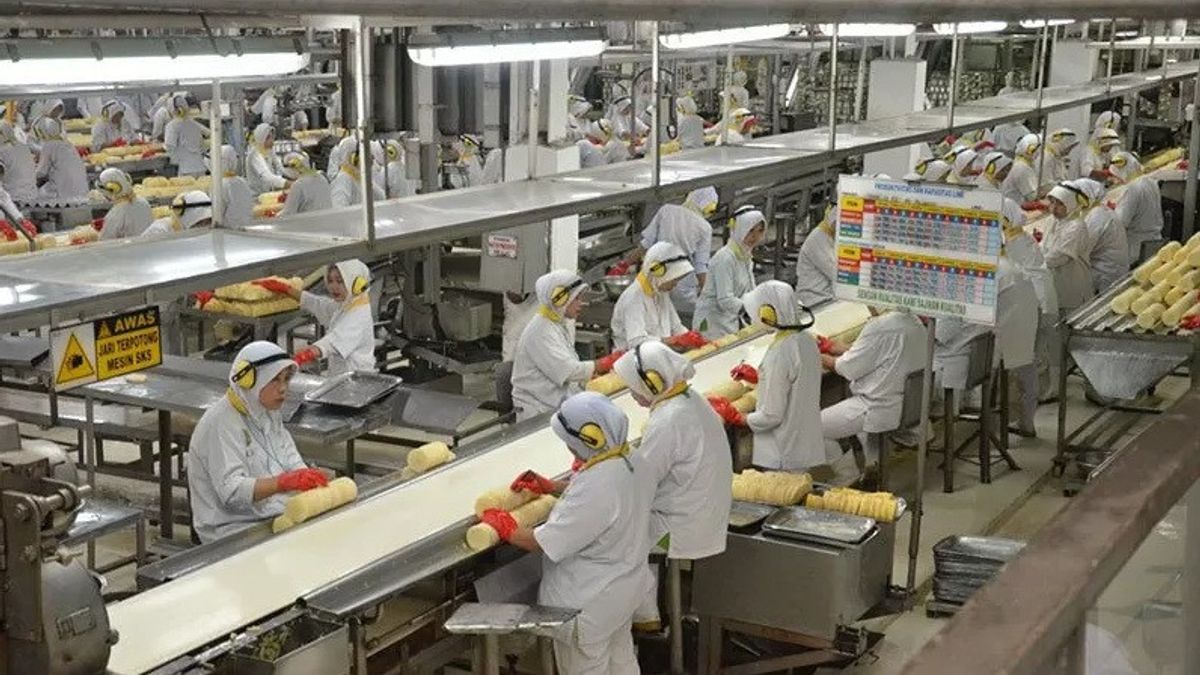


JAKARTA - The current global geopolitical dynamics have caused the sustainability of the national industry to be disrupted. The performance of the Indonesian manufacturing sector in April 2026 slowed down, reflected by the achievement of the Purchasing Manager's Index or PMI of Indonesian manufacturing which fell to 49.1 from 50.1 in March 2026.
This means that the performance of Indonesian manufacturing is under pressure or entering a contraction phase in April 2026.
Ministry of Industry spokesman Febri Hendri Antoni Arif said the weakening of the PMI figure was an impact of global dynamics, especially geopolitical conflicts in the Middle East which triggered supply disruptions and a surge in commodity prices and logistics costs.
"This will certainly have a direct impact on the production activities of national industries," said Febri as quoted from a written statement, Tuesday, May 5.
Responding to this condition, the Ministry of Industry continues to take mitigation and strengthening steps for the national industrial sector. Efforts carried out include bringing together the supply chain ecosystem of affected industries, such as the plastics industry, to maintain the sustainability of raw material supply.
In addition, the Ministry of Industry also encourages the use of the Local Currency Transaction (LCT) scheme to reduce dependence on foreign currencies and minimize the risk of exchange rate fluctuations.
In addition, the Ministry of Industry is also speeding up the formulation of various strategic policies, including strengthening import substitution, increasing the use of domestic products (P3DN) and diversifying the sources of raw materials and export markets.
This effort is also accompanied by facilitation for industry players through mentoring programs, increasing the capacity of small and medium industries (IKM) and accelerating digital transformation to increase the efficiency and competitiveness of the national industry.
"In the end, all of these efforts are aimed at the resilience and independence of the national industry and maintaining production utilization, so that it can achieve the goals that are the government's top priority, namely protecting industrial workers from labor reductions or layoffs," he said.
In addition to the industrial protection policy implemented before the geopolitical turmoil in the Middle East, the Ministry of Industry is currently preparing a new proposal for incentives and protection policies for industries in the face of global geopolitical turmoil, in order to maintain utilization and protect industrial workers from the threat of layoffs.
"The Minister of Industry (Agus Gumiwang) is preparing a proposal for new incentives and domestic industry protection policies to face the impact of geopolitical turmoil. This new incentive and policy draft strengthens the previous industrial protection policy," said Febri.
"This is expected to strengthen the supply chain of the industry in the face of global pressure and protect its workers well," he continued.
Based on data from the world rating agency, Standard & Poor's Global Ratings (S&P), not only Indonesia, but also countries in Southeast Asia are experiencing pressure on the manufacturing sector, albeit with different intensities.
Vietnam still recorded a PMI in the range of 50.5, while Malaysia was at the level of 51.6, indicating that the country was experiencing a slight contraction.
With a PMI of 49.1, Indonesia is in the moderate contraction group and in line with the trend of weakening in some ASEAN countries.
However, Indonesia is still relatively better supported by domestic demand compared to countries that have experienced deeper contractions such as the Philippines which decreased to 48.3.
"Indonesia's position is in moderate contraction, showing that the national manufacturing sector is relatively resilient in the midst of global pressure. However, this is also an important signal to strengthen the structure of domestic industries to be more resistant to external turmoil," he explained.
The survey of the Industrial Confidence Index (IKI) shows that industrial players still show optimism about the production outlook in the next six months which was recorded at 70.1 percent, although it experienced a slight decrease of 1.7 percent compared to the previous month.
The English, Chinese, Japanese, Arabic, and French versions are automatically generated by the AI. So there may still be inaccuracies in translating, please always see Indonesian as our main language. (system supported by DigitalSiber.id)
Most Popular Tags
#Prabowo Subianto #donald trump #Febrie Adriansyah #8791 #giias 2026Popular


