

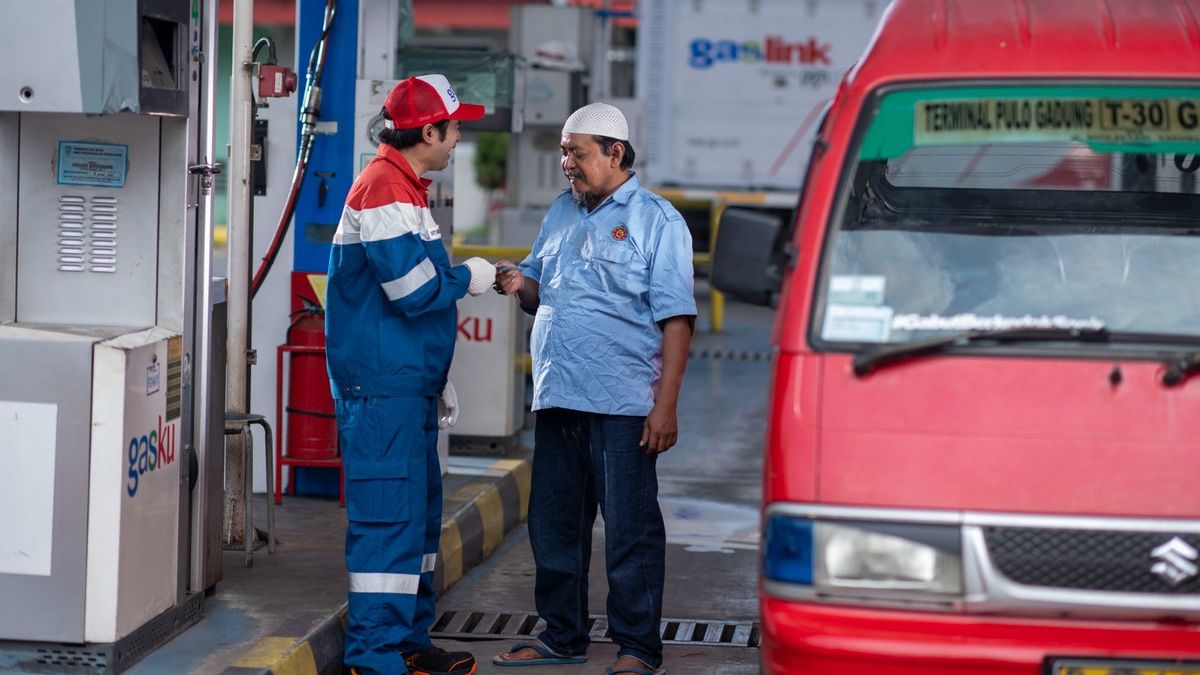


JAKARTA - PT Perusahaan Gas Negara (Persero) Tbk (PGN) through its subsidiary, PT Gagas Energi Indonesia revealed that gas fuel (BBG) is an efficient, environmentally friendly and sustainable alternative solution for the national transportation sector.
Director of Operations and Commercial Gagas Maisalina said the use of BBG is part of the strategy to maintain energy resilience while encouraging the use of cleaner energy in the midst of increasing vehicle fuel needs.
In terms of safety, he said, gas-powered vehicles are equipped with high-standard special tanks with a capacity of up to 15 liters of gas per tank. The system is designed so that the gas quickly decomposes in the air if there is a leak, thereby minimizing the risk of explosion.
"The public does not need to worry about security aspects, because the installation of each converter kit and BBG tank through international safety standards by competent experts," he said as quoted from a written statement, Thursday, April 16.
Technically, BBG is considered capable of becoming a new standard that supports the performance of vehicle engines more optimally than fuel oil (BBM).
Maisalina explained that BBG has a number of advantages, one of which is a high octane value or Research Octane Number (RON), which is in the range of 120 to 130. This characteristic allows the engine to operate with a higher compression ratio, thereby increasing thermal efficiency optimally.
In addition, as a methane-based fuel (CH4), BBG produces a more perfect combustion and carbon emissions about 20 percent lower than fuels.
The use of BBG also does not leave residues on engine components, so it can extend the life of the engine while reducing vehicle maintenance costs.
In terms of operations, BBG consumption varies depending on the type of vehicle. For personal vehicles, the average uses 10 liters of equivalent pertalite (LSP) per day, taxis around 20 LSP per day, and public transportation such as bajaj and angkot ranging from 15-20 LSP per day.
Meanwhile, large vehicles such as trucks and buses require around 125-165 LSP per day, with a mileage of up to 10 kilometers per LSP.
"The price of BBG is also stable at Rp. 4,500 per LSP, very friendly because the gas source comes from domestic sources. With many benefits that can be felt, we hope that interest in BBG will increase," he said.
In its implementation, BBG can be used on dedicated gas-based vehicles and dual fuel systems through the installation of a converter kit, which allows vehicles to use BBG and fuel alternately.
The system, according to him, also provides flexibility while extending the vehicle's mileage.
"We are partnering with the Gas Car Community (Komogas) which plays an important role in building the BBG ecosystem in Indonesia," he added.
The collaboration includes the development of infrastructure and education to the community, including through the launch of a BBG mobile workshop to increase the ease of access to services.
The English, Chinese, Japanese, Arabic, and French versions are automatically generated by the AI. So there may still be inaccuracies in translating, please always see Indonesian as our main language. (system supported by DigitalSiber.id)
Most Popular Tags
#Prabowo Subianto #donald trump #2026 World Cup #Febrie Adriansyah #8791Popular


