

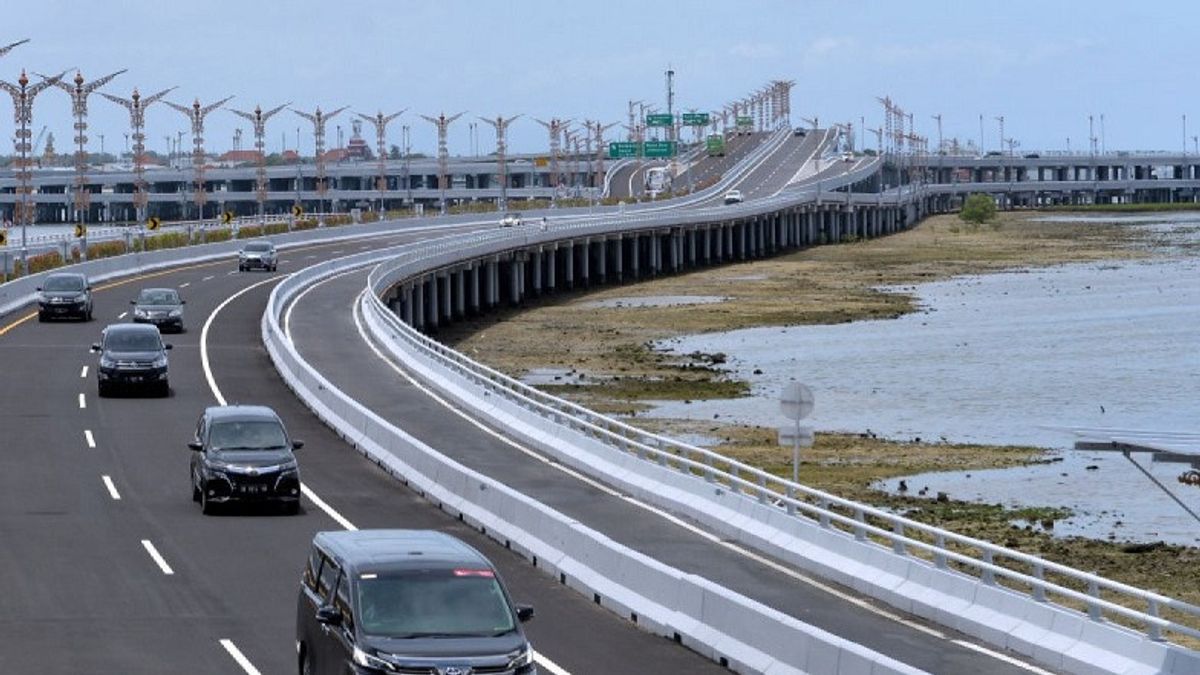


JAKARTA - The government through the Ministry of Public Works (PU) conveyed the latest developments regarding the Gilimanuk-Mengwi Toll Road project as a long-term solution to reduce congestion while improving connectivity in Bali Province.
Deputy Minister of PU Diana Kusumastuti said that the strategic project is planned to use a government and business entity (KPBU) cooperation scheme with a length of 96.84 kilometers (km).
"The benefit side of the road, this toll road is of course designed to significantly reduce the travel time from Gilimanuk to Mengwi, which was originally around 6 hours, this can be reduced to 3 hours," said Diana in a Working Meeting of Commission V of the DPR with the Ministry of Transportation and the Governor of Bali Province at the Parliament Complex, Senayan, Jakarta, Wednesday, April 8.
Diana explained that the investment needs for the project amounted to IDR 12.7 trillion, with details of construction costs of IDR 8.52 trillion and construction support of around IDR 4.59 trillion.
Currently, the government is preparing various supporting documents, ranging from environmental impact analysis (amdal), traffic impact analysis to recommendations for the suitability of space utilization activities and land procurement planning.
"All of these stages are important to ensure that the project runs according to the provisions and minimizes the impact on the environment and the community," he said.
He added that the procurement process for the toll road business entity (BUJT) is targeted to begin in 2027, after all planning and licensing documents are completed.
Furthermore, the construction phase will be carried out after reaching financial close, with the target of operational toll roads in 2031.
"The process of procuring this business entity is expected to begin in 2027 and it is planned that the toll road will start operating in 2031," he added.
The presence of the Gilimanuk-Mengwi Toll Road is expected to be a long-term solution in easing congestion and facilitating logistics and community mobility in Bali, especially from the western region to the tourism center area.
The English, Chinese, Japanese, Arabic, and French versions are automatically generated by the AI. So there may still be inaccuracies in translating, please always see Indonesian as our main language. (system supported by DigitalSiber.id)
Most Popular Tags
#Prabowo Subianto #donald trump #2026 World Cup #Febrie Adriansyah #8791Popular


