

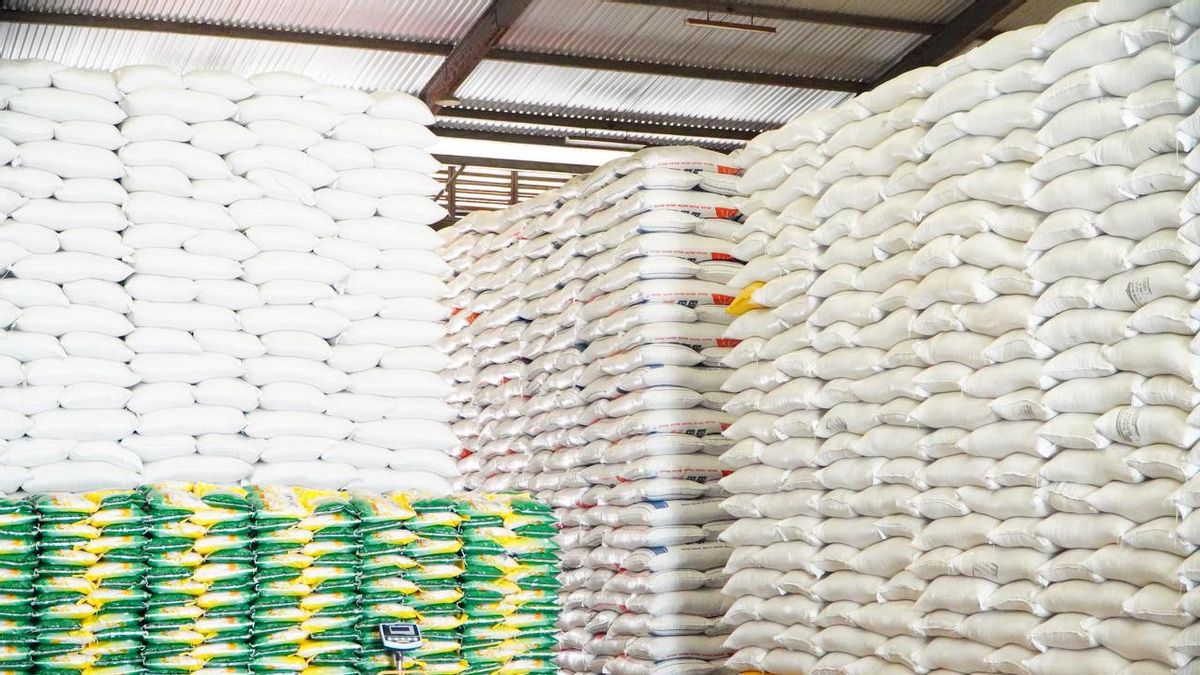


JAKARTA - The government through the National Food Agency (Bapanas) ensures that the national food reserves are more solid in the face of the potential impact of the El Nino phenomenon through the strengthening of integrated food reserves between the central and regional governments.
Deputy for Food Availability and Stabilization of Bapanas I Gusti Ketut Astawa said that the strengthening of food reserves was carried out comprehensively, ranging from increasing production to optimizing distribution and managing reserves at various levels of the region.
"He (the Head of the National Food Agency) has ordered all his ranks how to prepare fertilizer, distribute fertilizer, as well as increase the area of additional planting (LTT). This has been done since the last few months," said Ketut, quoted Saturday, April 4.
According to him, previously Bapanas had experience in 2023-2024 where Indonesia was hit by a high El Nino.
"The head of the agency has experience as well how to deal with it. So our hope is, even though there will be El Nino, we have mitigation and anticipation steps," he continued.
According to him, strengthening the food system is not only based on the central government, but also requires the active involvement of local governments in maintaining the sustainability of production and food availability.
"It is impossible to work alone. We expect collaboration with the local government, both provincial and district/city, to increase LTT, fertilizer distribution, seeds, and various other support," he explained.
Apart from the production aspect, strengthening food reserves is the main instrument in maintaining supply stability, especially in the face of climate uncertainty.
"Food reserves are not only prepared by the central government, but local governments are also required to have food reserves. This will level stocks and strengthen regional readiness in facing any conditions," he added.
Based on data as of April 2, 2026, the Government Food Reserve (CPP) shows a relatively strong condition, especially for strategic commodities. Rice stocks were recorded at around 4.4 million tons, equivalent to 169 percent of the national monthly demand, thus providing adequate room in maintaining the continuity of supply and price stability. Meanwhile, other commodities such as corn 168,000 tons, consumer sugar 49,000 tons, and cooking oil 121 thousand kiloliters also show sufficient availability to support community needs.
Food reserve reinforcement is also carried out down to the district level. Data shows that the Regional Government Food Reserve (CPPD) of districts/cities has reached 14,169.03 tons spread across 322 areas. The implementation of CPPD which reaches various regions further strengthens the resilience of supply at the local level while accelerating the response to potential distribution disruptions.
In terms of regional achievement, districts/cities in West Java recorded the largest reserve amount with 2,790.9 tons, followed by Banten with 2,007.25 tons, which shows the increasing capacity of the region in supporting the strengthening of food reserves more evenly.
At the provincial level, the national Government Rice Reserve (CBPP) was recorded at 7,561.23 tons, with 33 provinces having regulations and mechanisms for managing provincial government rice reserves.
The largest reserve amount was recorded in West Java with 2,626.94 tons, followed by East Java with 825.36 tons, reflecting the increasingly strong role of local governments in strengthening national food reserves through planned and coordinated reserve management.
Ketut emphasized that this collaborative approach is the key to ensuring the national food system remains resilient, especially in the face of extreme weather dynamics.
"These steps are carried out through collaboration between the central government, provinces, and regencies/cities in order to anticipate various weather phenomena. We must remain vigilant, not to scare, but to ensure that all mitigation measures that have been prepared can be carried out properly," he said.
Furthermore, the Head of the National Food Agency Andi Amran Sulaiman emphasized that strengthening the national food reserves is a strategic step in facing the increasingly complex global dynamics and climate risks.
"In accordance with the warning from BMKG that there is El Nino, we need to take strategic steps and acceleration. Now our achievement, our stock today is 4.4 million tons, God willing this month can reach 5 million tons. This is a pride in a time of crisis in the world economic condition, agriculture appears to mitigate risks, stabilize food, improve the welfare of farmers," said Amran.
The English, Chinese, Japanese, Arabic, and French versions are automatically generated by the AI. So there may still be inaccuracies in translating, please always see Indonesian as our main language. (system supported by DigitalSiber.id)


