

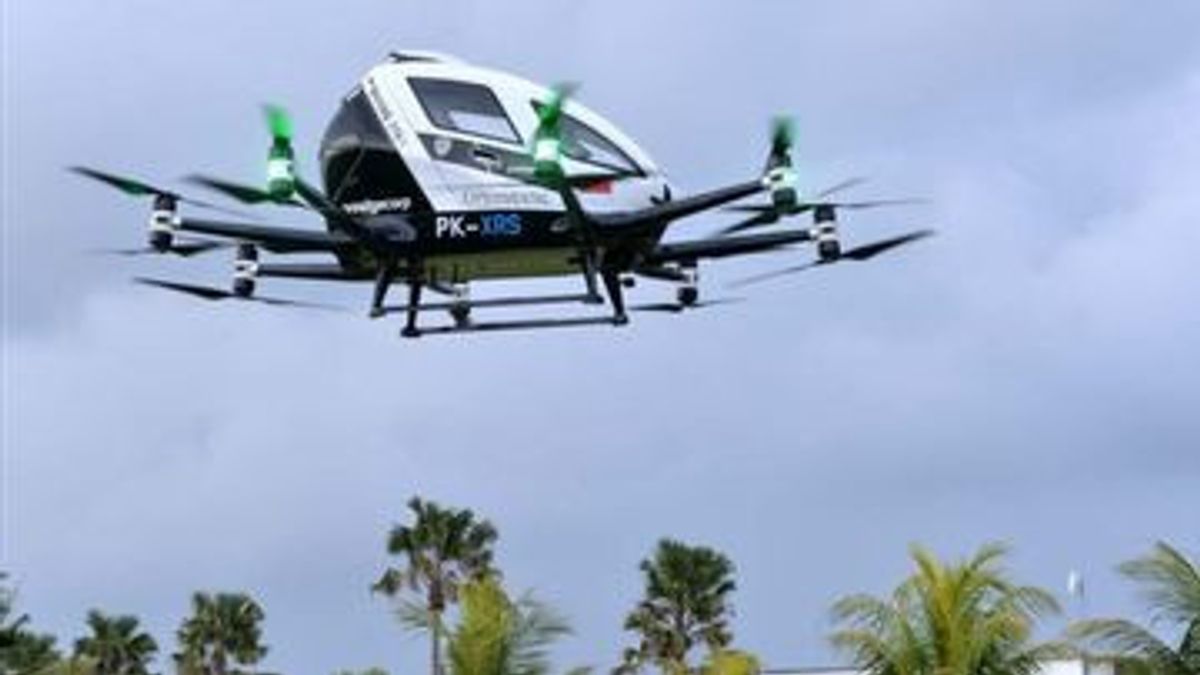


Japan is preparing permits for commercial flying taxi services that transport paying passengers as early as 2027 or 2028. According to a report by The Straits Times citing government sources, the initial service will be opened through a tourist flight in urban areas.
Tokyo and Osaka, especially coastal areas, are expected to be the first locations for operations. After that, the service will be expanded to short-distance intercity travel, including city and airport connecting routes.
Flying taxis are electric-powered vehicles that can take off and land vertically. The capacity is small, the sound is relatively quieter, and it does not require a large landing area. This character makes this mode easier to operate in densely built cities, as well as potentially becoming a new transportation option in the area.
The Straits Times report, quoted Wednesday, April 1, the Japanese government is now seeing the way to commercial operations begin to open. A type certification application based on the Civil Aviation Law has been submitted to the Ministry of Land, Infrastructure, Transport and Tourism. Certification is required for mass production of aircraft, as well as testing safety standards and other technical requirements.
Within two to three years after the initial service goes live, its operational coverage is expected to expand to more functional routes. These include short routes between two points as well as connections from major airports such as Narita and Kansai to surrounding cities.
Competition in this sector is also beginning to be seen. At the Osaka-Kansai Expo 2025, a demonstration flight without passengers was held. In Tokyo, two consortia were selected for the metropolitan government's flying taxi implementation project. One consortium contains nine companies, including Japan Airlines. Another involves seven companies, including Nomura Real Estate Development.
Starting in the new fiscal year, full-scale demonstration flights with real planes are scheduled to take place in Tokyo's seaside area and other areas.
International rules for flying taxis have not yet been formed. However, Japan has already prepared safety standards, ranging from battery performance requirements to the obligation to carry life jackets for flights over water. This position gives Japan room to lead the drafting of commercial operating rules.
The Japanese government is also paying attention to the development of its industry. In 2025, according to a report by The Straits Times, the Takaichi government included the aviation and space sectors in 17 strategic sectors that were prioritized.
The English, Chinese, Japanese, Arabic, and French versions are automatically generated by the AI. So there may still be inaccuracies in translating, please always see Indonesian as our main language. (system supported by DigitalSiber.id)


