

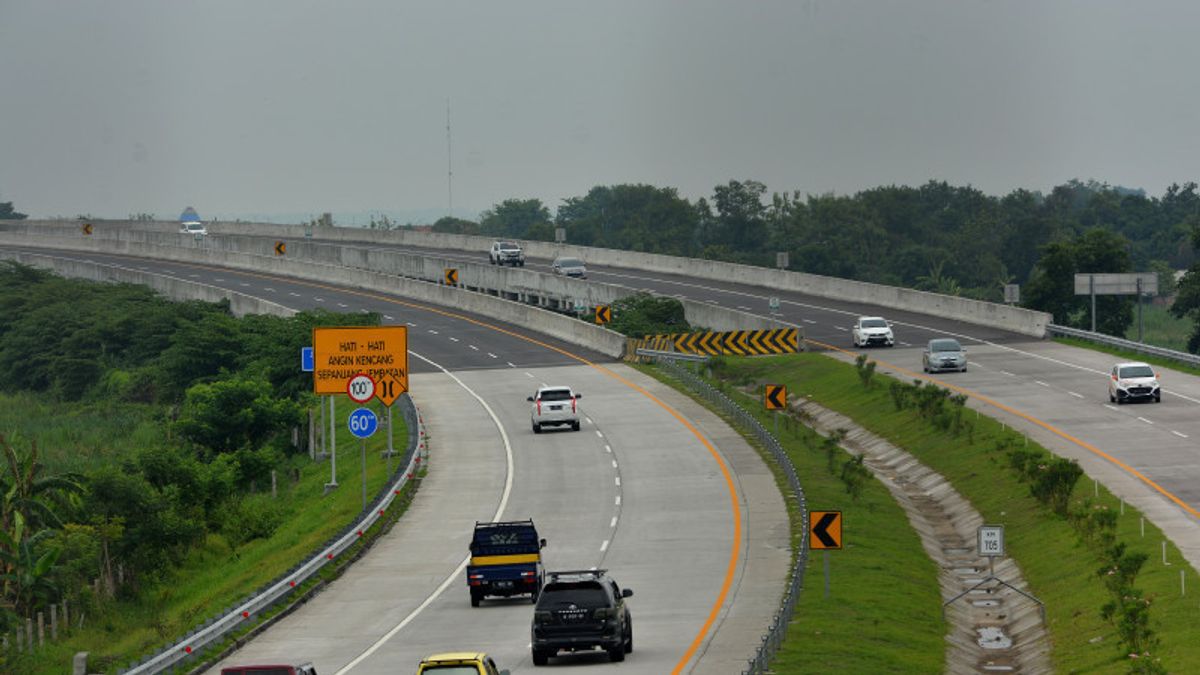


JAKARTA - The government has imposed traffic engineering in the form of a one-way system (one way) on the Trans Java Toll Road from KM 132 to KM 70 to disperse the backflow traffic density to Jakarta which began to increase on Friday, March 27.
This policy was decided by Minister of Transportation Dudy Purwagandhi together with the Head of the National Police, Agus Suryonugroho, following obstacles at a number of points, especially in the rest area.
Dudy said that the current traffic conditions on the ground were actually in line with the prediction, not too high. However, there are obstacles in several sections, especially in a number of rest areas.
"So there is a density so that we impose one way for a while from KM 132 to KM 70," said Dudy in an official statement, Friday, March 27.
Dudy explained that the implementation of one way is dynamic and will continue to be evaluated based on the development of vehicle volume in the field. If there is a significant increase, then traffic engineering will be expanded gradually.
"If the volume of vehicles increases during the journey, then at the discretion of the Police, the local one-way stage two from KM 169 to KM 70 and stage three from KM 188 to KM 70 will be enforced," he explained.
Furthermore, Dudy said the option of implementing a national one-way from the Kalikangkung Toll Road is also open if the surge in vehicle traffic continues to increase.
"However, for now, the one-way implementation for a period is expected to be able to disperse the density that occurs at a number of points since the morning," he said.
On this occasion, Dudy also appealed to the public to plan their trip well, including monitoring traffic information through the Travoy application or the Jasa Marga Call Center.
According to Dudy, this step is important so that the public can adjust travel time to traffic engineering policies that are situational, as well as knowing information about rest areas and other supporting facilities.
In addition, the Minister of Transportation again reminded logistics transportation business actors to comply with the Joint Decree (SKB) on traffic and crossing arrangements during the 2026 Lebaran Transportation period.
"I once again ask that the perpetrators of logistics transportation not operate vehicles with three axles upwards until the specified time, namely March 29, 2026. This is to maintain the safety of travelers," he said.
Based on data from the National Police Traffic Directorate, traffic safety performance during the homecoming and return trip period this year showed improvement. The fatality rate of accident victims was recorded as decreasing by 30.4 percent compared to last year, while the number of accidents decreased by 5.3 percent during Operation Ketupat.
"I appreciate all stakeholders, especially the Police, Jasa Marga, to Jasa Raharja who have succeeded in reducing the fatality rate of accident victims during Lebaran Transportation 2026. This shows that the traffic management that has been prepared is really effective," said Dudy.
Meanwhile, based on data from Jasa Marga, the number of vehicles that have entered the Jakarta area until 06.00 WIB reached 2.3 million units or around 69 percent of the total projection. As for the traffic volume returning to the Jabodetabek area on H+4 Lebaran, it was recorded as 206,243 vehicles.
The government ensures that it will continue to optimize traffic management to maintain the smoothness, safety, and comfort of the community during the 2026 Lebaran homecoming period.
The English, Chinese, Japanese, Arabic, and French versions are automatically generated by the AI. So there may still be inaccuracies in translating, please always see Indonesian as our main language. (system supported by DigitalSiber.id)
Most Popular Tags
#Prabowo Subianto #donald trump #Febrie Adriansyah #8791 #giias 2026Popular


