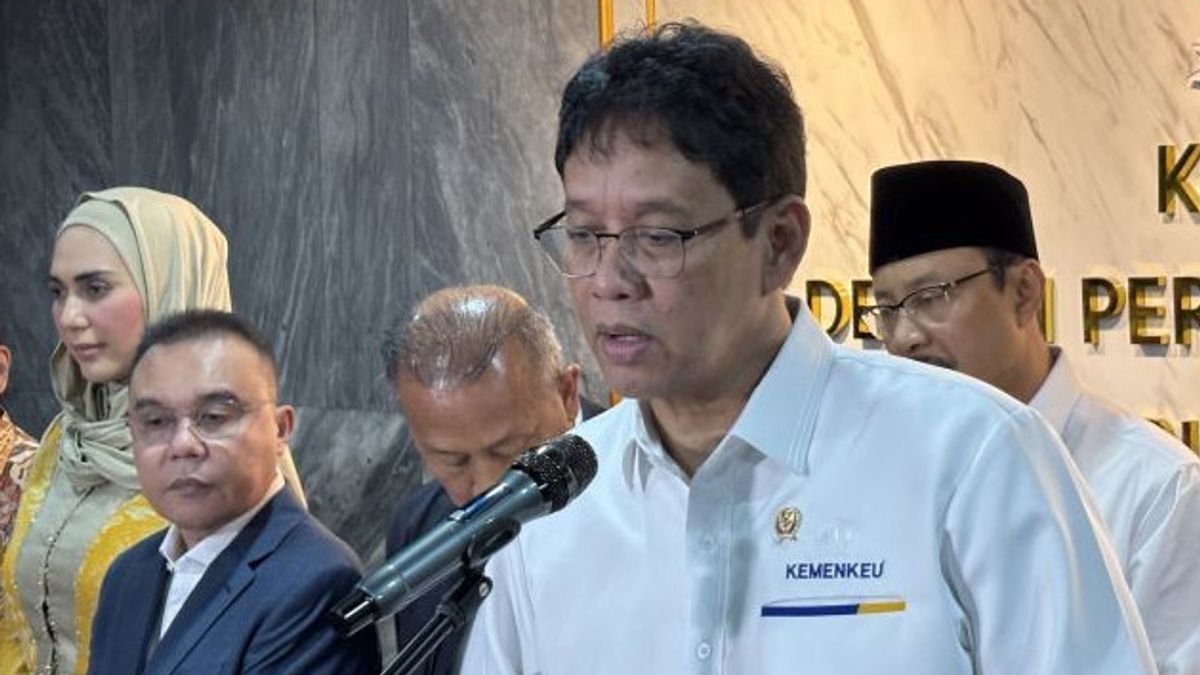


JAKARTA - The government is preparing a Presidential Regulation (Perpres) which regulates the elimination of dues and fines for the National Health Insurance (JKN) for participants in the Non-Wage Recipients (PBPU) and Non-Workers (BP) class 3.
Minister of Finance Purbaya Yudhi Sadewa said that this policy aims to ease the burden of participants while increasing the number of active participation in the JKN program.
"Currently, the government is also in the process of preparing a draft Presidential Regulation on the elimination of health insurance dues and fines for PBPU and BP class 3 participants," he said in a consultation meeting with the leadership of the Commission of the Indonesian House of Representatives regarding social security, Monday, February 9.
He added, the government has also continued to support the sustainability of JKN financing through the payment of premiums for participants of the Health Insurance Premium Assistance (PBI JK) which is allocated through the Ministry of Health's Implementation Budget (DIPA) Implementation List.
Since 2023, the realization of payment of PBI JK dues has been stable and consistent above 99 percent.
In addition, starting in 2021, the amount of JKN contributions for PBPU and BP class 3 participants has been equalized with the contributions of PBI participants, namely Rp. 42,000 per person per month.
Of the total contribution, Rp35,000 is paid by the participant or another party on behalf of the participant, while Rp7,000 is a contribution assistance from the government.
The assistance consists of Rp4,200 from the central government and Rp2,800 from the local government.
Purbaya, conveyed that the adjustment of PBI JK membership was carried out to improve the quality of implementation and management of the JKN so that it is more targeted, especially for poor and vulnerable people.
However, he reminded that the process should be carried out with good data updates and not cause a commotion in the community.
He gave an example of the situation when participants who were in need of urgent medical services, such as dialysis, were suddenly declared no longer entitled to benefits and the situation was detrimental to the government because the budget was still being spent, but it created a bad image.
"In fact, the money I spent was the same. I lost there, the money came out, the image was ugly, the government lost in this case, if it made the money I spent for you smaller, I support the riots a little bit, but this is the same, the money spent was the same, the riots again. I lost a lot, sir, in the future please betulin," he said.
Furthermore, Purbaya proposed that the deactivation of PBI JK participants should not be immediately enforced and suggested a transition period of two to three months accompanied by socialization to the community.
He added, when someone is no longer recorded as a participant in the JK PBI, the person concerned has received information and has time to take the necessary steps.
Purbaya said that during this period, participants can also submit a rebuttal if they feel they still meet the criteria for receiving tuition assistance.
He also asked that the determination of the number of participants in the JK PBI be carried out carefully and measured, while still prioritizing target accuracy, ease of access to health services, and the sustainability of the JKN program.
Going forward, Purbaya emphasized the need for control of the number of deactivations to be carried out more subtly within a period of several months so that it does not cause a commotion again.
"So this is what must be controlled in the future. If the numbers are drastic like this, yes, it will be smooth in a little over 3 months or 4 months, but don't cause such a shock," he said.
The English, Chinese, Japanese, Arabic, and French versions are automatically generated by the AI. So there may still be inaccuracies in translating, please always see Indonesian as our main language. (system supported by DigitalSiber.id)
Most Popular Tags
#Prabowo Subianto #donald trump #firearm #8791 #giias 2026Popular