

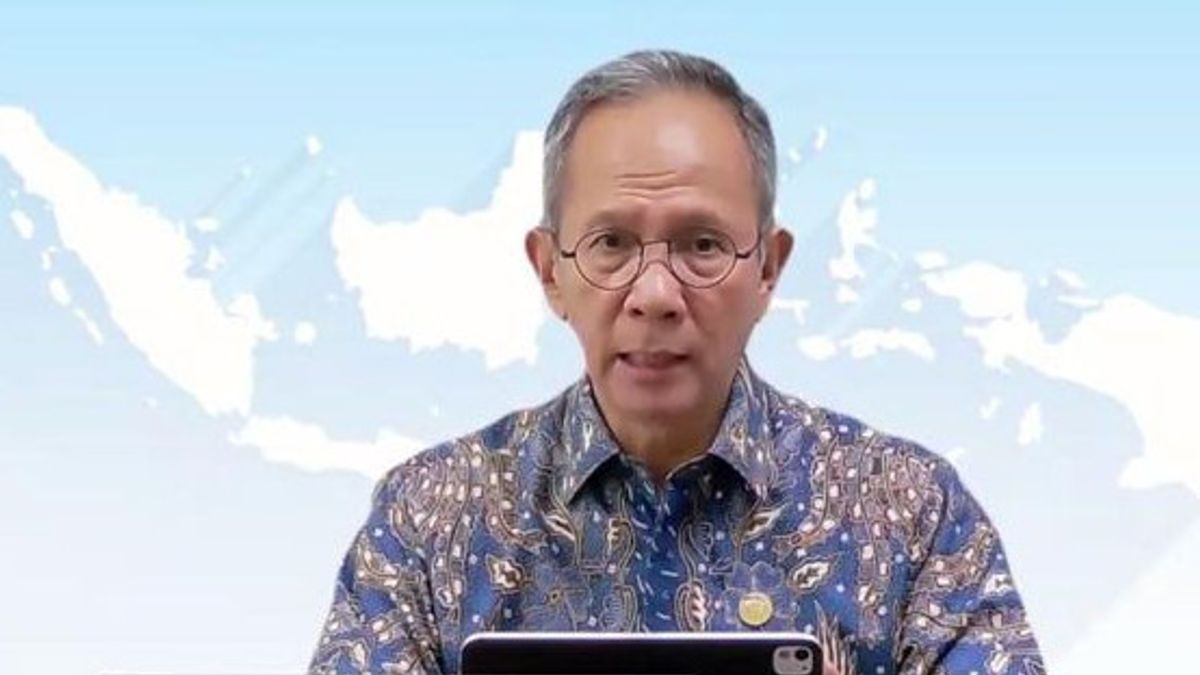


JAKARTA - Chairman of the Board of Commissioners of the Financial Services Authority (OJK) Mahendra Siregar conveyed his views regarding the impact of the conflict between the United States (US) and Venezuela on the national economy and the Indonesian financial services sector.
According to Mahendra, until now, the perpetrators of the financial services and financial market industries are still monitoring the developing dynamics, especially those related to global political stability and international financial markets.
However, so far, there has been no significant impact on Indonesia.
He explained that in the short term, there has not been a direct impact on Indonesia, both in terms of world oil production and prices as well as from the movement of the prices of major commodities for national exports.
"In the short term to date, it can be seen that the direct impact on Indonesia from the possible influence of world oil production and prices, as well as in terms of prices of Indonesia's main export commodities, it is not visible or has not been seen at all such direct impact," he said in a press conference. Results of the December 2025 Monthly Board of Commissioners (RDK) Meeting, Friday, January 9.
However, Mahendra emphasized that the potential impact in the medium to long term still needs to be considered.
In addition, he assessed that even before the US-Venezuela conflict occurred, the global geopolitical situation had been colored by high uncertainty.
According to him, this situation is exacerbated by the prevalence of violations of the sovereignty of one country by another country which does not seem to be accompanied by firm international consequences, and this condition is considered to be a worrying precedent.
"After Ukraine by Russia, Palestine or Gaza by Israel, now Venezuela by the US. Of course, these precedents raise concerns for the future for similar things because it turns out that it can be done without real consequences for the country that committed the violation, including the possibility in our region," he said.
In line with this, Mahendra said that OJK ensures that it will continue to monitor the risks arising from the increasing geopolitical tensions and global uncertainties.
He also appealed to all financial services institutions to intensively monitor various risks, both in terms of markets, liquidity, and credit financing.
"This is becoming increasingly difficult because in 2026 before the incident, various multilateral and international institutions have predicted that world economic growth in 2026 will not reach 3 percent, which means the lowest growth rate after the COVID-19 pandemic," he said.
Thus, Mahendra emphasized that even though in the short term the impact has not been felt directly, the medium and long-term risks must still be observed and anticipated continuously.
The English, Chinese, Japanese, Arabic, and French versions are automatically generated by the AI. So there may still be inaccuracies in translating, please always see Indonesian as our main language. (system supported by DigitalSiber.id)


